

LETRS Unit 1-4 Post Test

Save

The LETRS Units 1-4 Posttest covers foundational reading science, including phonology, phonics, and spelling, requiring an 80-88% passing score. Key topics include phoneme segmentation, syllable types, syllable division (e.g., fright-en-ing has 3), and advanced decoding. Key concepts focus on the role of phonemic awareness, orthographic mapping, and explicit, systematic instruction.

Thumbnail for LETRS Unit 1-4 Post Test
Category:
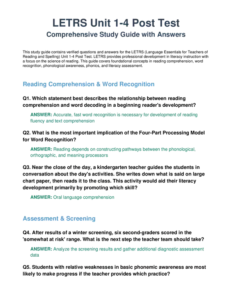
LETRS Unit 1-4 Post Test Comprehensive Study Guide with Answers

This study guide contains verified questions and answers for the LETRS (Language Essentials for Teachers of Reading and Spelling) Unit 1-4 Post Test. LETRS provides professional development in literacy instruction with a focus on the science of reading. This guide covers foundational concepts in reading comprehension, word recognition, phonological awareness, phonics, and literacy assessment.

Reading Comprehension & Word Recognition

Q1. Which statement best describes the relationship between reading comprehension and word decoding in a beginning reader’s development?

ANSWER: Accurate, fast word recognition is necessary for development of reading fluency and text comprehension

Q2. What is the most important implication of the Four-Part Processing Model for Word Recognition?

ANSWER: Reading depends on constructing pathways between the phonological, orthographic, and meaning processors

Q3. Near the close of the day, a kindergarten teacher guides the students in conversation about the day’s activities. She writes down what is said on large chart paper, then reads it to the class. This activity would aid their literacy development primarily by promoting which skill?

ANSWER: Oral language comprehension

Assessment & Screening

Q4. After results of a winter screening, six second-graders scored in the ‘somewhat at risk’ range. What is the next step the teacher team should take?

ANSWER: Analyze the screening results and gather additional diagnostic assessment data

Q5. Students with relative weaknesses in basic phonemic awareness are most likely to make progress if the teacher provides which practice?

ANSWER: Frequent practice with segmenting and blending phonemes in spoken words

Phonological Awareness

Q6. How is the word sn-ow divided?

ANSWER: Onset-rime

Q7. How many spoken syllables are there in frightening?

ANSWER: 3 (fright-en-ing)

Q8. How many phonemes are in the word ‘grass’?

ANSWER: 4 (/g/ /r/ /a/ /s/)

Q9. How many phonemes are in the word ‘string’?

ANSWER: 5 (/s/ /t/ /r/ /i/ /ng/)

Q10. How many phonemes are in the word ‘through’?

ANSWER: 3 (/th/ /r/ /oo/)

Q11. Which word has four phonemes?

ANSWER: Crash (c-r-a-sh)

Phoneme-Grapheme Mapping

Q12. In phoneme-grapheme mapping, students first segment and mark boxes for the phonemes. Then, they map the graphemes. If students were mapping the graphemes in the word ‘wife’, how many boxes (phonemes) would they need?

ANSWER: 3 phonemes (/w/ /i/ /f/)

Q13. If students were mapping graphemes in the word ‘streamed’, how many boxes (phonemes) would they need?

ANSWER: 6 phonemes

Q14. When mapping phonemes on a worksheet, a student puts the /k/ sound in one box and the /s/ sound in another for the word ‘box’. What type of error is this?

ANSWER: The student is demonstrating difficulty with final consonant blends and needs more practice

Phonics Instruction & Word Walls

Q15. A teacher has posted a word wall in first grade, using alphabetical order to list the words (e.g., under T: to, too, them, the, this, then). How could the teacher best ensure that students will recognize and spell these words?

ANSWER: By removing regularly spelled ‘th’ words and teaching them through sound blending

Q16. A good phonics lesson should include opportunities for students to apply the phoneme-grapheme relationships that have been explicitly taught. Which text type would best provide the practice needed?

ANSWER: Decodable text

Q17. Which of the following is the best example of a well-designed word list for a word chain activity?

ANSWER: rat, chat, chap, chip, rip, rap (changes one phoneme at a time)

Syllable Types & Word Structure

Q18. Students blend these word parts to make a whole word: /s/ /p/ /r/ /i/ /ng/.

The activity is called: ANSWER: Phoneme blending

Q19. What is the main reason why knowledge of syllable types is useful for a student?

ANSWER: It helps students decode multisyllabic words

Q20. Which syllable type is the most common in English?

ANSWER: Closed syllable
Orthographic Patterns & Spelling Rules

Q21. Words that sort into the same category have the same: ANSWER: Orthographic pattern or spelling feature

Q22. Which statement is true about words such as ‘dog’, ‘flag’, and ‘pig’?

ANSWER: They follow a closed syllable pattern (CVC)

Q23. Which is true about words ending in ‘j’ and ‘v’?

ANSWER: Words never end in the letters ‘j’ or ‘v’ in English

Reading Fluency

Q24. Which of these is a common characteristic of students who have reading difficulties?

ANSWER: Poor fluency and slow reading rate

Q25. What is the primary purpose of progress monitoring in reading?

ANSWER: To determine if students are making adequate progress and to modify instruction if needed

Morphology & Vocabulary

Q26. A student is able to decode single-syllable words but has difficulty with multisyllabic words. What instructional focus would be most beneficial?

ANSWER: Teaching syllable division patterns and morphology

Q27. What is the smallest unit of meaning in a word?

ANSWER: Morpheme

Reading Instruction Best Practices

Q28. Which activity would be most effective for developing phonological awareness in kindergarten?

ANSWER: Segmenting and blending spoken words into phonemes

Q29. Students with dyslexia are most likely to have difficulty with: ANSWER: Phonological processing and rapid naming

Q30. In a tiered intervention model (RTI/MTSS), Tier 2 intervention is best characterized as: ANSWER: Targeted, small-group instruction for students who need additional support

Diagnostic Teaching

Q31. Which assessment would best help a teacher understand a student’s ability to apply phonics skills in context?

ANSWER: Oral reading of a decodable text

Q32. What is the purpose of a reading miscue analysis?

ANSWER: To analyze the types of errors a student makes while reading to inform instruction

Key Concepts to Remember

• Phoneme: The smallest unit of sound in spoken language (e.g., /c/ /a/ /t/ = 3 phonemes in ‘cat’)

• Grapheme: A letter or letter combination that represents a phoneme (e.g., ‘sh’, ‘ch’, ‘igh’)

• Phonological Awareness: Awareness of sounds in spoken language, including syllables, rhymes, and phonemes

• Phonemic Awareness: The ability to identify and manipulate individual phonemes in spoken words

• Onset-Rime: Onset is the initial consonant(s), rime is the vowel and what follows (e.g., sn-ow)

• Decodable Text: Text that primarily uses phonics patterns students have been taught

• Orthography: The spelling system of a language, including letter patterns and conventions

• Morpheme: The smallest unit of meaning (e.g., ‘un-‘ ‘help’ ‘-ful’ = 3 morphemes)

• Closed Syllable: A syllable ending in a consonant with a short vowel sound (e.g., cat, napkin)

• Open Syllable: A syllable ending in a vowel with a long vowel sound (e.g., me, hotel)

Study Tips for Success

• Understand the Science of Reading: LETRS is based on research about how the brain learns to read – focus on the evidence-based practices

• Master Phoneme Counting: Practice identifying the number of phonemes in words – remember that spelling doesn’t always match sounds

• Know Your Syllable Types: Be able to identify closed, open, vowel-consonant-e, vowel team, r-controlled, and consonant-le syllables

• Practice Phoneme-Grapheme Mapping: Work through examples of breaking words into sounds and matching them to letters

• Review Assessment Principles: Understand the purpose of screening, diagnostic, progress monitoring, and outcome assessments

• Apply Knowledge to Scenarios: LETRS tests your ability to apply concepts to real classroom situations

IMPORTANT DISCLAIMER: This study guide is compiled from publicly available LETRS practice materials and educational resources. It should be used as a supplemental study tool to support your LETRS training. Always refer to official LETRS training materials, course content, and your facilitator’s guidance. The information provided here is for educational purposes and should complement, not replace, the comprehensive LETRS professional development program.
Share:
Related
Thumbnail for DOD Cyber Awareness Challenge 2026 Knowledge check
Read More
Thumbnail for Prophecy General ICU RN A v2
Read More
Thumbnail for Cyber Awareness Challenge Answers
Read More
Thumbnail for Procedure 2 Time To Trace
Read More
Thumbnail for Modeling Periodic Behavior Module 6
Read More
Thumbnail for Properties of Gases
Read More
Thumbnail for Level 1 Antiterrorism Awareness Training Answers
Read More
Thumbnail for Peptides and Proteins Lab Report
Read More
Thumbnail for US Marine Corps: 11 General Orders for Sentries
Read More
Thumbnail for 10.5
Read More

Report This Content

Copyright infringement

If you are the copyright owner of this document or someone authorized to act on a copyright owner’s behalf, please use the DMCA form to report infringement.

Report an issue