Agriculture in Pakistan: Types and Practices

Agriculture in Pakistan: Types and Practices

Agriculture in Pakistan explores various farming practices, including subsistence and commercial farming. It delves into the types of crops grown, livestock management, and the geographical distribution of agricultural activities across the country. This resource is ideal for students and professionals interested in agricultural studies, providing insights into the challenges and advancements in the sector. Key topics include irrigation methods, crop rotation, and the impact of climate on farming. The document serves as a comprehensive guide for those preparing for exams or seeking to understand the agricultural landscape of Pakistan.

Key Points

  • Explains different types of farming in Pakistan, including subsistence and commercial practices.
  • Covers major crops grown in various regions, highlighting geographical distribution and climate impact.
  • Discusses livestock management and its role in the agricultural economy of Pakistan.
  • Includes insights into irrigation techniques and their importance for crop yield.
128
/ 20
PAST PAPER (Geography)
Chapter No. 7 (Agriculture)
(June 2020)
Q 4 (a,b,c,d)
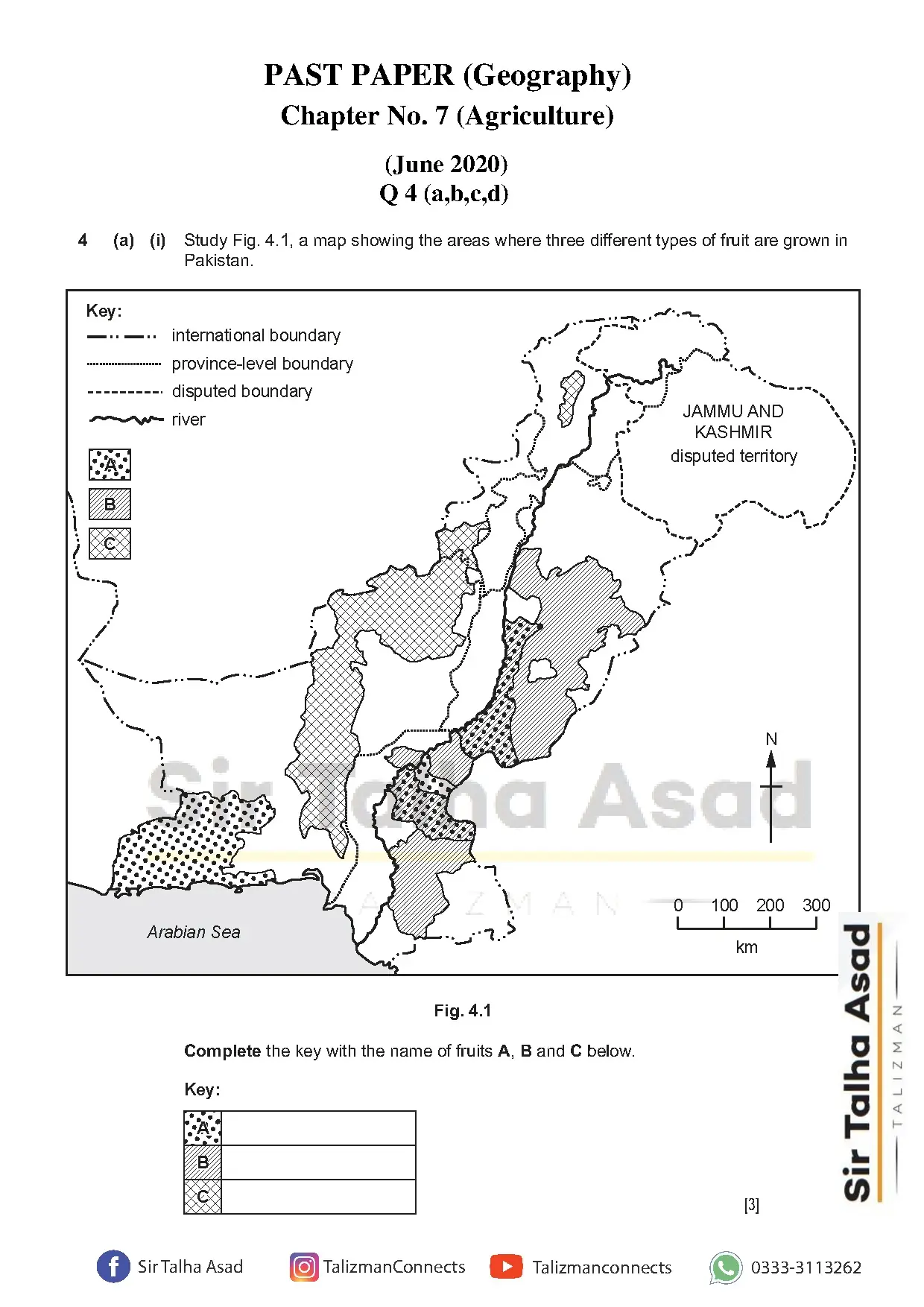
4 (a) (i) Study Fig. 4.1, a map showing the areas where three different types of fruit are grown in
Pakistan.
Arabian Sea
N
0 100 200
km
300
Key:
international boundary
province-level boundary
disputed boundary
river
JAMMU AND
KASHMIR
disputed territory
JAMMU AND
KASHMIR
JAMMU AND
KASHMIR
A
B
C
A
B
C
Fig. 4.1
Complete the key with the name of fruits A, B and C below.
A
B
C
A
B
C
Key:
[3]

(ii) Using Fig. 4.1 only describe the distribution of the areas where fruit A is grown.
...........................................................................................................................................
...........................................................................................................................................
...........................................................................................................................................
...........................................................................................................................................
...........................................................................................................................................
..................................................................................................................................... [3]
(iii) Using Fig. 4.1 only, state two differences between the location of the areas where fruits
B and C are grown.
1 ........................................................................................................................................
...........................................................................................................................................
2 ........................................................................................................................................
..................................................................................................................................... [2]
(c) (i) Define ‘subsistence farming’.
...........................................................................................................................................
..................................................................................................................................... [1]
(ii) State two human and two natural inputs for subsistence rice farming.
human inputs natural inputs
[4]
(iii) Suggest two disadvantages of subsistence farming.
1 ........................................................................................................................................
...........................................................................................................................................
2 ........................................................................................................................................
...........................................................................................................................................
[2]


(November 2020)
Q 1 (a,b,c,d)
1 (a) Study Fig. 1.1, a map of Pakistan.
Arabian Sea
0 100 200
km
300
N
JAMMU AND
KASHMIR
disputed territory
Key:
international boundary
province-level boundary
disputed boundary
Fig. 1.1
(i) On Fig. 1.1, shade one area where apples are grown in Pakistan. [1]
(ii) State one reason why apples are grown in this area and one important use of apples.
Reason ..............................................................................................................................
Use ...................................................................................................................................
[2]


/ 20
End of Document
128
You May Also Like

FAQs of Agriculture in Pakistan: Types and Practices

What are the main types of farming practiced in Pakistan?
Pakistan primarily practices subsistence farming, where farmers grow crops mainly for personal consumption, and commercial farming, where crops are produced for sale. Subsistence farming is common in rural areas, focusing on staple crops like wheat and rice. Commercial farming, on the other hand, includes cash crops such as cotton and sugarcane, which are grown for export and profit.
How does climate affect agriculture in Pakistan?
Climate plays a significant role in agriculture in Pakistan, influencing crop selection and farming practices. The country experiences a range of climatic conditions, from arid to semi-arid, affecting water availability for irrigation. Seasonal variations, such as monsoon rains, are crucial for crop growth, particularly for rice and other water-intensive crops. Farmers must adapt their practices to these climatic challenges to ensure sustainable yields.
What are the major crops grown in Pakistan?
Major crops in Pakistan include wheat, rice, cotton, and sugarcane. Wheat is the staple food and is grown extensively across the country, while rice is primarily cultivated in the Punjab and Sindh regions. Cotton is a key cash crop, contributing significantly to the textile industry, and sugarcane is also important for sugar production. Each crop has specific growing conditions and is affected by regional climate and soil types.
What irrigation methods are used in Pakistani agriculture?
Irrigation is vital for agriculture in Pakistan, given the country's reliance on the Indus River system. Common methods include canal irrigation, tube wells, and drip irrigation. Canal irrigation is the most traditional method, distributing water from rivers to fields, while tube wells extract groundwater. Drip irrigation is gaining popularity for its efficiency in water use, especially in arid regions.
What challenges does agriculture face in Pakistan?
Agriculture in Pakistan faces several challenges, including water scarcity, climate change, and outdated farming techniques. Water scarcity is exacerbated by over-extraction of groundwater and inefficient irrigation practices. Climate change impacts weather patterns, leading to unpredictable rainfall and extreme temperatures, which affect crop yields. Additionally, many farmers still rely on traditional methods, limiting productivity.
How is livestock integrated into agricultural practices in Pakistan?
Livestock plays a crucial role in Pakistani agriculture, providing not only food sources like milk and meat but also serving as draught animals for farming. Cattle, sheep, and goats are commonly raised, contributing to the livelihoods of many rural families. Livestock also helps in maintaining soil fertility through manure, which is used as organic fertilizer, enhancing crop production.
What role does agriculture play in Pakistan's economy?
Agriculture is a cornerstone of Pakistan's economy, contributing significantly to GDP and employment. It employs a large portion of the workforce, particularly in rural areas, and is vital for food security. The agricultural sector also supports related industries, such as textiles and food processing, making it essential for overall economic development.

Related of Agriculture in Pakistan: Types and Practices