Algebra 1 Unit 8 Transformations of Quadratic Functions

Algebra 1 Unit 8 Transformations of Quadratic Functions

Algebra 1 Unit 8 focuses on transformations of quadratic functions, exploring vertex form and the effects of changing parameters. Students will learn how to graph quadratic equations, identify vertices, and describe transformations such as translations, reflections, and stretches. The unit includes practice problems for various transformations and advanced problems that challenge students to apply their knowledge. This resource is ideal for high school students preparing for algebra assessments or anyone looking to strengthen their understanding of quadratic functions.

Key Points

  • Explains the vertex form of quadratic functions and its significance.
  • Covers transformations including translations, reflections, and stretches.
  • Includes practice problems for identifying vertices and graphing quadratics.
  • Features advanced problems that challenge students to apply transformation concepts.

52
/ 3
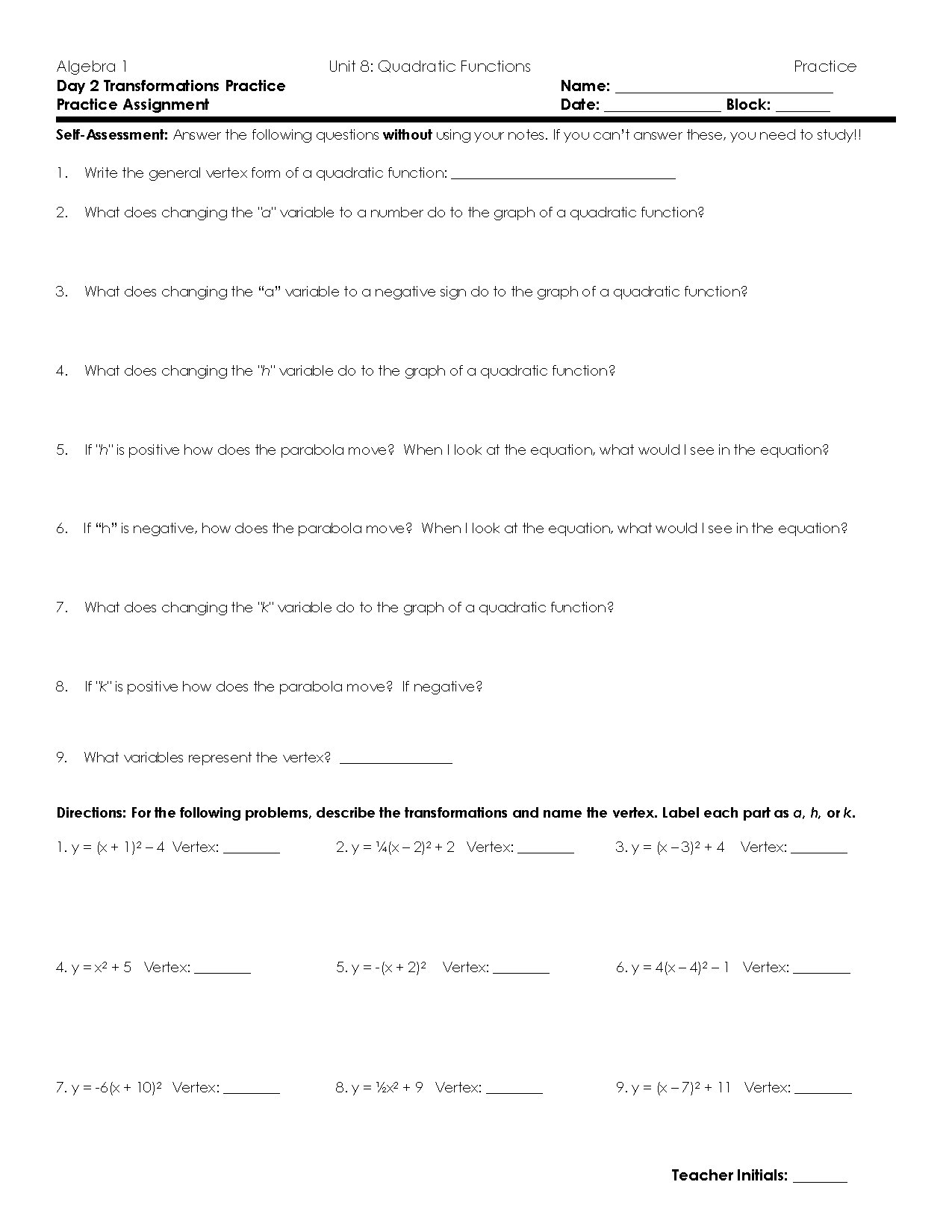
Algebra 1 Unit 8: Quadratic Functions Practice
Day 2 Transformations Practice Name: ____________________________
Practice Assignment Date: _______________ Block: _______
Self-Assessment: Answer the following questions without using your notes. If you can’t answer these, you need to study!!
1. Write the general vertex form of a quadratic function: ________________________________
2. What does changing the "a" variable to a number do to the graph of a quadratic function?
3. What does changing the “a” variable to a negative sign do to the graph of a quadratic function?
4. What does changing the "h" variable do to the graph of a quadratic function?
5. If "h" is positive how does the parabola move? When I look at the equation, what would I see in the equation?
6. If “h” is negative, how does the parabola move? When I look at the equation, what would I see in the equation?
7. What does changing the "k" variable do to the graph of a quadratic function?
8. If "k" is positive how does the parabola move? If negative?
9. What variables represent the vertex? ________________
Directions: For the following problems, describe the transformations and name the vertex. Label each part as a, h, or k.
1. y = (x + 1)
2
4 Vertex: ________ 2. y = ¼(x 2)
2
+ 2 Vertex: ________
3. y = (x 3)
2
+ 4 Vertex: ________
4. y = x
2
+ 5 Vertex: ________ 5. y = -(x + 2)
2
Vertex: ________ 6. y = 4(x 4)
2
1 Vertex: ________
7. y = -6(x + 10)
2
Vertex: ________ 8. y = ½x
2
+ 9 Vertex: ________ 9. y = (x 7)
2
+ 11 Vertex: ________
Teacher Initials: _______
Algebra 1 Unit 8: Quadratic Functions Practice
Write the quadratic equations as transformations from
2
.yx
Label each part of the description as a, h, or k.
10. Translate 1 unit to the right and 5 units down __________________________________
11. Stretch by a factor of 2, reflect across the x-axis, and translate 3 units up __________________________________
12. Shrink by a factor of 1/3 and translate 7 units to the left __________________________________
13. Shift to the right 4 and up 3 __________________________________
14. Reflect over the x-axis and shifted left 11 __________________________________
15. Move down 4 and shrunk by ¼ __________________________________
16. Reflect over the x-axis, shift left 9 and down 8. __________________________________
Teacher Initials: _______
17. Put the following functions in order from the widest to narrowest.
a. f(x) = 2x
2
b. g(x) = ¼x
2
c. h(x) =
1
8
x
2
d. j(x) = -6x
2
e. k(x) =
3
2
x
2
f. m(x) = 4.7x
2
18. Put the following functions in order from the narrowest to widest.
a. f(x) = -3x
2
b. g(x) = ½x
2
c. h(x) =
1
9
x
2
d. j(x) = 5x
2
e. k(x) =
5
4
x
2
f. m(x) = 3.5x
2
Advanced Problems
19. If f(x) = x
2
5 is transformed to create the quadratic function g(x) = ¼x
2
+ 1, what transformations took place?
20. If f(x) = (x 3)
2
is transformed to create the quadratic function g(x) = (x + 1)
2
6, what transformations took place?
21. If f(x) = x
2
+ 2 is transformed to create the quadratic function g(x) = 3x
2
4, what transformations took place?
22. If f(x) = (x 2)
2
+ 5 is transformed to create the quadratic function g(x) = (x + 1)
2
3, what transformations took place?
23. If y = (x 3)
2
2 was shifted up 5 units, what would the new equation be?
24. If y = (x + 4)
2
+ 1 was shifted right 7 units, what would the new equation be?
Algebra 1 Unit 8: Quadratic Functions Practice
Challenge Multiple Choice Questions:
26.
27.
28.
29.
30.
31.
32.
If the graph y = -3x
2
is transformed so it opens up and
is wider, which of the following is a possible equation
for the new graph?
A. y = -x
2
B. y = 1/2x
2
C. y = 3x
2
D. y = 5x
2
33.
If the -5 in y = -x
2
5 is changed to a positive number,
what is the effect on the graph?
A. The graph gets wider.
B. The graph gets narrower.
C. The graph shifts up.
D. The graph is shifts right.
/ 3
End of Document
52
You May Also Like

FAQs of Algebra 1 Unit 8 Transformations of Quadratic Functions

What is the vertex form of a quadratic function?
The vertex form of a quadratic function is expressed as y = a(x - h)² + k, where (h, k) represents the vertex of the parabola. This form allows for easy identification of the vertex and facilitates graphing by showing how the graph shifts based on the values of h and k. The parameter 'a' affects the width and direction of the parabola, indicating whether it opens upwards or downwards.
How do changes in the 'a' value affect the graph of a quadratic function?
Changing the 'a' value in the vertex form of a quadratic function affects the width and direction of the parabola. If 'a' is greater than 1, the graph becomes narrower, while if 'a' is between 0 and 1, the graph widens. A negative 'a' value reflects the graph across the x-axis, changing the direction in which the parabola opens. Understanding these transformations is crucial for accurately graphing quadratic functions.
What transformations occur when the 'h' value is changed?
Altering the 'h' value in the vertex form of a quadratic function results in horizontal translations of the graph. If 'h' is positive, the graph shifts to the right, while a negative 'h' value shifts the graph to the left. This transformation directly affects the location of the vertex, making it essential for graphing and understanding the function's behavior. Students must recognize how these shifts impact the overall graph.
What is the significance of the 'k' value in the vertex form?
The 'k' value in the vertex form of a quadratic function determines the vertical position of the graph. A positive 'k' value shifts the graph upward, while a negative 'k' value shifts it downward. This vertical translation affects the vertex's y-coordinate, playing a crucial role in graphing the function accurately. Understanding the 'k' value helps students visualize how the parabola is positioned relative to the x-axis.
What types of transformations are covered in this unit?
This unit covers various transformations of quadratic functions, including translations, reflections, and stretches. Students learn how to translate graphs horizontally and vertically by adjusting the 'h' and 'k' values, reflect graphs across the x-axis by changing the sign of 'a', and stretch or compress the graphs by modifying the 'a' value. These transformations are essential for mastering the graphing of quadratic functions and understanding their properties.

Related of Algebra 1 Unit 8 Transformations of Quadratic Functions