An Introduction to Probability and Statistics

An Introduction to Probability and Statistics

An Introduction to Probability and Statistics by J. Calvin Berry provides a comprehensive overview of statistical methods and probability theory. This resource is essential for students in mathematics and statistics courses, particularly those studying Statistics 325 at the University of Louisiana at Lafayette. Key topics include descriptive statistics, probability measures, random variables, and inferential statistics. The text features numerous examples and problems to enhance understanding of concepts such as the binomial and normal distributions, hypothesis testing, and confidence intervals. Ideal for learners seeking to strengthen their statistical analysis skills, this guide is updated for the July 2024 revision.

Key Points

  • Covers foundational concepts in probability and statistics, including descriptive statistics and sampling methods.
  • Explains probability measures and their properties, with a focus on discrete and continuous random variables.
  • Includes detailed sections on hypothesis testing and confidence intervals for proportions and means.
  • Features numerous examples and practice problems to reinforce understanding of statistical concepts.

356
/ 301
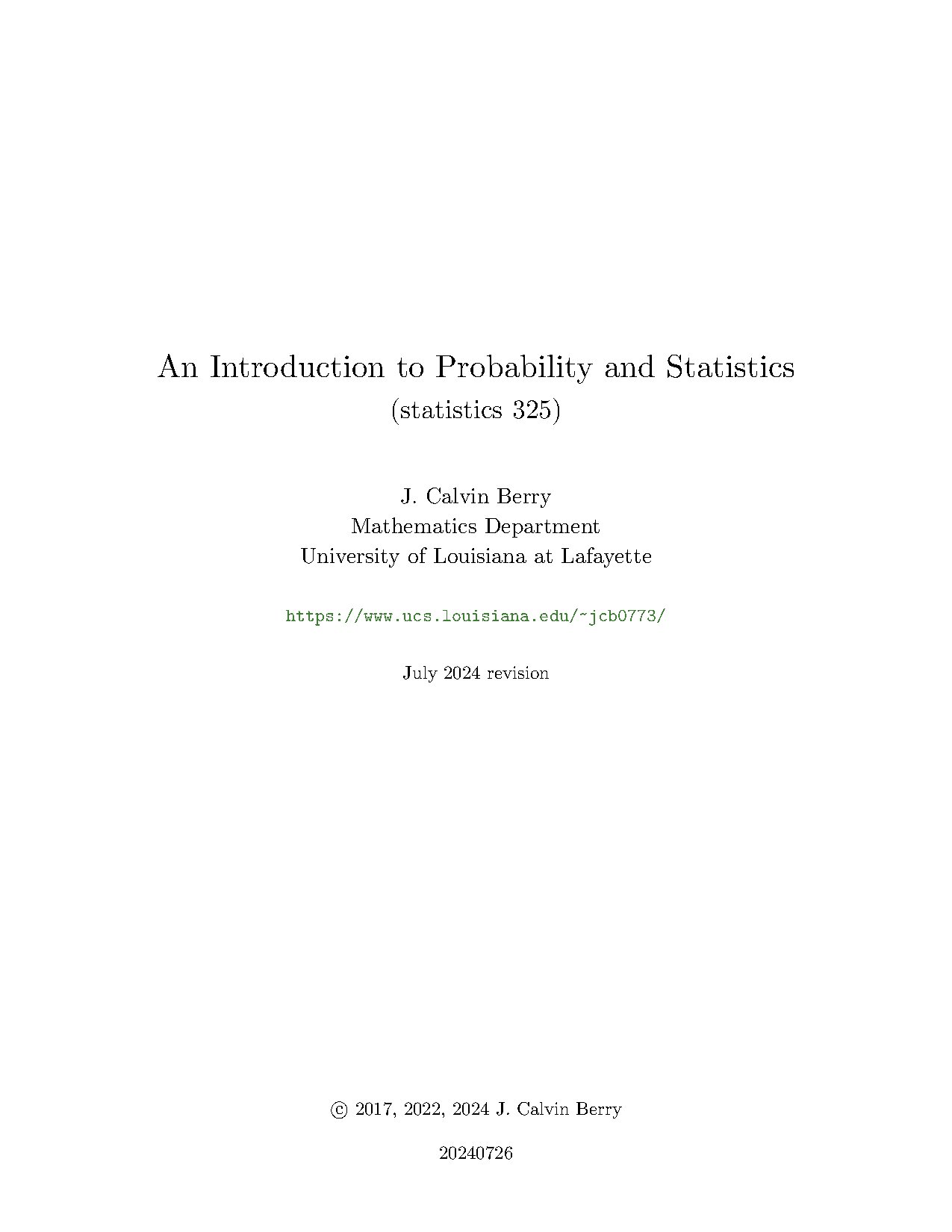
An Introduction to Probability and Statistics
(statistics 325)
J. Calvin Berry
Mathematics Department
University of Louisiana at Lafayette
https://www.ucs.louisiana.edu/
~
jcb0773/
July 2024 revision
c
2017, 2022, 2024 J. Calvin Berry
20240726
20240726
Table of Contents
Part 1: Introduction and Descriptive Statistics
1 Introduction 1
1.1 Basic ideas 1
1.2 Sampling 6
1.3 Experimentation 11
1.4 Problems 14
2 Descriptive Statistics 15
2.1 Tabular and graphical summary 15
2.2 Types of variables 16
2.3 Qualitative data 17
2.4 Quantitative data 20
2.5 Numerical summary 25
2.6 Quantiles and percentiles in general 37
2.7 The mean and standard deviation 38
2.8 A measure of relative position 42
2.9 Problems 44
Part 2: Probability
3 Probability 45
3.1 The setting 45
3.2 Some illustrative examples 45
3.3 Sample spaces and events 50
3.4 Partitioning an event 59
3.5 Problems 62
4 Probability measures 63
4.1 Definition of a probability measure 63
4.2 Properties of probability measures 63
4.3 Probabilities on discrete sample spaces 68
4.4 Problems 69
i
/ 301
End of Document
356
You May Also Like

FAQs of An Introduction to Probability and Statistics

What are the main topics covered in An Introduction to Probability and Statistics?
An Introduction to Probability and Statistics covers a wide range of topics essential for understanding statistical analysis. Key areas include descriptive statistics, probability measures, random variables, and inferential statistics. The text delves into specific distributions such as the binomial, hypergeometric, and normal distributions. Additionally, it addresses hypothesis testing and confidence intervals, providing a thorough framework for statistical inference.
How does the book explain the concept of random variables?
The book introduces random variables by defining them as measurable characteristics that can take on different values. It discusses both discrete and continuous random variables, providing examples of each type. For discrete random variables, the text covers distributions such as the binomial and Poisson distributions, while for continuous random variables, it explores the normal and exponential distributions. The concept of expected value and variance is also explained, highlighting their significance in statistical analysis.
What is the significance of hypothesis testing in statistics as discussed in the book?
Hypothesis testing is a critical component of statistical analysis, and the book provides a detailed examination of its principles and applications. It explains the process of formulating null and alternative hypotheses, selecting appropriate tests, and interpreting results. The text covers various scenarios, including tests for proportions and means, and discusses the importance of p-values and confidence intervals in making informed decisions based on data.
What types of problems are included in An Introduction to Probability and Statistics?
The book includes a variety of problems designed to reinforce the concepts presented in each chapter. These problems range from basic calculations involving descriptive statistics to more complex scenarios requiring the application of probability measures and hypothesis testing. Each section concludes with problems that challenge students to apply their knowledge, ensuring a practical understanding of statistical methods.

Related of An Introduction to Probability and Statistics