Aidan Boutot
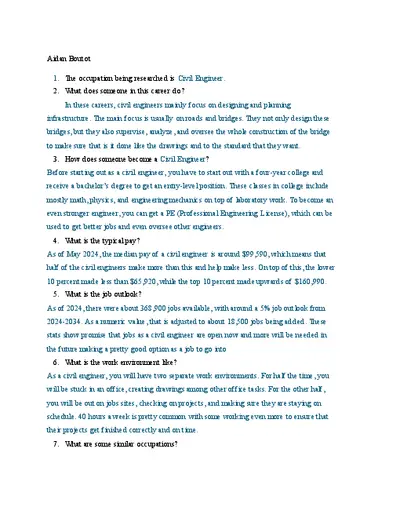
1. The occupation being researched is Civil Engineer.
2. What does someone in this career do?
In these careers, civil engineers mainly focus on designing and planning
infrastructure. The main focus is usually on roads and bridges. They not only design these
bridges, but they also supervise, analyze, and oversee the whole construction of the bridge
to make sure that is it done like the drawings and to the standard that they want.
3. How does someone become a Civil Engineer?
Before starting out as a civil engineer, you have to start out with a four-year college and
receive a bachelor’s degree to get an entry-level position. These classes in college include
mostly math, physics, and engineering mechanics on top of laboratory work. To become an
even stronger engineer, you can get a PE (Professional Engineering License), which can be
used to get better jobs and even oversee other engineers.
4. What is the typical pay?
As of May 2024, the median pay of a civil engineer is around $99,590, which means that
half of the civil engineers make more than this and help make less. On top of this, the lower
10 percent made less than $65,920, while the top 10 percent made upwards of $160,990.
5. What is the job outlook?
As of 2024, there were about 368,900 jobs available, with around a 5% job outlook from
2024-2034. As a numeric value, that is adjusted to about 18,500 jobs being added. These
stats show promise that jobs as a civil engineer are open now and more will be needed in
the future making a pretty good option as a job to go into
6. What is the work environment like?
As a civil engineer, you will have two separate work environments. For half the time, you
will be stuck in an office, creating drawings among other office tasks. For the other half,
you will be out on jobs sites, checking on projects, and making sure they are staying on
schedule. 40 hours a week is pretty common with some working even more to ensure that
their projects get finished correctly and on time.
7. What are some similar occupations?