Chapter 3: Parallel and Perpendicular Lines 3.3

Chapter 3: Parallel and Perpendicular Lines 3.3

Chapter 3.3 of Parallel and Perpendicular Lines focuses on proving lines parallel using various theorems and postulates. It covers the Corresponding Angles Postulate, Alternate Interior Angles Theorem, and Same Side Interior Angles Theorem, providing essential tools for geometry students. The chapter includes practical examples and construction techniques to demonstrate how to establish parallel lines. Ideal for high school geometry learners preparing for exams, this chapter enhances understanding of angle relationships and their implications in geometric proofs.

Key Points

  • Explains the Corresponding Angles Postulate and its converse for proving parallel lines.
  • Covers the Alternate Interior Angles Theorem and its application in geometric proofs.
  • Includes practical examples demonstrating how to construct parallel lines using angle congruence.
  • Discusses the Parallel Lines Property and its relevance in transitive relationships between lines.
243
/ 11
www.ck12.org Chapter 3. Parallel and Perpendicular Lines
3.3
Proving Lines Parallel
Learning Objectives
Use the converses of the Corresponding Angles Postulate, Alternate Interior Angles Theorem, Alternate
Exterior Angles Theorem, and the Same Side Interior Angles Theorem to show that lines are parallel.
Construct parallel lines using the above converses.
Use the Parallel Lines Property.
Review Queue
Answer the following questions.
1. Write the converse of the following statements:
a. If it is summer, then I am out of school.
b. I will go to the mall when I am done with my homework.
c. If two parallel lines are cut by a transversal, then the corresponding angles are congruent.
2. Are any of the three converses from #1 true? Why or why not? Give a counterexample.
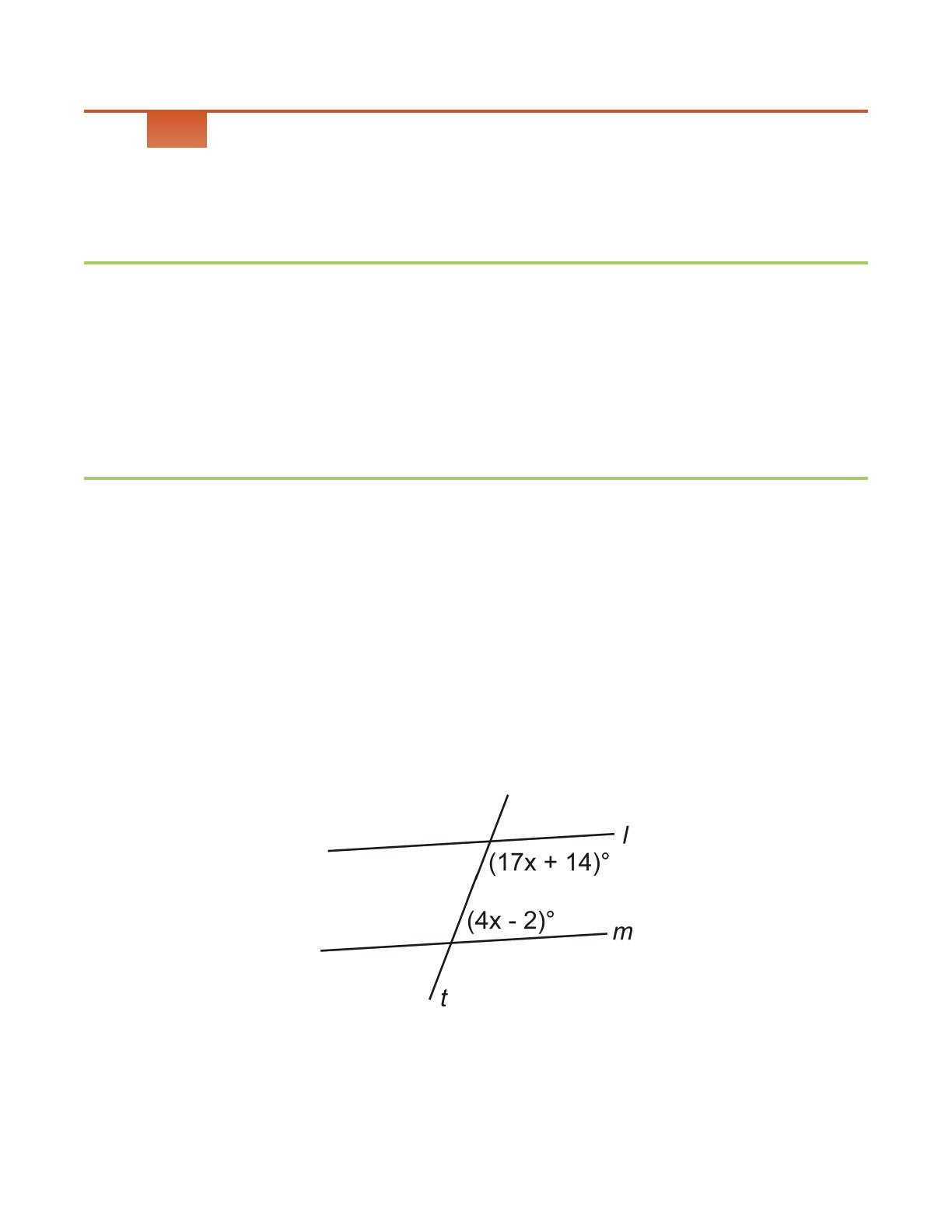
3. Determine the value of x if l || m.
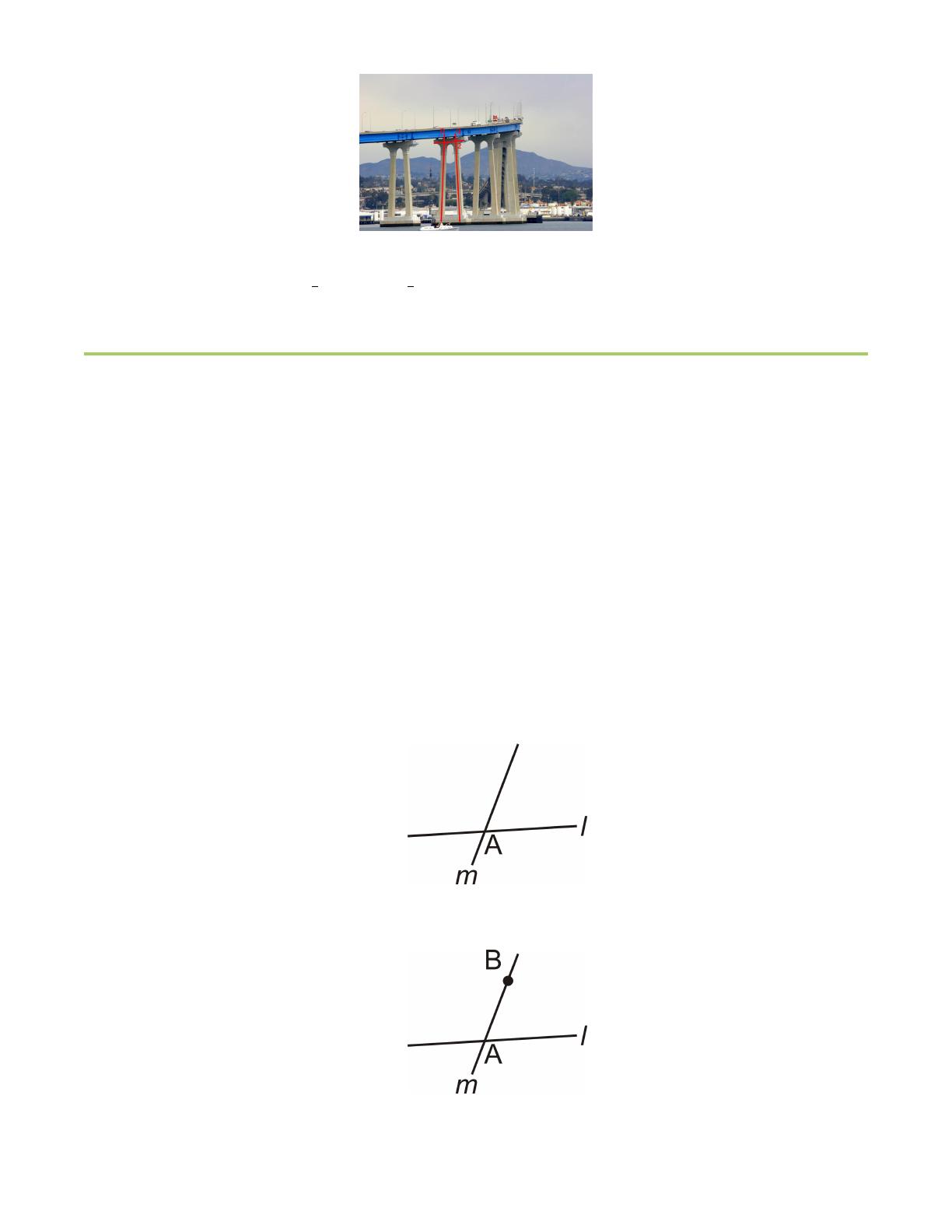
Know What? Here is a picture of the support beams for the Coronado Bridge in San Diego. This particular bridge,
called a girder bridge, is usually used in straight, horizontal situations. The Coronado Bridge is diagonal, so the
beams are subject to twisting forces (called torque). This can be fixed by building a curved bridge deck. To aid
the curved bridge deck, the support beams should not be parallel. If they are, the bridge would be too fragile and
susceptible to damage.
137
3.3. Proving Lines Parallel www.ck12.org
This bridge was designed so that
6
1 = 92
and
6
2 = 88
. Are the support beams parallel?
Corresponding Angles Converse
Recall that the converse of a statement switches the conclusion and the hypothesis. So, if a, then b becomes if b,
then a. We will find the converse of all the theorems from the last section and will determine if they are true.
The Corresponding Angles Postulate says: If two lines are parallel, then the corresponding angles are congruent.
The converse is:
Converse of Corresponding Angles Postulate: If corresponding angles are congruent when two lines are cut by a
transversal, then the lines are parallel.
Is this true? For example, if the corresponding angles both measured 60
, would the lines be parallel? YES. All
eight angles created by l, m and the transversal are either 60
or 120
, making the slopes of l and m the same which
makes them parallel. This can also be seen by using a construction.
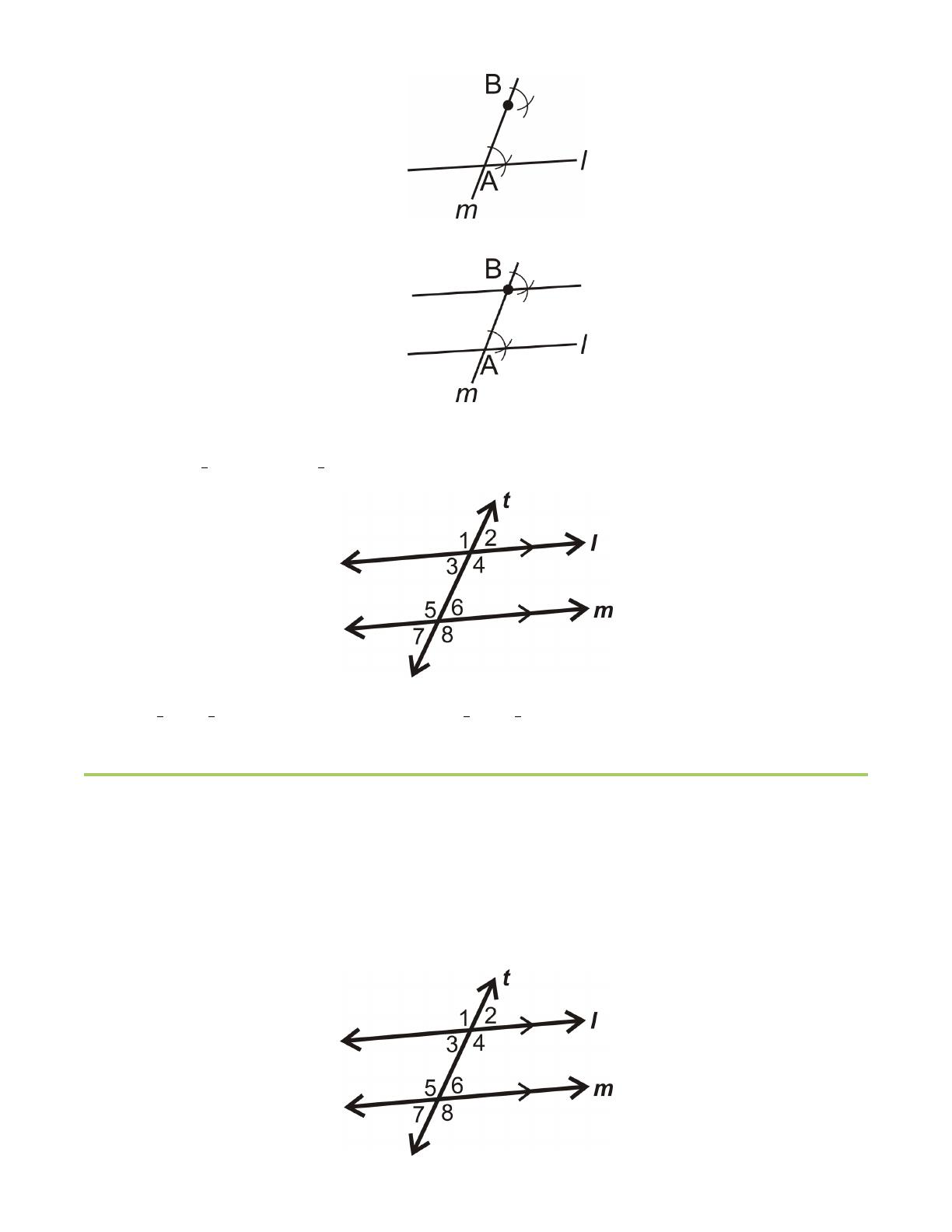
Investigation 3-5: Creating Parallel Lines using Corresponding Angles
1. Draw two intersecting lines. Make sure they are not perpendicular. Label them l and m, and the point of
intersection, A, as shown.
2. Create a point, B, on line m, above A.
3. Copy the acute angle at A (the angle to the right of m) at point B. See Investigation 2-2 in Chapter 2 for the
directions on how to copy an angle.
138
www.ck12.org Chapter 3. Parallel and Perpendicular Lines
4. Draw the line from the arc intersections to point B.
From this construction, we can see that the lines are parallel.
Example 1: If m
6
8 = 110
and m
6
4 = 110
, then what do we know about lines l and m?
Solution:
6
8 and
6
4 are corresponding angles. Since m
6
8 = m
6
4, we can conclude that l || m.
Alternate Interior Angles Converse
We also know, from the last lesson, that when parallel lines are cut by a transversal, the alternate interior angles are
congruent. The converse of this theorem is also true:
Converse of Alternate Interior Angles Theorem: If two lines are cut by a transversal and alternate interior angles
are congruent, then the lines are parallel.
Example 3: Prove the Converse of the Alternate Interior Angles Theorem.
139
/ 11
End of Document
243
You May Also Like

FAQs of Chapter 3: Parallel and Perpendicular Lines 3.3

What is the Corresponding Angles Postulate?
The Corresponding Angles Postulate states that if two parallel lines are cut by a transversal, then the corresponding angles formed are congruent. This theorem is crucial for establishing the parallelism of lines based on angle measurements. For instance, if two angles are found to be equal when a transversal intersects two lines, it can be concluded that those lines are parallel. This concept is foundational in geometry, especially when working with proofs and constructions.
How can alternate interior angles prove lines are parallel?
The Alternate Interior Angles Theorem asserts that if two lines are cut by a transversal and the alternate interior angles are congruent, then the lines are parallel. This theorem is instrumental in geometric proofs where angle relationships are analyzed. For example, if one angle measures 70 degrees and its alternate interior angle also measures 70 degrees, it can be concluded that the two lines are parallel. This principle is frequently applied in various geometric constructions and proofs.
What is the significance of the Same Side Interior Angles Theorem?
The Same Side Interior Angles Theorem states that if two lines are cut by a transversal and the consecutive interior angles are supplementary, then the lines are parallel. This theorem is significant as it provides an alternative method to establish parallelism through angle addition. For example, if the measures of two same-side interior angles add up to 180 degrees, it confirms that the lines are parallel. This theorem is particularly useful in solving problems involving angle relationships.
How does the Parallel Lines Property work?
The Parallel Lines Property is a transitive property that applies to parallel lines. It states that if line l is parallel to line m, and line m is parallel to line n, then line l is also parallel to line n. This property is essential in geometric proofs where multiple lines are involved. For instance, if two pairs of lines are established as parallel through angle relationships, the Parallel Lines Property allows for conclusions about the third line's parallelism. This concept is widely used in geometry to simplify complex problems.

Related of Chapter 3: Parallel and Perpendicular Lines 3.3