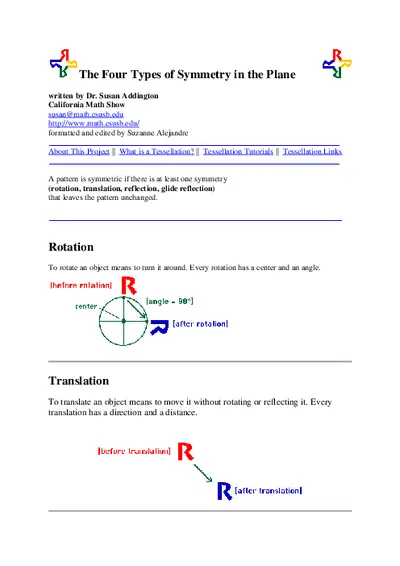
The Four Types of Symmetry in the Plane by Dr. Susan Addington explores the fundamental concepts of symmetry, including rotation, translation, reflection, and glide reflection. This educational resource is designed for students and educators in mathematics, providing clear definitions and examples of each symmetry type. Readers will learn how these symmetries apply to patterns in nature and art, enhancing their understanding of geometric principles. The document includes practical problems that encourage exploration of symmetry in various contexts, making it suitable for classroom use or self-study.
Key Points
Explains the four types of symmetry: rotation, translation, reflection, and glide reflection.
Includes practical examples and problems to enhance understanding of geometric symmetry.
Discusses the application of symmetry in nature, art, and mathematics.
Provides definitions and visual representations for each type of symmetry.
This link leads to an external site. We do not know or endorse its content, and are not responsible for its safety. Click the link to proceed only if you trust this site.
What are the four types of symmetry discussed in this document?
The document outlines four types of symmetry: rotation, translation, reflection, and glide reflection. Rotation involves turning an object around a center point, while translation refers to moving an object without altering its orientation. Reflection creates a mirror image across a line, and glide reflection combines reflection with translation along the mirror line. Each type is illustrated with examples to clarify their distinct characteristics and applications.
How does glide reflection differ from other types of symmetry?
Glide reflection is unique because it combines two operations: reflection and translation. Unlike simple reflection, which only produces a mirror image, glide reflection involves moving the reflected image along the direction of the mirror line. This two-step process creates more complex symmetrical patterns, making glide reflection particularly interesting in the study of tessellations and artistic designs.
What practical problems are included in the document?
The document includes several practical problems that encourage readers to apply their understanding of symmetry. For instance, one problem asks students to classify capital letters based on their symmetry types, while another prompts them to create symmetric patterns using translations and reflections. These exercises are designed to reinforce the concepts discussed and provide hands-on experience with symmetry in various forms.
How can symmetry be observed in nature and art?
Symmetry is prevalent in both nature and art, serving as a fundamental principle in design and aesthetics. In nature, examples include the bilateral symmetry of animals and the radial symmetry of flowers. Artists and mathematicians utilize symmetry to create visually appealing patterns and structures, often employing techniques like tessellation. The document emphasizes the importance of recognizing these patterns, as they help us understand the world conceptually.
Related of The Four Types of Symmetry in the Plane