Data Analytics Overview and Techniques for Businesses

Data Analytics Overview and Techniques for Businesses

Data analytics is essential for businesses to improve decision-making and performance. It explores customer behavior, market trends, and operational efficiency. This resource outlines various data analytics tools, including R, Python, and Tableau, and discusses their applications in generating insights and reports. It also covers data modeling techniques, types of data, and methods for handling missing data. Aimed at professionals and students in data science and business analytics, this guide provides a comprehensive overview of the data analytics landscape.

Key Points

  • Explains the importance of data analytics in improving business performance and decision-making.
  • Covers various data analytics tools such as R, Python, and Tableau for effective data analysis.
  • Details data modeling techniques including hierarchical and entity-relationship models.
  • Discusses types of data including structured, semi-structured, and unstructured data.
  • Outlines methods for handling missing data to enhance data quality.

178
/ 13
Introduction to Analysis
Introduction
Data has become one of the most valuable resources in today’s
world. It is generated from businesses, organizations, websites,
mobile applications, and even individuals. Analysing this data helps in
finding useful information, identifying patterns, and making better
decisions. The process of examining data to gain meaningful insights
is called Data Analytics.
Why is Data Analytics Important?
Data analytics plays an important role in improving business
performance and decision-making. It helps organizations understand
customer behaviour, market trends, and business performance. By
analysing data, companies can improve efficiency, reduce risks, and
increase profits.
Role of Data Analytics
1. Gather Hidden Insights
Data analytics helps in discovering hidden patterns, relationships, and
trends from large amounts of data. These insights help organizations
understand their business better.
2. Generate Reports
Analytics helps in creating reports and dashboards that support
managers and teams in making important business decisions.
3. Perform Market Analysis
Organizations can analyse market trends, customer preferences, and
competitor performance to improve their strategies.
4. Improve Business Requirements
By analysing customer data, businesses can improve products,
services, and customer experience.
Ways to Use Data Analytics
1. Improved Decision Making
Data analytics helps organizations make accurate decisions based on
facts instead of assumptions.
2. Better Customer Service
By understanding customer needs and preferences, companies can
provide personalized services and improve customer satisfaction.
3. Efficient Operations
Analytics helps businesses optimize processes, reduce costs, and
improve productivity.
4. Effective Marketing
Organizations can analyse marketing campaigns, identify target
customers, and improve marketing performance.
Steps Involved in Data Analytics
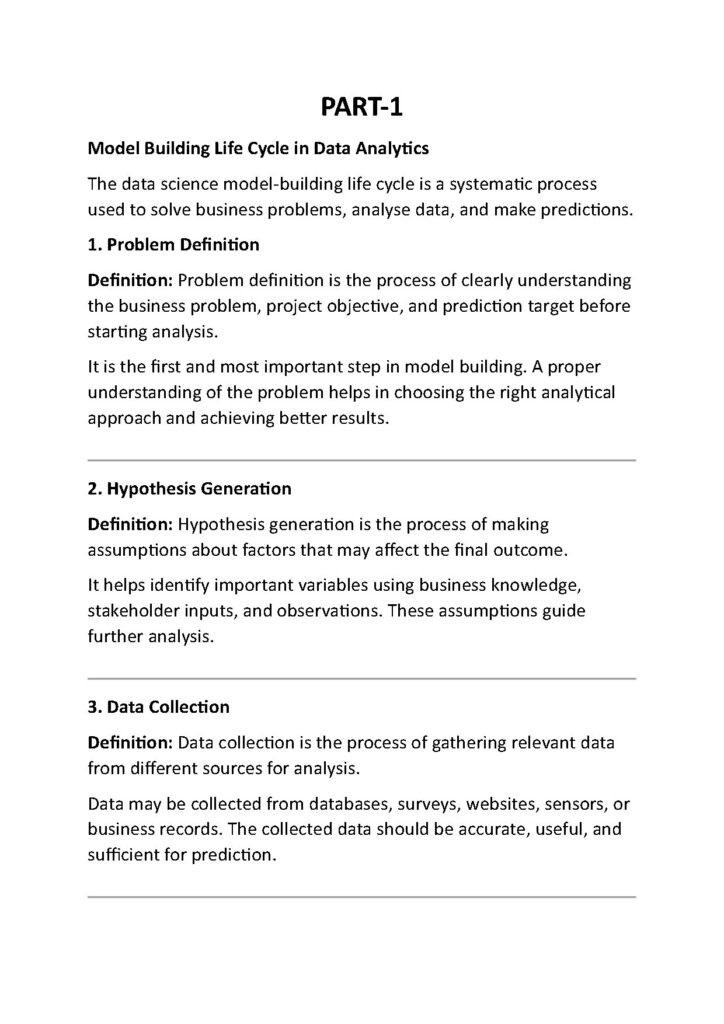
1. Understand the Problem
The first step is identifying the business problem and defining goals.
2. Data Collection
Relevant data is collected from various sources such as databases,
websites, applications, and business records.
3. Data Cleaning
The collected data may contain missing or incorrect values, so it is
cleaned before analysis.
4. Data Exploration and Analysis
The cleaned data is analysed using statistical methods, visualization,
and predictive models to identify patterns and trends.
5. Interpret Results
The final step is interpreting the results and using insights for
decision-making.
Tools Used in Data Analytics
Some popular tools used in data analytics are:
• R – Used for statistical analysis and data modelling.
• Python – Used for data analysis, machine learning, and
visualization.
• Tableau Public – Used for dashboards and data visualization.
• Microsoft Excel – Used for calculations, charts, and pivot tables.
• Apache Spark – Used for big data analytics.
Introduction to Tools and Environment in Data Analytics
With the increasing demand for data analytics, many tools and
development environments have emerged to help in data collection,
processing, analysis, visualization, and model building. These tools
may be open-source or commercial and are widely used in industries
for better decision-making.
/ 13
End of Document
178
You May Also Like

FAQs of Data Analytics Overview and Techniques for Businesses

What are the key benefits of using data analytics in business?
Data analytics offers numerous benefits for businesses, including improved decision-making based on factual insights rather than assumptions. It helps organizations understand customer preferences and market trends, leading to enhanced customer service and targeted marketing strategies. Additionally, analytics can optimize operations by identifying inefficiencies, ultimately reducing costs and increasing profitability. By leveraging data, businesses can also mitigate risks and make informed strategic decisions.
What tools are commonly used in data analytics?
Several tools are widely used in data analytics, each serving different purposes. R is popular for statistical analysis and data modeling, while Python is favored for its versatility in data analysis and machine learning. Tableau is known for creating interactive visualizations and dashboards, and Microsoft Excel is often used for data entry and basic analysis. Other tools like Apache Spark are utilized for big data processing, making them essential for handling large datasets.
What types of data are analyzed in data analytics?
Data analytics involves various types of data, primarily categorized into structured, semi-structured, and unstructured data. Structured data is organized in tables with defined rows and columns, making it easy to analyze. Semi-structured data, such as JSON and XML, contains tags or labels but doesn't adhere to a strict format. Unstructured data includes formats like images, videos, and text files, which require more complex analysis methods to extract meaningful insights.
How does data modeling support data analytics?
Data modeling is crucial in data analytics as it defines how data is organized and related within a database. It helps create a robust database design that improves data quality and facilitates easier maintenance. Various data modeling techniques, such as hierarchical, network, and entity-relationship models, allow analysts to visualize and structure data effectively. By identifying relationships and attributes, data modeling ensures that the data is accessible and usable for analysis.
What methods are used to handle missing data in analytics?
Handling missing data is vital for maintaining the integrity of data analysis. Common methods include ignoring or removing missing data, which can be effective if the missing values are minimal. Alternatively, analysts may fill in missing values manually or replace them with a constant or average value. More sophisticated approaches involve predicting missing values using statistical models, which can provide more accurate datasets for analysis.

Related of Data Analytics Overview and Techniques for Businesses