Homer The Odyssey

Homer The Odyssey

Homer's The Odyssey narrates the epic journey of Odysseus as he strives to return home after the Trojan War. This translation by Ian Johnston, first published in 2002, captures the trials and tribulations faced by Odysseus, including encounters with mythical creatures and divine beings. The text explores themes of heroism, loyalty, and the quest for identity, making it essential for literature students and fans of ancient Greek mythology. Each book is accompanied by footnotes and summaries to enhance understanding, with a comprehensive table of contents detailing key events from Athena's visit to Ithaca to Odysseus's reunion with Penelope. This version is freely available under a Creative Commons license, allowing for distribution and adaptation.

Key Points

  • Explores Odysseus's journey home after the Trojan War, highlighting his encounters with gods and monsters.
  • Features a comprehensive table of contents detailing each book from Athena's visit to Ithaca to the final reunion with Penelope.
  • Includes footnotes and summaries for each book to aid in understanding the text's themes and characters.
  • This translation by Ian Johnston is based on the Greek text from the Perseus Digital Library and has been revised since its initial publication.
423
/ 444
1
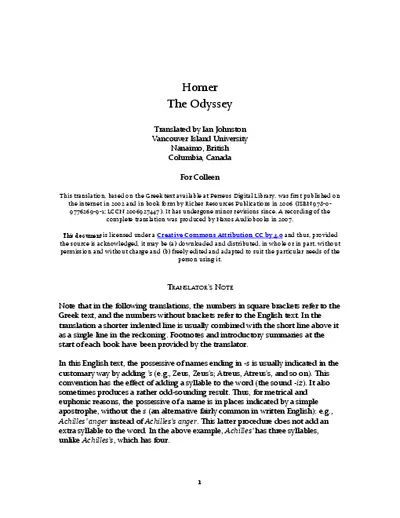
Homer
The Odyssey
Translated by Ian Johnston
Vancouver Island University
Nanaimo, British
Columbia, Canada
For Colleen
This translation, based on the Greek text available at Perseus Digital Library, was first published on
the internet in 2002 and in book form by Richer Resources Publications in 2006 (ISBN 978-0-
9776269-9-1; LCCN 2006927447). It has undergone minor revisions since. A recording of the
complete translation was produced by Naxos Audiobooks in 2007.
This document
is licensed under a Creative Commons Attribution CC by 4.0 and thus, provided
the source is acknowledged, it may be (a) downloaded and distributed, in whole or in part, without
permission and without charge and (b) freely edited and adapted to suit the particular needs of the
person using it.
T
RANSLATOR
S
N
OTE
Note that in the following translations, the numbers in square brackets refer to the
Greek text, and the numbers without brackets refer to the English text. In the
translation a shorter indented line is usually combined with the short line above it
as a single line in the reckoning. Footnotes and introductory summaries at the
start of each book have been provided by the translator.
In this English text, the possessive of names ending in -s is usually indicated in the
customary way by adding ’s (e.g., Zeus, Zeus’s; Atreus, Atreus’s, and so on). This
convention has the effect of adding a syllable to the word (the sound -iz). It also
sometimes produces a rather odd-sounding result. Thus, for metrical and
euphonic reasons, the possessive of a name is in places indicated by a simple
apostrophe, without the s (an alternative fairly common in written English): e.g.,
Achilles’ anger instead of Achilles’s anger. This latter procedure does not add an
extra syllable to the word. In the above example, Achilles’ has three syllables,
unlike Achilles’s, which has four.
2
T
ABLE OF
C
ONTENTS
Book 1: Athena Visits Ithaca 3
Book 2: Telemachus Prepares for His Voyage 20
Book 3: Telemachus Visits Nestor in Pylos 36
Book 4: Telemachus Visits Menelaus and Helen in Sparta 54
Book 5: Odysseus Leaves Calypso’s Island 85
Book 6: Odysseus and Nausicaa 102
Book 7: Odysseus at the Court of Alcinous in Phaeacia 113
Book 8: Odysseus is Entertained in Phaeacia 125
Book 9: Ismarus, the Lotus Eaters, and the Cyclops 146
Book 10: Aeolus, the Laestrygonians, and Circe 166
Book 11: Odysseus Meets the Shades of the Dead 186
Book 12: The Sirens, Scylla and Charybdis, The Cattle of the Sun 210
Book 13: Odysseus Leaves Phaeacia and Reaches Ithaca 226
Book 14: Odysseus Meets Eumaeus 242
Book 15: Telemachus Returns to Ithaca 261
Book 16: Odysseus Reveals Himself to Telemachus 281
Book 17: Odysseus Goes to the Palace as a Beggar 298
Book 18: Odysseus and Irus the Beggar 320
Book 19: Eurycleia Recognizes Odysseus 336
Book 20: Odysseus Prepares for His Revenge 357
Book 21: The Contest with Odysseus’s Bow 372
Book 22: The Killing of the Suitors 388
Book 23: Odysseus and Penelope 406
Book 24: Zeus and Athena End the Fighting 419
Possible Floor Plan of Odysseus’s House 439
Glossary 440
3
B
OOK
O
NE
A
THENA
V
ISITS
I
THACA
[The invocation to the Muse; the gods discuss Odysseus and decide he should return;
Athena goes to Ithaca to encourage Telemachus, speaks to him disguised as Mentes,
offering advice about dealing with his mother and the suitors and suggesting he go
on a trip to Pylos and Sparta; Penelope speaks to Phemius, the singer, asking him to
change the song; Telemachus criticizes her; Penelope goes upstairs; Eurycleia carries
the lit torches to escort Telemachus to his rooms.]
Muse, speak to me now of that resourceful man
who wandered far and wide after ravaging
the sacred citadel of Troy.
1
He came to see
many people’s cities, where he learned their customs,
while on the sea his spirit suffered many torments,
as he fought to save his life and lead his comrades home.
But though he wanted to, he could not rescue them—
they all died from their own stupidity, the fools.
They feasted on the cattle of Hyperion,
god of the sun—and so he snatched away their chance 10
of getting home someday.
2
So now, daughter of Zeus,
tell us his story, starting anywhere you wish. [10]
The other warriors, all those who had escaped
being utterly destroyed, were now back safely home,
facing no more dangers from battle or the sea.
But Odysseus, who longed to get back to his wife
and reach his home, was being held in a hollow cave
by that mighty nymph Calypso, noble goddess,
who desired to have Odysseus as her husband.
But as the seasons came and went, the year arrived 20
in which, according to what gods had once ordained,
he was to get back to his home in Ithaca—
not that he would be free from troubles even there,
among his people. The gods pitied Odysseus,
all except Poseidon, who kept up his anger [20]
against godlike Odysseus and did not relent
until he reached his native land.
3
1
The Muses, the divine patrons of the arts, are daughters of Zeus.
2
Hyperion, who is also called Helios, treasured his several herds of cattle; the incident with his
cattle is related in detail in Book 12.
3
Poseidon, divine brother of Zeus and god of the sea, is often called “encircler of the earth” or
“Earthshaker (because he rules over earthquakes).
/ 444
End of Document
423
You May Also Like

FAQs of Homer The Odyssey

What are the main themes explored in The Odyssey?
The Odyssey delves into several key themes, including the struggle for identity, the importance of loyalty, and the nature of heroism. Odysseus's long journey home symbolizes the quest for self-discovery and the challenges one faces in overcoming adversity. The relationships between characters, such as Odysseus and Penelope, highlight loyalty and fidelity, while encounters with divine beings emphasize the influence of fate and the gods in human affairs. Additionally, the text examines the consequences of hubris, particularly through the actions of Odysseus's crew.
Who are the significant characters in The Odyssey?
The Odyssey features a rich cast of characters, including the hero Odysseus, his faithful wife Penelope, and their son Telemachus. Odysseus is portrayed as a cunning and resourceful leader, while Penelope exemplifies loyalty and patience during his long absence. Telemachus embarks on his own journey of growth and self-discovery as he seeks news of his father. Other notable characters include Athena, the goddess who aids Odysseus, Poseidon, who seeks to hinder his return, and various mythical beings such as Circe and the Cyclops.
What is the significance of Odysseus's encounters with mythical creatures?
Odysseus's encounters with mythical creatures serve to illustrate the challenges and temptations he faces on his journey home. Each creature, from the Cyclops to the Sirens, represents different trials that test his wit, courage, and resolve. These encounters highlight the themes of survival and the consequences of human choices, as Odysseus must navigate both physical dangers and moral dilemmas. They also emphasize the interplay between human agency and divine intervention, showcasing how the gods influence his fate.
How does The Odyssey address the concept of homecoming?
The concept of homecoming is central to The Odyssey, symbolizing not only the physical return to Ithaca but also the emotional and psychological journey of Odysseus. His longing for home reflects the universal desire for belonging and stability. The narrative explores the challenges of reclaiming one's place in the world after prolonged absence, as Odysseus must confront the changes that have occurred in his absence, including the suitors vying for Penelope's hand. Ultimately, the story emphasizes the importance of home as a source of identity and fulfillment.

Related of Homer The Odyssey