Idaho Public Driver Education
IDAHO PUBLIC DRIVER EDUCATION
Risk
If cars travelled on tracks and never had to
interact with other vehicles – we wouldn’t have
over 30,000 traffic fatalities in the U.S. each year
and we wouldn’t need driver education.
But cars do not travel on independent tracks or
have 100% crash avoidance systems built in - yet
– so understanding the risks involved in driving is
essential to staying safe and alive.
Falling into a false sense of security is a big
problem as drivers become more and more
comfortable behind the wheel. Soon, they forget
that they are driving a 2,000 pound rolling missile
and allow their attention to drift to more interesting
things, like a text message or music or video
player.
IPDE
Driving is a very busy activity. It is so much more
than simply stepping on the gas and steering. In
driver education we like to say we could teach a
monkey to drive but it would not be able to have
the focus or make the smart choices required to
be a SAFE and SKILLED driver. This is because
driving is primarily a thinking task.
One of the skills necessary to stay aware of the
ever-changing conditions around you while you
drive is to use “IPDE” (identify, predict, decide,
execute). While driving you must constantly
“identify” important objects and situations that
might affect you, “predict” what might happen,
“decide” how you will react if necessary, and then
“execute” that reaction if necessary.
Since “prediction” is an essential part of the IPDE
proce
ss but you can usually only predict what
you’ve experienced, getting good at IPDE will take
time.
Zone Control
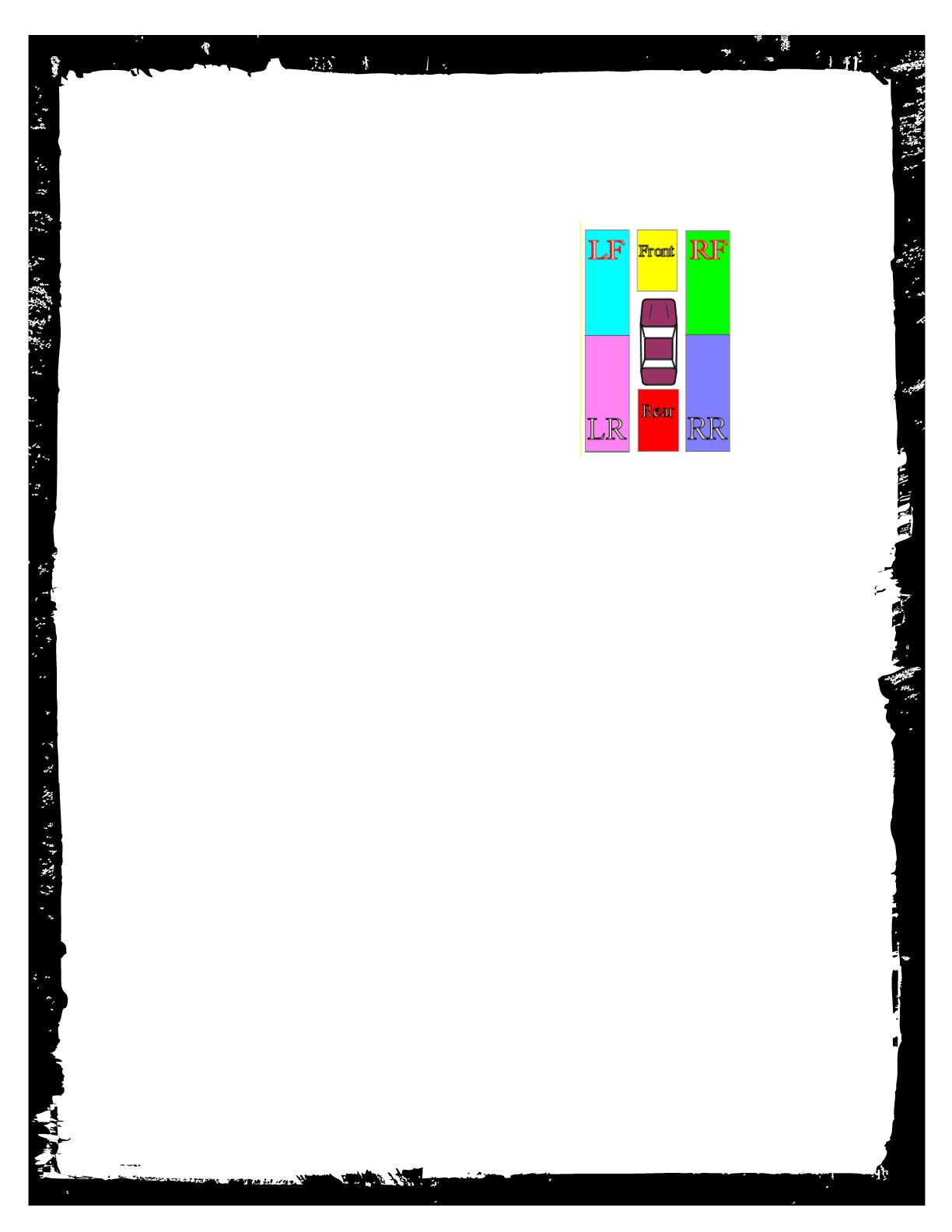
The Zone Control system helps you control the six
areas around your vehicle at all times. Combined
with the IPDE process, you will be able to practice
good visual habits that will help you enjoy low-risk
and low-stress driving.
The six zones around any vehicle include
front left, front, front right, left rear, rear, and
right rear.
What do you do about these six zones? While
driving, always be aware whether these
zones are “open” or “closed” – meaning there
is or isn’t something blocking that zone.
POT – LOS Restrictions
Closed zones come in the form of “POT”
(path of travel) or “LOS” (line of sight)
restrictions. Your path of travel is where your
vehicle is headed and will be momentarily
unless a change of direction or speed is
required. Your line of sight is what you see
ahead where you are looking.
Orderly Visual Search
Pattern
Driving down the road knowing about IPDE
and Zone Control is not enough. Your job as
a responsible driver is to use IPDE and Zone
Control to manage the time and space around
your vehicle. In order to do this you must use
an orderly visual search pattern.
An orderly visual search pattern is a process
of searching around you - dangerous areas
first - in a routine manner. Look ahead and to
the side about 5 seconds – checking the front
left, center, and front right zones - then about




