Integralrechnung by G. Hoever

Integralrechnung by G. Hoever

Integralrechnung by G. Hoever explores the fundamental concepts of integral calculus, focusing on the calculation of areas under curves and the relationship between integration and differentiation. The text provides a thorough introduction to Riemann sums, the definition of integrals, and various techniques for integration, including substitution and partial integration. Aimed at advanced mathematics students, this resource includes numerous examples and exercises to reinforce understanding. Key topics covered include the properties of integrable functions, the Riemann integral, and applications of integrals in solving real-world problems.

Key Points

  • Explains the definition and properties of integrals in calculus.
  • Covers Riemann sums and their role in approximating areas under curves.
  • Includes techniques for integration such as substitution and partial integration.
  • Discusses the relationship between differentiation and integration as outlined in the Fundamental Theorem of Calculus.
372
/ 22
6 Integralrechnung
Integrale treten nicht nur bei Fl
¨
achenberechnungen auf. Auch bei vielen ande-
ren Sachverhalten trifft man auf den Prozess des immer feineren Unterteilens
und Aufsummierens, wie er bei der Definition des Integrals zu Grunde liegt.
Der erste Abschnitt widmet sich diesem Verst
¨
andnis von Integralen als Grenz-
wert einer Aufsummierung bei immer feineren Zerlegungen. Auf den ersten
Blick vielleicht erstaunlich zeigt sich dann, dass die Integration die Umkehrung
der Differenziation ist, so dass man aus den Regeln zur Differenziation Regeln
zur Integration herleiten kann.
6.1 Definition und elementare Eigenschaften
600
Einf
¨
uhrung 6.1.1
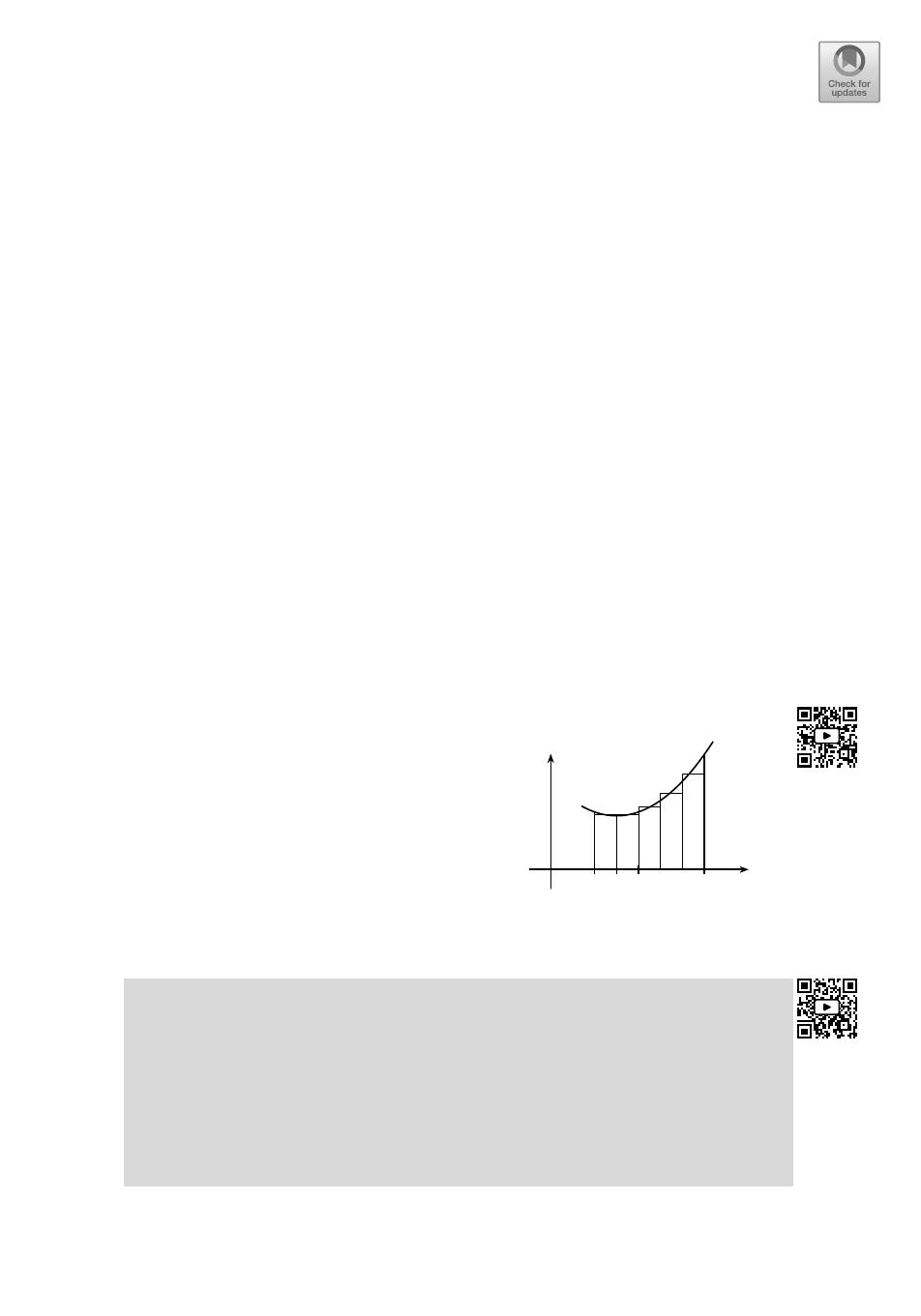
Motivation der Integralrechnung ist die
Berechnung der Fl
¨
ache unter einer Funk-
tion f :[a, b] R.
Dazu kann man die Fl
¨
ache durch Recht-
ecke approximieren. Die x-Achse wird da-
bei in kleine Abschnitte eingeteilt,
¨
uber
denen Rechtecke mit einer H
¨
ohe betrach-
tet werden, die in etwa der des Funktions-
grafen entspricht (s. Abb. 6.1).
x
0
x
n
a
b
...
x
1
x
2
f(x)
x
Abb. 6.1 Approximation der
Fl
¨
ache durch Rechtecke.
601
Definition 6.1.2 (Zerlegung)
Eine Zerlegung Z von [a, b] wird gebildet durch Stellen x
k
mit
a = x
0
<x
1
< ... <x
n1
<x
n
= b,
Δx
k
:= x
k
x
k1
ist die L
¨
ange des k-ten Teilintervalls,
ΔZ := max{Δx
1
, ..., Δx
n
} heißt Feinheit der Zerlegung.
119
© Springer-Verlag GmbH Deutschland, ein Teil von Springer Nature 2020
G. Hoever, Höhere Mathematik kompakt,
https://doi.org/10.1007/978-3-662-62080-9_6
120 6 Integralrechnung
Bemerkung 6.1.3 (
¨
aquidistante Zerlegung)
Oft nutzt man eine
¨
aquidistante Zerlegung, d.h., eine Zerlegung mit gleich
langen Teilintervallen. Dann ist Δx
k
=
ba
n
und x
k
= a + k ·
ba
n
.
Als H
¨
ohe des approximierenden Rechtecks in dem Intervall [x
k1
,x
k
]kann
man den Funktionswert an einer Zwischenstelle "x
k
[x
k1
,x
k
]nehmen.Der
Fl
¨
acheninhalt des Rechtecks ist dann f("x
k
) ·(x
k
x
k1
)=f("x
k
) ·Δx
k
.
602
Definition 6.1.4 (Riemannsche Zwischensumme)
Sei f :[a, b] R eine Funktion, Z = {x
0
,x
1
, ... ,x
n
} eine Zerlegung
von [a, b], und Zwischenstellen "x
k
[x
k1
,x
k
]gew
¨
ahlt. Dann heißt
S(f,Z, "x
k
):=
n
k=1
f("x
k
) ·Δx
k
Riemannsche Zwischensumme.
603
604
Bemerkung 6.1.5 (Ober- und Untersumme)
W
¨
ahlt man die Zwischenstellen "x
k
so, dass der Funktionswert f("x
k
)im
Intervall [x
k1
,x
k
] maximal bzw. minimal ist, so nennt man S(f, Z, "x
k
)
auch Obersumme bzw. Untersumme.
Definition 6.1.6 (Integral)
Eine Funktion f :[a, b] R ist integrierbar
: f
¨
ur jede Folge Z
n
von Zerlegungen mit lim
n→∞
ΔZ
n
= 0 und
entsprechend Z
n
gew
¨
ahlten Zwischenstellen "x
k
(n)
existiert
lim
n→∞
S
f,Z
n
, "x
k
(n)
.
Dieser Grenzwert wird dann mit
b
#
a
f(x)dx bezeichnet (
Integral von
a bis b
¨
uber f“).
Bemerkungen 6.1.7 zur Definition des Integrals
1. Ein Integral entsprechend Definition 6.1.6 heißt auch Riemann-Integral.
Andere Zug
¨
ange f
¨
uhren zu teils anderen Integralbegriffen, z.B. zum soge-
nannten Lebesgue-Integral.
Die Schreibweise erinnert an die Riemannsche Zwischensumme: Das Sum-
mensymbol
Σ wird zum Integralzeichen
#
und
Δx
k
“wirdzu
dx“.
6.1 Definition und elementare Eigenschaften 121
2. Statt der Integrationsvariablen x bei
b
#
a
f(x)dx kann man auch andere Be-
zeichner w
¨
ahlen, z.B.
b
#
a
f(t)dt.
3. Eine Riemannsche Zwischensumme kann man zur numerischen Berechnung
eines Integrals benutzen:
b
$
a
f(x)dx
n
k=1
f("x
k
) · Δx
k
.
4. Falls die Funktion f integrierbar ist, ist der Grenzwert der Zwischensummen
tats
¨
achlich eindeutig.
5. Statt die Konvergenz f
¨
ur jede Zerlegungsfolge zu verlangen, kann man In-
tegrierbarkeit auch definieren, indem man verlangt, dass bei einer Zerle-
gungsfolge Z
n
mit lim
n→∞
Z
n
= 0 der Grenzwert der Ober- und Untersummen
gleich ist.
605
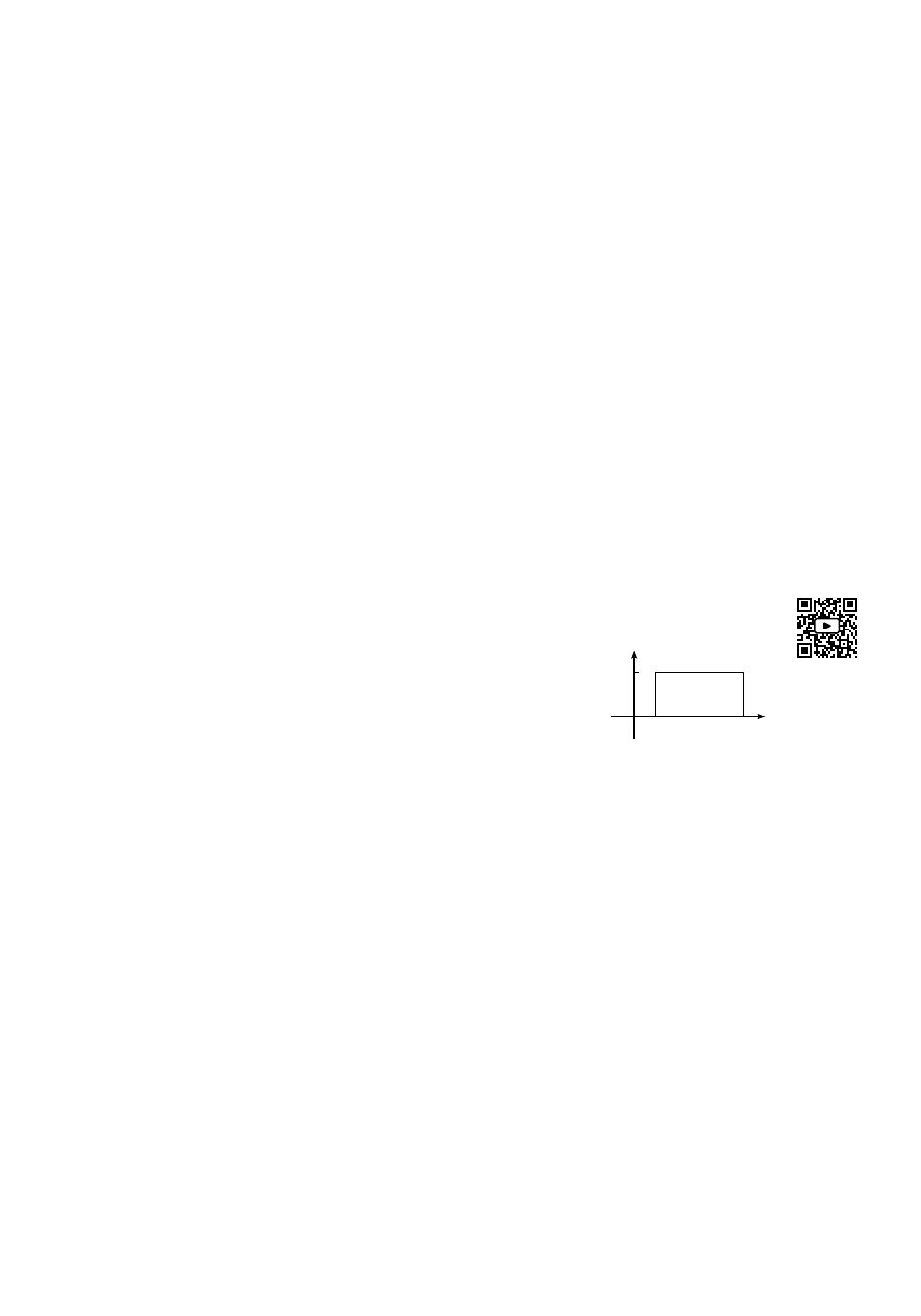
Beispiel 6.1.8
Betrachtet wird die konstante Funktion
f :[a, b] R,x→ c.
Sei Z =(x
0
,x
1
, ... ,x
n
) eine Zerlegung des In-
tervalls [a, b], also a = x
0
<x
1
< ... < x
n
= b,
und "x
k
[x
k1
,x
k
] entsprechende Zwischenstel-
len.
Dann gilt
a
b
c
f(x)
x
Abb. 6.2 Eine konstante
Funktion.
S (f,Z, "x
k
)=
n
k=1
f("x
k
) · Δx
k
=
n
k=1
c · (x
k
x
k1
)=c ·
n
k=1
(x
k
x
k1
)
= c ·
(x
1
x
0
)+(x
2
x
1
)+ ... +(x
n
x
n1
)
= c · (x
0
+ x
n
)
= c · (b a).
Die Riemannsche Zwischensumme ist also unabh
¨
angig von der konkreten
Zerlegung. Damit ist die Funktion f integrierbar mit
b
$
a
f(x)dx = c · (b a).
/ 22
End of Document
372
You May Also Like

FAQs of Integralrechnung by G. Hoever

What are Riemann sums and how are they used in integration?
Riemann sums are a method for approximating the area under a curve by dividing the interval into smaller subintervals and summing the areas of rectangles formed within those intervals. The height of each rectangle is determined by the value of the function at specific points within the subintervals. As the number of subintervals increases and their width decreases, the Riemann sum approaches the exact value of the integral, illustrating the concept of limits in calculus.
How does the Fundamental Theorem of Calculus connect differentiation and integration?
The Fundamental Theorem of Calculus establishes a profound connection between differentiation and integration, stating that if a function is continuous on an interval, then the integral of its derivative over that interval equals the net change in the function's values at the endpoints. This theorem allows for the evaluation of definite integrals through the use of antiderivatives, simplifying the process of finding areas under curves.
What techniques are covered for solving integrals in this text?
The text covers various techniques for solving integrals, including substitution, which simplifies integrals by changing variables, and partial integration, which is useful for integrating products of functions. Each technique is illustrated with examples and exercises, allowing students to practice and apply these methods effectively. Understanding these techniques is crucial for tackling more complex integrals encountered in advanced calculus.
What is the significance of integrability in calculus?
Integrability is a key concept in calculus that determines whether a function can be integrated over a given interval. A function is considered integrable if the limit of its Riemann sums exists as the partition of the interval becomes finer. This concept is essential for understanding the behavior of functions and their applications in real-world scenarios, such as calculating areas, volumes, and other physical quantities.
What examples are provided to illustrate the concepts of integral calculus?
The text includes numerous examples that illustrate the application of integral calculus concepts, such as calculating the area under curves, solving problems related to motion, and finding volumes of solids of revolution. Each example is designed to reinforce the theoretical concepts presented and provide practical insights into how integrals are used in various fields, including physics and engineering.

Related of Integralrechnung by G. Hoever