This document is a comprehensive lab guide focused on amino acids and their zwitterion structures. It covers chromatography techniques, Rf value calculations, and provides detailed analysis questions and answers. Ideal for students in general, organic, and biological chemistry courses.
/ 5

LAB 33: Amino Acids Analysis
Zwitterion Structures & Chromatography • General/Organic/Biological Chemistry
Part A: Amino Acid Zwitterion Structures
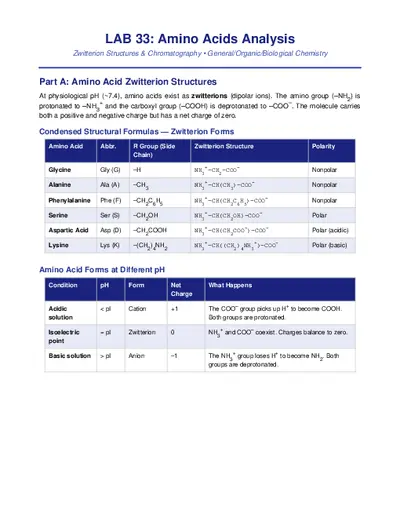
At physiological pH (~7.4), amino acids exist as zwitterions (dipolar ions). The amino group (–NH
2
) is
protonated to –NH
3
+
and the carboxyl group (–COOH) is deprotonated to –COO
–
. The molecule carries
both a positive and negative charge but has a net charge of zero.
Condensed Structural Formulas — Zwitterion Forms
Amino Acid Abbr. R Group (Side
Chain)
Zwitterion Structure Polarity
Glycine Gly (G) –H NH
3
+
–CH
2
–COO
–
Nonpolar
Alanine Ala (A) –CH
3
NH
3
+
–CH(CH
3
)–COO
–
Nonpolar
Phenylalanine Phe (F) –CH
2
C
6
H
5
NH
3
+
–CH(CH
2
C
6
H
5
)–COO
–
Nonpolar
Serine Ser (S) –CH
2
OH NH
3
+
–CH(CH
2
OH)–COO
–
Polar
Aspartic Acid Asp (D) –CH
2
COOH NH
3
+
–CH(CH
2
COO
–
)–COO
–
Polar (acidic)
Lysine Lys (K) –(CH
2
)
4
NH
2
NH
3
+
–CH((CH
2
)
4
NH
3
+
)–COO
–
Polar (basic)
Amino Acid Forms at Different pH
Condition pH Form Net
Charge
What Happens
Acidic
solution
< pI Cation +1 The COO
–
group picks up H
+
to become COOH.
Both groups are protonated.
Isoelectric
point
= pI Zwitterion 0 NH
3
+
and COO
–
coexist. Charges balance to zero.
Basic solution > pI Anion –1 The NH
3
+
group loses H
+
to become NH
2
. Both
groups are deprotonated.

Part B: Chromatography of Amino Acids
Paper chromatography separates amino acids based on their polarity and interaction with the stationary
phase (paper) and mobile phase (solvent). The R
f
value (retention factor) is calculated to identify each
amino acid.
R
f
Value Calculation
R
f
= Distance traveled by amino acid / Distance traveled by solvent front
Practice Problem:
A student calculated that the solvent front was 8.0 cm above the starting line. Arginine traveled 2.0 cm
and glycine traveled 4.0 cm. Calculate the R
f
values.
Answers:
Amino Acid Distance
Traveled
Solvent Front R
f
Calculation R
f
Value
Arginine 2.0 cm 8.0 cm 2.0 / 8.0 0.25
Glycine 4.0 cm 8.0 cm 4.0 / 8.0 0.50
Which amino acid traveled further? Why?
Glycine traveled further (4.0 cm vs. 2.0 cm). Glycine is a smaller, less polar amino acid with a
simple hydrogen side chain (–H), so it interacts less with the polar stationary phase (paper) and
moves more readily with the mobile solvent. Arginine is a larger, basic amino acid with a positively
charged guanidinium group in its side chain at neutral pH. This polar, charged side chain causes
stronger interactions with the polar paper, slowing its movement and resulting in a lower R
f
value.
Part C: Analysis Questions with Answers
Q1. What is a zwitterion?
A zwitterion is a molecule that contains both a positive charge and a negative charge on different
atoms but has an overall net charge of zero. In amino acids, the amino group is protonated (NH
3
+
)
and the carboxyl group is deprotonated (COO
–
). Zwitterions are also called dipolar ions or internal
salts.
Q2. Why do amino acids have high melting points compared to other organic compounds of
similar size?
Amino acids exist as zwitterions (internal salts) with strong electrostatic attractions between the
positive NH
3
+
and negative COO
–
groups of neighboring molecules. These ionic interactions are
much stronger than the van der Waals forces or hydrogen bonds found in similarly sized non-ionic
organic compounds, requiring more energy (higher temperature) to overcome.
Q3. Draw the structure of glycine in: (a) acidic solution, (b) neutral/zwitterion form, (c) basic
solution.


(a) Acidic solution (low pH): NH
3
+
–CH
2
–COOH → Net charge = +1 (both groups protonated)
(b) Zwitterion (at pI, ~pH 6.0): NH
3
+
–CH
2
–COO
–
→ Net charge = 0
(c) Basic solution (high pH): NH
2
–CH
2
–COO
–
→ Net charge = –1 (both groups deprotonated)
Q4. Write the zwitterion (ionized) form of phenylalanine.
NH
3
+
–CH(CH
2
C
6
H
5
)–COO
–
The amino group is protonated and the carboxyl group is deprotonated. The side chain is a benzyl
group (–CH
2
C
6
H
5
), which is nonpolar.
Loading document...
/ 5
Upload to Download
Every 3 documents you upload earns 1 download credit.
You have uploaded 0 documents. Upload 3 more to earn a download.
Upload Documents
End of Document
261
Report this document
Why are you reporting this content?
Embed document
* The code will be updated based on your changes.
Upload to Print
Every 3 documents you upload earns 1 print/download credit.
You have uploaded 0 documents. Upload 3 more to earn a credit.
Upload Documents