Locating Earthquake Epicenters via Triangulation PDF

Locating Earthquake Epicenters via Triangulation PDF

Locating earthquake epicenters using triangulation is essential for understanding seismic activity. This educational resource explains the process of identifying epicenters through the analysis of P-waves and S-waves. It provides mathematical formulas and step-by-step activities for students studying geology or earth science. The content is designed for Grade 10 science students, offering practical exercises to enhance their understanding of seismic waves and their implications for earthquake detection. Key concepts include the differences in wave arrival times and the triangulation method for pinpointing epicenter locations.

Key Points

  • Explains the triangulation method for locating earthquake epicenters.
  • Covers the differences between P-waves and S-waves in seismic activity.
  • Includes mathematical formulas for calculating distances to epicenters.
  • Provides activities for Grade 10 students to practice earthquake detection skills.

376
/ 16
RO_Science_Grade10_Q1_LP2
1
Science- Grade 10
Earthquake Epicenters Using Triangulation Method
I. INTRODUCTORY CONCEPT
Earthquakes are naturally occurring phenomena caused by the continuous
movement of the plates beneath us. Scientists are continuously observing its
behaviour and movement to identify its location. One of the ways that scientists use
in locating earthquake is by locating its epicentre using the triangulation method.
You have learned in your Grade 8 Science that an earthquake releases three
types of seismic waves; Primary (P-waves), Secondary (S-waves), and Long Surface
Waves (L-waves). The first two travel into the Earth’s interior while the last one
travels on the surface. These waves travel in different velocities; thus, does not
arrive at a seismic recording station at the same time. The farther the recording
instrument is from the focus, the greater the difference in arrival time that will tell us
the distance of the earthquake’s focus from the seismic recording station. The
difference in the arrival time will tell us the distance of the earthquake’s focus from
the seismic recording station.
Reference: Science 10 Learner’s Material page 7
II. LEARNING COMPETENCIES
Describe the distribution of Active Volcanoes, Earthquake Epicenters and
Major Mountain Belts (S10ES-Ia-j36.1)
Objectives:
1. Identify the different parts of the cross section of an earthquake;
2. Compute mathematically the distance of an epicenter; and
3. Locate the epicenter of an earthquake using the triangulation method.
III. ACTIVITIES
3.1 ELICIT:
Direction: Read the questions carefully. Choose the letter of the correct answer.
1. What is the study of earthquakes and seismic waves that move through and
around the earth?
A. Meteorology C. Seismology
B. Volcanology D. Geology
RO_Science_Grade10_Q1_LP2
2
2. Of the following seismic waves, which is caused by the sudden breaking of rock
within the earth?
A. Body wave C. Seismic wave
B. Primary wave D. Secondary wave
3. Which is the wave that can travel through the earth’s inner layer?
A. Body wave C. Seismic wave
B. Primary wave D. Secondary wave
4. Which of the following is the fastest type of seismic wave?
A. Body wave C. Seismic wave
B. Primary wave D. Secondary wave
5. What is the second wave that you can feel when there is an earthquake?
A. Body wave C. Seismic wave
B. Primary wave D. Secondary wave
3.2 ENGAGE:
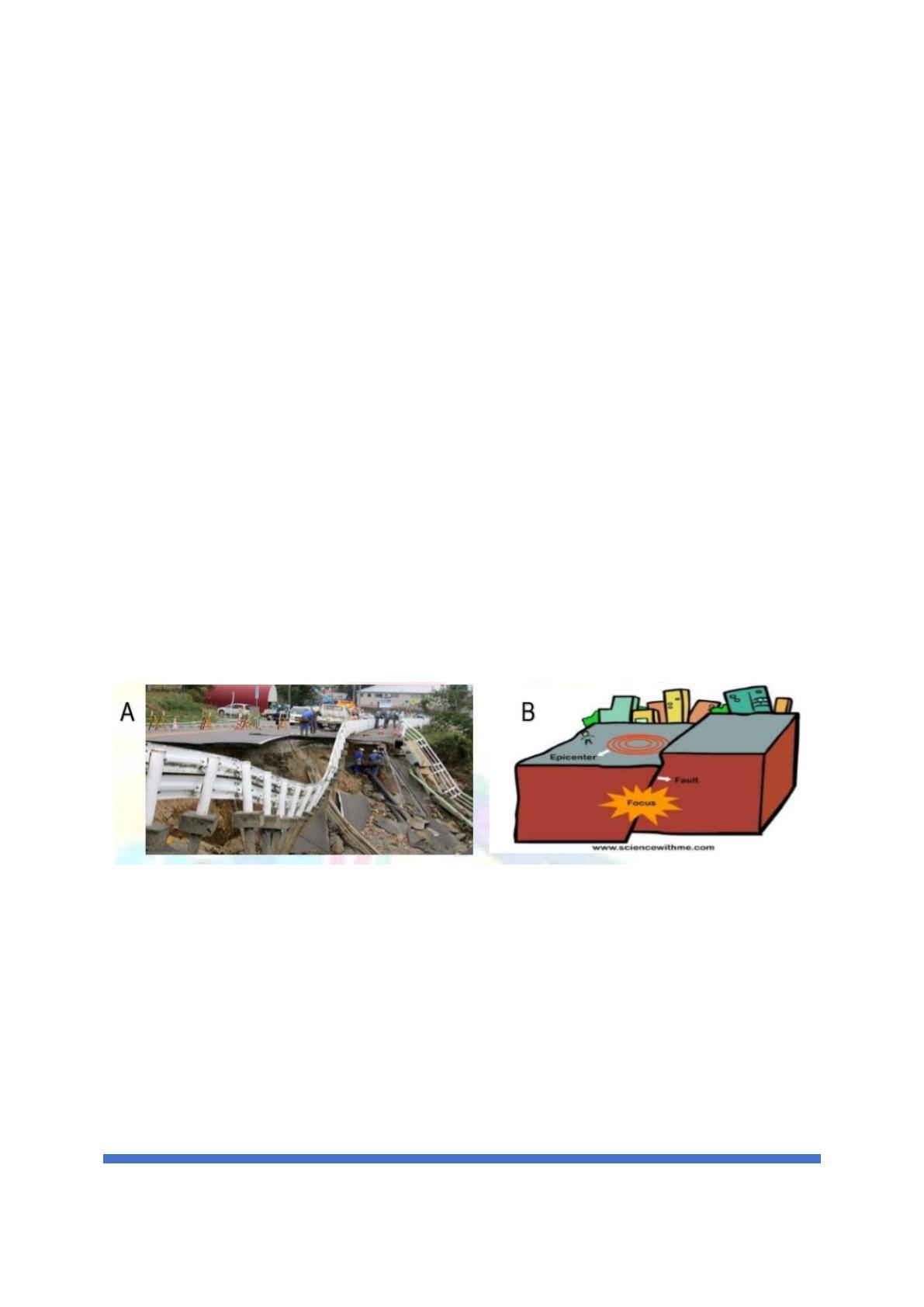
Activity 1: What’s on the Picture
Study the pictures.
1. What do you think is depicted in picture A? What is the cause of destruction?
___________________________________________________________________
___________________________________________________________________
2. Picture B is a graphical illustration of Picture A. From the label, what is the source
of this destruction?
___________________________________________________________________
___________________________________________________________________
RO_Science_Grade10_Q1_LP2
3
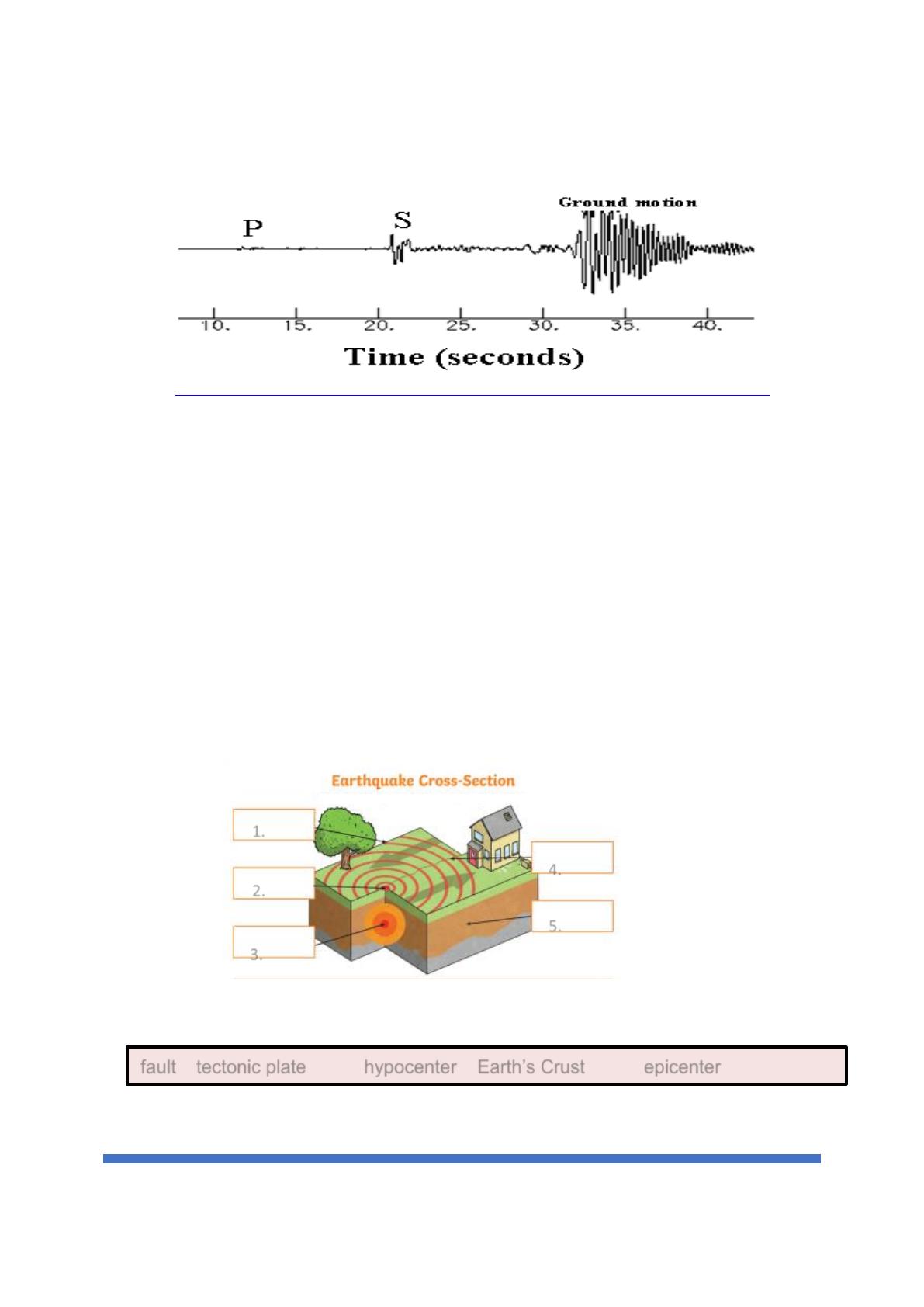
Activity 2: P & S Waves
Directions: Study the picture and answer the question.
Guide Questions:
1. Among the types of wave, which is detected first in the seismograph?
______________________________________________________________
______________________________________________________________
2. What is the interval between the P and S Waves?
______________________________________________________________
___________________________________________________________________
Activity 3: Inside the Earthquake
Directions: Identify the different parts of the cross section of an earthquake.
Choose your answer from the choices below.
https://en.wikinews.org/wiki/Research_articles_predict_next_earthquake#/media/File:Pwave.png
fault tectonic plate hypocenter Earth’s Crust epicenter
1.
2.
3.
4.
5.
/ 16
End of Document
376
You May Also Like

FAQs of Locating Earthquake Epicenters via Triangulation PDF

What is the triangulation method for locating earthquake epicenters?
The triangulation method involves using data from at least three seismic stations to determine the epicenter of an earthquake. Each station records the arrival times of P-waves and S-waves, and the differences in these times are used to calculate the distance from each station to the epicenter. By drawing circles around each station with radii equal to these distances, the point where the circles intersect indicates the location of the epicenter. This method is crucial for accurate earthquake monitoring and response.
How do P-waves and S-waves differ in their travel through the Earth?
P-waves, or primary waves, are compressional waves that travel fastest through the Earth, moving through both solid and liquid layers. In contrast, S-waves, or secondary waves, are shear waves that can only travel through solids, making them slower than P-waves. The difference in arrival times of these waves at seismic stations is critical for determining the distance to the earthquake's epicenter. Understanding these differences helps scientists analyze the Earth's internal structure and the dynamics of seismic events.
What activities are included to help students understand earthquake detection?
The resource includes several hands-on activities designed for Grade 10 students to practice locating earthquake epicenters. Students engage in exercises that involve calculating lag times between P-wave and S-wave arrivals, using mathematical formulas to determine distances, and applying the triangulation method to map out epicenters. These activities not only reinforce theoretical knowledge but also provide practical skills in analyzing seismic data, essential for future studies in geology and earth sciences.

Related of Locating Earthquake Epicenters via Triangulation PDF