Nixon’s Decision to End the Gold Standard

Nixon's Decision to End the Gold Standard

Nixon's decision to end the Gold Standard in 1971 marked a pivotal moment in U.S. economic policy, transitioning the country from a gold-backed currency to a fiat system. This change allowed for greater government control over the money supply, impacting inflation and trade dynamics. The paper analyzes the economic challenges Nixon faced, including rising inflation and trade deficits, and how the abandonment of the Gold Standard affected both domestic and international markets. It also discusses the long-term implications of this decision on monetary policy and economic stability, making it essential reading for students of economics and history.

Key Points

  • Analyzes Nixon's 1971 decision to abandon the Gold Standard and its economic implications.
  • Explains how the shift to fiat currency allowed for greater flexibility in monetary policy.
  • Discusses the immediate effects on inflation and U.S. trade competitiveness.
  • Examines the long-term impact on global currency markets and economic management.
76
/ 4
Adriana Rodriguez
Prof. Peter Casella
Case Study Analysis: Gold Standard
January 18, 2026
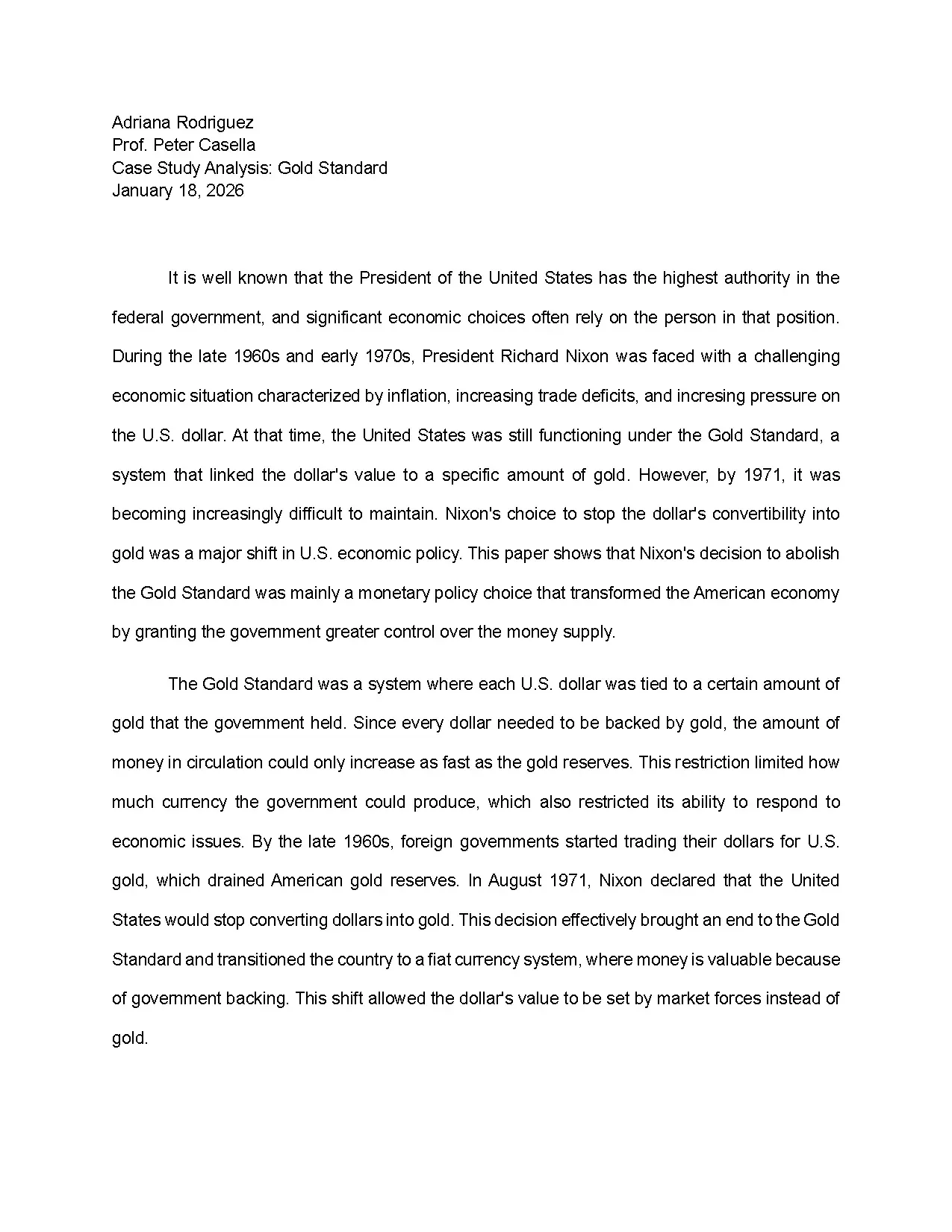
It is well known that the President of the United States has the highest authority in the
federal government, and significant economic choices often rely on the person in that position.
During the late 1960s and early 1970s, President Richard Nixon was faced with a challenging
economic situation characterized by inflation, increasing trade deficits, and incresing pressure on
the U.S. dollar. At that time, the United States was still functioning under the Gold Standard, a
system that linked the dollar's value to a specific amount of gold. However, by 1971, it was
becoming increasingly difficult to maintain. Nixon's choice to stop the dollar's convertibility into
gold was a major shift in U.S. economic policy. This paper shows that Nixon's decision to abolish
the Gold Standard was mainly a monetary policy choice that transformed the American economy
by granting the government greater control over the money supply.
The Gold Standard was a system where each U.S. dollar was tied to a certain amount of
gold that the government held. Since every dollar needed to be backed by gold, the amount of
money in circulation could only increase as fast as the gold reserves. This restriction limited how
much currency the government could produce, which also restricted its ability to respond to
economic issues. By the late 1960s, foreign governments started trading their dollars for U.S.
gold, which drained American gold reserves. In August 1971, Nixon declared that the United
States would stop converting dollars into gold. This decision effectively brought an end to the Gold
Standard and transitioned the country to a fiat currency system, where money is valuable because
of government backing. This shift allowed the dollar's value to be set by market forces instead of
gold.
The effects of ending the Gold Standard showed quickly. In the short run, the dollar
decreased in value against other currencies, making American exports cheaper and more
competitive internationally. Nixon also implemented temporary wage and price controls to slow
down inflation, which helped keep prices stable for a short time. However, these controls were
not permanent, and more serious economic problems soon emerged.
On the other hand, this time was characterized because of significant inflation. But, with
gold no longer restricting the money supply, the government and the Federal Reserve had more
freedom to increase the money in circulation. The Federal Reserve was able to adjust interest
rates more effectively and react to economic downturns. Global currency markets also grew, as
exchange rates were no longer tied to gold. Over time, the federal government gained better
control over the money supply, which eventually helped to stabilize inflation in the 1980s and so
on.
During these times inflation was rising, Vietnam War spending and domestic programs.
The U.S. gold reserves were shrinking as foreign governments traded their dollars for gold,
threatening the stability of the entire system. The country also faced balance-of-payments
problems, meaning it was importing more than it was exporting. These were some problems that
led to Nixon ending the Gold Standard. He saw it as a way to protect U.S. gold reserves and
regain control over the economy. The decision affected many groups. American consumers felt
the impact through rising prices in the years that followed. Foreign governments had to adjust to
a new global financial system where the dollar was no longer tied to gold. Banks and investors
had to adapt to floating exchange rates and new risks in currency markets
Fiscal policy is about how the government spends money and sets taxes, and this is
overseen by Congress. Monetary policy, in contrast, focuses on the money supply and interest
rates, which are handled by the Federal Reserve. Nixon’s choice to abandon the Gold Standard

was definitely a monetary policy move because it altered the way the money supply could be
regulated.
In the long run, ending the Gold Standard can be seen as a beneficial decision. Although
the 1970s brought high inflation and economic uncertainty, the flexibility of a fiat currency
eventually allowed the United States to respond more effectively to recessions, financial crises,
and global economic changes. The ability to adjust interest rates and influence the money supply
has become a central tool for stabilizing the economy. While the Gold Standard provided
discipline, it also limited economic growth and made it harder to respond to emergencies.
Overall, Nixon’s decision to end the Gold Standard marked a major shift in American
economic policy and demonstrated the power of presidential leadership in times of crisis. Although
the change created short-term challenges, it ultimately gave the United States better and smarter
control over its monetary system and allowed for more responsive economic management. The
long-term effects of the decision continue to shape the modern economy, showing how one
top-level decision can influence financial policy for decades.
/ 4
End of Document
76
You May Also Like

FAQs of Nixon’s Decision to End the Gold Standard

What were the main reasons Nixon ended the Gold Standard?
Nixon ended the Gold Standard primarily due to mounting economic pressures, including rising inflation and trade deficits. By the late 1960s, foreign governments were exchanging their dollars for U.S. gold, depleting American gold reserves. This situation threatened the stability of the dollar and the U.S. economy. Nixon's decision aimed to protect these reserves and regain control over monetary policy, allowing for a more flexible response to economic challenges.
How did ending the Gold Standard affect inflation in the U.S.?
The end of the Gold Standard initially led to a decrease in the dollar's value against other currencies, which made American exports cheaper and more competitive. However, without the constraints of gold backing, the government increased the money supply, contributing to higher inflation rates in the 1970s. While Nixon implemented temporary wage and price controls to stabilize prices, these measures were not sustainable, leading to ongoing economic challenges.
What is the significance of transitioning to a fiat currency system?
Transitioning to a fiat currency system allowed the U.S. government and the Federal Reserve to have greater control over the money supply and interest rates. This flexibility enabled more effective responses to economic downturns and financial crises. Over time, the ability to adjust monetary policy became crucial for stabilizing the economy, particularly during periods of inflation and recession, demonstrating the importance of Nixon's decision in shaping modern economic management.
What were the short-term effects of Nixon's decision on the economy?
In the short term, Nixon's decision to end the Gold Standard led to a depreciation of the dollar, which made U.S. exports more competitive internationally. The implementation of wage and price controls temporarily stabilized prices. However, these measures were short-lived, and the economy soon faced significant inflation and other challenges as the government adjusted to the new fiat currency system.

Related of Nixon’s Decision to End the Gold Standard