Pakistan Studies Multiple Choice Questions provide comprehensive coverage of key topics related to the society, culture, and history of Pakistan. This resource includes questions on cultural diversity, regional festivals, social stratification, and constitutional development. Ideal for students preparing for exams or anyone interested in understanding Pakistan's unique cultural landscape. The document also features questions on sports, citizenship, foreign policy, and international organizations, making it a valuable study aid for a variety of educational contexts.

Key Points

  • Includes multiple-choice questions on Pakistani culture and society.
  • Covers topics such as social stratification and regional festivals.
  • Features questions on Pakistan's constitutional development and foreign policy.
  • Ideal for students preparing for exams in Pakistan Studies.
Usman Haider
9 pages
Language:English
Type:Study Guide
Usman Haider
9 pages
Language:English
Type:Study Guide
123
/ 9
# Multiple Choice Questions (Units 01–06)
## Unit 01: Society and Culture of Pakistan
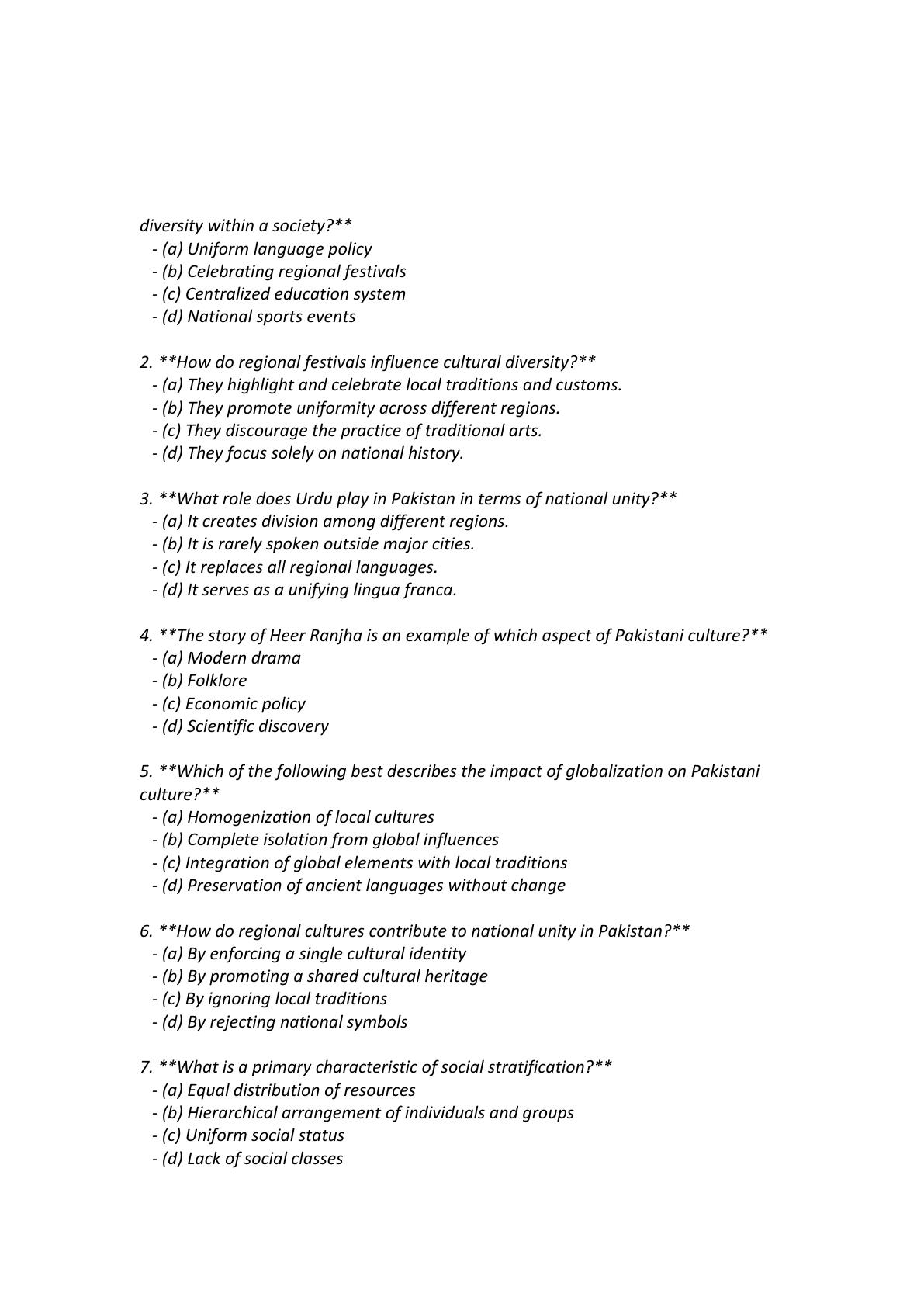
1. **Which of the following cultural elements can most directly promote cultural
diversity within a society?**
- (a) Uniform language policy
- (b) Celebrating regional festivals
- (c) Centralized education system
- (d) National sports events
2. **How do regional festivals influence cultural diversity?**
- (a) They highlight and celebrate local traditions and customs.
- (b) They promote uniformity across different regions.
- (c) They discourage the practice of traditional arts.
- (d) They focus solely on national history.
3. **What role does Urdu play in Pakistan in terms of national unity?**
- (a) It creates division among different regions.
- (b) It is rarely spoken outside major cities.
- (c) It replaces all regional languages.
- (d) It serves as a unifying lingua franca.
4. **The story of Heer Ranjha is an example of which aspect of Pakistani culture?**
- (a) Modern drama
- (b) Folklore
- (c) Economic policy
- (d) Scientific discovery
5. **Which of the following best describes the impact of globalization on Pakistani
culture?**
- (a) Homogenization of local cultures
- (b) Complete isolation from global influences
- (c) Integration of global elements with local traditions
- (d) Preservation of ancient languages without change
6. **How do regional cultures contribute to national unity in Pakistan?**
- (a) By enforcing a single cultural identity
- (b) By promoting a shared cultural heritage
- (c) By ignoring local traditions
- (d) By rejecting national symbols
7. **What is a primary characteristic of social stratification?**
- (a) Equal distribution of resources
- (b) Hierarchical arrangement of individuals and groups
- (c) Uniform social status
- (d) Lack of social classes

8. **How does social stratification lead to social inequality?**
- (a) By providing equal opportunities to all
- (b) By creating economic and social disparities
- (c) By ensuring equal distribution of wealth
- (d) By eliminating class distinctions
## Unit 02: Recreation – Sports
1. **What is a primary benefit of engaging in leisure activities?**
- (a) Increased stress levels
- (b) Improved physical health
- (c) Decreased social interaction
- (d) Reduced cognitive functions
2. **How do leisure activities contribute to community building?**
- (a) By promoting isolation
- (b) By reducing social bonds
- (c) By fostering social cohesion and community engagement
- (d) By increasing work-related stress
3. **Which traditional game is played using a small wooden stick and a larger
stick?**
- (a) Kabaddi
- (b) Gilli-Danda
- (c) Cricket
- (d) Hockey
4. **What mental health benefit is associated with leisure activities?**
- (a) Increased anxiety
- (b) Improved emotional well-being
- (c) Decreased self-esteem
- (d) Increased cognitive decline
5. **Which Pakistani boxer won a bronze medal at the 1988 Seoul Olympics?**
- (a) Muhammad Waseem
- (b) Hussain Shah
- (c) Kaleemullah Khan
- (d) Ahsan Ramzan
6. **How do sports contribute to the physical fitness of individuals?**
- (a) By promoting sedentary lifestyles
- (b) By reducing physical activity levels
- (c) By increasing the risk of chronic diseases
- (d) By enhancing cardiovascular health and muscle strength
7. **In which sport did Muhammad Asif win the World Championship?**
- (a) Football
- (b) Cricket
- (c) Squash
- (d) Snooker
8. **What is a key social benefit of participating in team sports?**
- (a) Enhancing teamwork and cooperation
- (b) Promoting individualism
- (c) Decreasing communication skills
- (d) Reducing social interaction
9. **What traditional sport involves grappling and is particularly popular in rural
Punjab and Sindh?**
- (a) Hockey
- (b) Football
- (c) Wrestling
- (d) Tennis
10. **Arshad Nadeem is famous for which sport?**
- (a) Kabaddi
- (b) Javelin Throw
- (c) Wrestling
- (d) Snooker
## Unit 03: Constitutional Development
1. **How did the inclusion of representatives from regions like Balochistan, Tribal
Areas, Bahawalpur, and Khairpur impact the Constituent Assembly of Pakistan?**
- (a) It ensured a more inclusive and representative constitution-drafting process.
- (b) It complicated the legislative process due to increased regional conflicts.
- (c) It delayed the formation of the assembly due to logistical challenges.
- (d) It strengthened central authority by reducing regional autonomy.
2. **What is the significance of the Objectives Resolution in Pakistan’s constitutional
history?**
- (a) It established Urdu as the national language.
- (b) It laid down foundational principles for Pakistan’s future constitution.
- (c) It proposed a presidential system of governance.
- (d) It resolved the political issues.
3. **Which document served as a preamble in the constitutions of Pakistan?**
- (a) Lahore Resolution
- (b) Two-Nation Theory
- (c) Objectives Resolution
- (d) Bogra Formula
4. **How was the Second Constituent Assembly of Pakistan formed?**
- (a) Through direct elections by the people of East and West Pakistan
- (b) By appointment of members by the Governor-General
- (c) Indirectly elected by provincial legislatures of East and West Pakistan
/ 9
End of Document
123
You May Also Like

FAQs of Pakistan Studies Multiple Choice Questions and Answers

What topics are covered in the Pakistan Studies questions?
The Pakistan Studies Multiple Choice Questions cover a wide range of topics including cultural diversity, regional festivals, social stratification, and constitutional development. Additionally, it addresses sports, citizenship, foreign policy, and the role of international organizations. This comprehensive approach helps students grasp the complexities of Pakistan's society and history.
How can these questions help students prepare for exams?
These multiple-choice questions are designed to reinforce key concepts and themes in Pakistan Studies. By practicing with these questions, students can identify areas where they need further study and gain confidence in their understanding of the material. This resource serves as an effective tool for exam preparation and self-assessment.
What is the significance of regional festivals in Pakistan?
Regional festivals in Pakistan play a crucial role in promoting cultural diversity and unity. They celebrate local traditions and customs, allowing communities to express their unique identities while fostering a sense of belonging. These festivals also contribute to social cohesion and help preserve cultural heritage, making them an essential aspect of Pakistani society.
What role does social stratification play in Pakistan?
Social stratification in Pakistan creates a hierarchical arrangement of individuals and groups, leading to economic and social disparities. Understanding this concept is vital for analyzing issues related to inequality and access to resources within the country. The study of social stratification helps illuminate the complexities of Pakistan's social fabric.
How does globalization impact Pakistani culture?
Globalization has a significant impact on Pakistani culture, leading to both the homogenization of local traditions and the integration of global elements. While some argue that it threatens cultural diversity, others believe it offers opportunities for cultural exchange and enrichment. This duality makes the study of globalization's effects on Pakistan particularly relevant.

Related of Pakistan Studies Multiple Choice Questions and Answers