Sheetmetal Design Interview Questions

Sheetmetal Design Interview Questions

This document is a comprehensive guide on sheetmetal design interview questions, covering essential topics such as bending allowances, K-factor, and surface finish operations. It serves as a valuable resource for candidates preparing for interviews in the sheetmetal fabrication industry.

285
/ 4
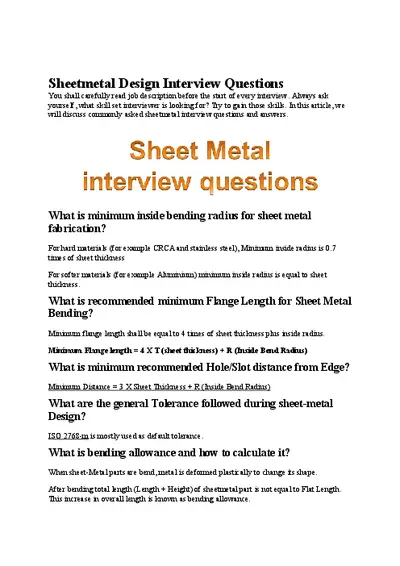
Sheetmetal Design Interview Questions
You shall carefully read job description before the start of every interview. Always ask
yourself, what skill set interviewer is looking for? Try to gain those skills. In this article, we
will discuss commonly asked sheetmetal interview questions and answers.
What is minimum inside bending radius for sheet metal
fabrication?
For hard materials (for example CRCA and stainless steel), Minimum inside radius is 0.7
times of sheet thickness
For softer materials (for example Aluminium) minimum inside radius is equal to sheet
thickness.
What is recommended minimum Flange Length for Sheet Metal
Bending?
Minimum flange length shall be equal to 4 times of sheet thickness plus inside radius.
Minimum Flange length = 4 X T (sheet thickness) + R (Inside Bend Radius)
What is minimum recommended Hole/Slot distance from Edge?
Minimum Distance = 3 X Sheet Thickness + R (Inside Bend Radius)
What are the general Tolerance followed during sheet-metal
Design?
ISO 2768-m is mostly used as default tolerance.
What is bending allowance and how to calculate it?
When sheet-Metal parts are bend, metal is deformed plastically to change its shape.
After bending total length (Length + Height) of sheetmetal part is not equal to Flat Length.
This increase in overall length is known as bending allowance.
Flat Length = Length + Height – Bend Deduction
Calculation of bending allowance
What is K-factor in sheet metal fabrication?
K-Factor is a constant factor, used to calculate the flat pattern using CAD software’s.
Value of k-factor depends on material, Bend radius, sheet thickness and machines
used.
Mathematically K-Factor is a ratio of position of neutral axis and sheet
thickness.Value of K-factor is always less than 0.5
What is Y-Factor in Sheet metal?
Y-factor is similar to y factor. It is used to calculate flat pattern of sheetmetal parts:
What are sheet metal surface finish operations ?
Following are commonly used sheet metal surface finish operations:
Pre-Treatment : Phosphate Conversion Coating, Chromate Conversion Coating,
Derusting, Descaling
Powder Coating
Anodising
Plating: Zn Plating/Galvanising, Tin plating, Silver plating
What are design parameters need to be considered for the
selection of sheet metal material?
Following parameters are considered during material selection:
Product IP-Rating
Working Temperature
Corrosion Resistance
Required Part Strength
Part Weight constraints
Final Finish operation
Part joining Methods (Riveting/Welding/Screw)
What are the reinforcement techniques used to improve
strength of sheetmetal parts?
Reinforcement techniques are used to increase sheetmetal strength in localized section.
Various Reinforcement Techniques are:
Bending: Bending in direction 90 degree to load applied, hem bend
Forming tools: sheet-metal rib, louver, lance & Tab
What is a press tool and why it is used in sheetmetal ?
Press tools are used in hydraulic, pneumatic & mechanical presses to produce stamped sheet-
metal parts.
Press tools can be classified based on operation: blanking, piercing, bending and forming.
What is the difference between progressive, compound &
combination tools?
What is stamping operation?
Stamping is a process of shaping sheet-metal parts using press tool.
Blanking, punching, pressing, piercing, bending and forming operations are done with
stamping dies.
What are various types of sheetmetal operations?
Various types of sheetmetal operation includes cutting, forming, joining and final finish
operations:
Sheet metal Cutting operations: Punching, Piercing,Perforation, Cutting off, Parting
off, Dinking, Trimming, Shaving, Shearing, Notching etc
Material Removal Operations: Deburring, Grinding
Sheetmetal Forming: Straight bend, Angle bend, Hem bend
Material Joining Operations: Welding (Tig, MIG, GAS Welding), Riveting,
Folding, Screws
Final Finish Operations: Passivation, Chromate Conversion Coating, Plating,
powder Coating
What are various sheet-metal assembly operations?

/ 4
End of Document
285

You May Also Like

Related of Sheetmetal Design Interview Questions