Smart System Automation Unit 1 Notes

Smart System Automation Unit 1 Notes

This document is a comprehensive set of notes for Unit 1 of Smart System Automation. It covers key concepts related to smart systems, including hardware and software selection, smart sensors, actuators, and communication protocols. The content is structured to provide an overview of smart systems, detailing their components such as data processing, knowledge storage, and artificial intelligence. It also discusses the importance of sensor technology and the role of actuators in smart systems. Additionally, the document highlights various communication protocols used in smart systems, both wired and wireless. This resource serves as a valuable study guide for students and professionals interested in the field of automation and smart technology.

187
/ 21
EC3V36 Smart System Automation Unit I Introduction
1
UNIT I INTRODUCTION
Overview of a smart system - Hardware and software selection - Smart sensors and Actuators -
Communication protocols used for smart systems.
Overview of a smart system:
Smart Systems are a key driving force for a range of rapidly emerging intelligent and autonomous
systems and objects such as self-driving cars, artificial pancreas, Internet of Things (IoT), M2M-enabled
advanced manufacturing robots or wearable health monitors.
Smart Systems are miniaturised systems, combining data processing with multi-modal (optical, biological,
mechanical) sensing, actuation and communication functions.
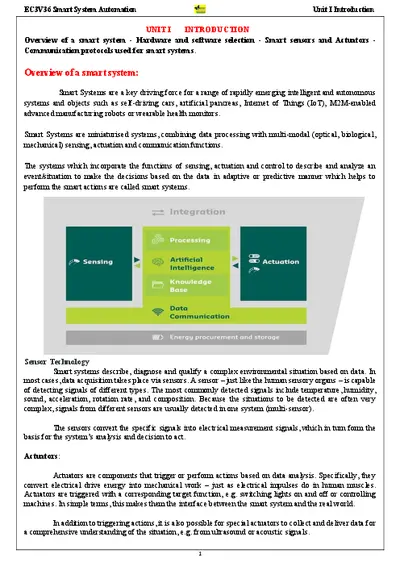
The systems which incorporate the functions of sensing, actuation and control to describe and analyze an
event/situation to make the decisions based on the data in adaptive or predictive manner which helps to
perform the smart actions are called smart systems.
Sensor Technology
Smart systems describe, diagnose and qualify a complex environmental situation based on data. In
most cases, data acquisition takes place via sensors. A sensor just like the human sensory organs is capable
of detecting signals of different types. The most commonly detected signals include temperature, humidity,
sound, acceleration, rotation rate, and composition. Because the situations to be detected are often very
complex, signals from different sensors are usually detected in one system (multi-sensor).
The sensors convert the specific signals into electrical measurement signals, which in turn form the
basis for the system’s analysis and decision to act.
Actuators:
Actuators are components that trigger or perform actions based on data analysis. Specifically, they
convert electrical drive energy into mechanical work just as electrical impulses do in human muscles.
Actuators are triggered with a corresponding target function, e.g. switching lights on and off or controlling
machines. In simple terms, this makes them the interface between the smart system and the real world.
In addition to triggering actions, it is also possible for special actuators to collect and deliver data for
a comprehensive understanding of the situation, e.g. from ultrasound or acoustic signals.
EC3V36 Smart System Automation Unit I Introduction
2
Data Processing, Knowledge Storage and Artificial Intelligence:
The reason why we talk about “smart” systems today is because of the way they handle the
information they acquire. This is because the information processing processes are increasingly similar to
those in the human brain. Through the use of artificial intelligence (AI) and machine learning algorithms,
smart systems have the potential to recognize complex facts even faster and better than humans themselves.
To achieve this, the processing of measurement data is a crucial prerequisite. In this context, data
processing encompasses the various processes of data analysis from data preprocessing, data transmission
and calculation of variables to comparison with threshold and limit values.
In this process, known correlations, algorithms, rules and data for decision-making are used, which
are stored in a knowledge store or database. This database also collects sensor data, historical data, or user
information that can also be accessed in the decision-making process.
Depending on the application, data analysis is increasingly possible using artificial intelligence
methods. AI helps the system to learn, to recognize complex relationships, to make predictions and to
continuously improve its decisions and actions.
Only smart systems are thus able to describe, diagnose and qualify their environment in a given
complex situation, make predictions or decisions and take appropriate actions.
In order for them to be able to do this, other components are essential for the functionality of the
smart system in addition to data acquisition, analysis and decision-making.
Components:
In a smart system there are basic modules without which the system cannot function. These can be
compared to the human body, which simply cannot exist without nourishment (energy = power supply) and
which possesses or produces nerve pathways, receptors, messenger substances, etc. that act as data interfaces
between the eye, brain and hand (data transfer). All of these elements must exist within a body in order to
function together (integration).
Translated into smart systems, this means the following:
Communication: enables the exchange of data and information between different components of the system.
It typically involves multiple layers of technologies and protocols to ensure that data can be exchanged
effectively and securely. At the innermost level, this often happens by wire. In the communication from system
to system or to the environment, various wireless network technologies such as WLAN, Bluetooth or ZigBee
are often used.
There is also a wide variety of protocols in the transmission of data from sensors and actuators. For example,
protocols such as MQTT or CoAP are used for the transmission of data between system components.
The power supply (energy supply): is a critical component of a smart system, since the system cannot
function without energy. Since smart systems are often operated for long periods of time, they must be able
to use energy efficiently to keep operating costs low. An efficient power supply can thus also help reduce the
carbon footprint of the system itself. In addition to a stationary power supply, rechargeable batteries and
energy harvesters are other interesting options.
Integration: describes both the so-called packaging of the various components and modules in a system and
the interaction within the smart system that ultimately makes it effective and efficient. Integration is possible
at the hardware, software and data levels.
Hardware integration: Packaging is an integration on hardware level and addresses topics such as 3D
integration, integration on chip and wafer level, integration of components made of different materials or
integration of optical components. In addition to classical packaging processes, innovative processes are
developed and transferred into use. These include processes for joining wafers near room temperature.
Software integration: This takes place on the one hand in the smart system, but also in the integration of
different smart systems into a system of systems. An example is the cooperation between a smart home and a
security system.

EC3V36 Smart System Automation Unit I Introduction
3
Data integration: In data integration, data from different sources is merged in real time. Often, due to the
sheer volume of data, artificial intelligence is used for analysis.
Technology Enablers for Smart Systems
Big Data Analytics: The large amount of data being generated by the connected devices can be processed
with AI tools, technologies, and algorithms to predict and prescribe. These models have become more
specialized and are becoming more sophisticated in nature
The Internet of Things (IoT): The smart system needs a setup of connected devices, comprising sensors and
monitors to monitor smooth functioning of processes and devices so as to predict problems/failures in advance
and take corrective actions before any serious malfunctions.
Cloud Computing: The cloud provides unlimited online storage, and powerful services such as SaaS, PaaS,
IaaS, and recently AaaS. Smart systems cannot sustain without cloud storage, which is a major requirement
for its effective implementation and availability of data on the go, meaning anytime, anywhere accessibility
to the stored data.
Augmented Reality (AR)/Virtual Reality (VR)/Extended Reality (ER): AR/VR technologies can be used
in providing information and experiences to its users virtually. AR is a mixture of a real as well as an imaginary
world. Whilst the other technologies are considered as "back-end" technologies working in the background
and hidden from view, AR/VR/ER are the interfaces that provide access to all the benefits of a smart system.
Blockchain: Blockchain technology, which is a decentralized ledger of all transactions across a peer-to-peer
network, assures that participants can confirm transactions without the need for a central certifying authority.
5G Networks: 5G communication technologies are all set to enhance the carrier bandwidths and
correspondingly the network speeds to support seamless transmission of data and provisioning of network
services to users in all dynamic and pervasive environments.
/ 21
End of Document
187

You May Also Like

Related of Smart System Automation Unit 1 Notes