Superman And Me Annotation Notes

Superman And Me Annotation Notes

This document contains annotation notes for Sherman Alexie’s autobiographical essay ‘Superman and Me’. It explores themes of literacy, cultural expectations, and the transformative power of reading, particularly within Native American communities. The structured analysis includes paragraph summaries, rhetorical devices, and key themes, making it a valuable study guide.

222
/ 6
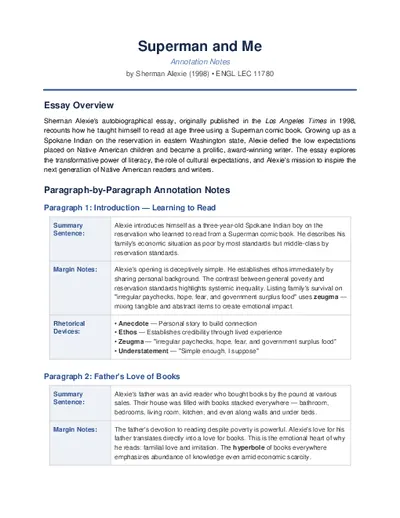
Superman and Me
Annotation Notes
by Sherman Alexie (1998) • ENGL LEC 11780
Essay Overview
Sherman Alexie's autobiographical essay, originally published in the Los Angeles Times in 1998,
recounts how he taught himself to read at age three using a Superman comic book. Growing up as a
Spokane Indian on the reservation in eastern Washington state, Alexie defied the low expectations
placed on Native American children and became a prolific, award-winning writer. The essay explores
the transformative power of literacy, the role of cultural expectations, and Alexie's mission to inspire the
next generation of Native American readers and writers.
Paragraph-by-Paragraph Annotation Notes
Paragraph 1: Introduction — Learning to Read
Summary
Sentence:
Alexie introduces himself as a three-year-old Spokane Indian boy on the
reservation who learned to read from a Superman comic book. He describes his
family's economic situation as poor by most standards but middle-class by
reservation standards.
Margin Notes: Alexie's opening is deceptively simple. He establishes ethos immediately by
sharing personal background. The contrast between general poverty and
reservation standards highlights systemic inequality. Listing family's survival on
"irregular paychecks, hope, fear, and government surplus food" uses zeugma
mixing tangible and abstract items to create emotional impact.
Rhetorical
Devices:
Anecdote — Personal story to build connection
Ethos — Establishes credibility through lived experience
Zeugma — "irregular paychecks, hope, fear, and government surplus food"
Understatement — "Simple enough, I suppose"
Paragraph 2: Father's Love of Books
Summary
Sentence:
Alexie's father was an avid reader who bought books by the pound at various
sales. Their house was filled with books stacked everywhere — bathroom,
bedrooms, living room, kitchen, and even along walls and under beds.
Margin Notes: The father's devotion to reading despite poverty is powerful. Alexie's love for his
father translates directly into a love for books. This is the emotional heart of why
he reads: familial love and imitation. The hyperbole of books everywhere
emphasizes abundance of knowledge even amid economic scarcity.

Rhetorical
Devices:
Hyperbole — Exaggerated description of books everywhere
Pathos — "I loved my father with an aching devotion"
Imagery — Vivid picture of books stacked in every room
Catalog/List — Genres the father read (westerns, spy thrillers, mysteries, etc.)
Paragraph 3: Understanding Paragraphs
Summary
Sentence:
Before he could even say the word "paragraph," Alexie understood that a
paragraph was like a fence holding words together for a common purpose. He
began seeing everything around him in terms of paragraphs — the reservation,
his house, his family members.
Margin Notes: This is the key extended metaphor of the essay. The paragraph-as-fence
metaphor shows how Alexie's mind worked even at age three — organizing the
world into comprehensible structures. He sees his family as an "essay of seven
paragraphs," each member a separate paragraph linked by genetics and shared
experience. This is remarkably sophisticated thinking for a small child.
Rhetorical
Devices:
Extended Metaphor — Paragraph = fence; family = essay; reservation =
paragraph within the U.S.
Analogy — Connecting abstract literacy concepts to concrete, everyday
objects
Logos — Logical progression of his reasoning process
Paragraph 4: The Superman Comic Book
Summary
Sentence:
He applied his paragraph idea to a Superman comic, treating each panel as a
three-dimensional paragraph. By looking at pictures of Superman breaking
through a door and pretending to read the words aloud, he actually taught
himself to read.
Margin Notes: This is the pivotal moment. The act of "pretending to read" becoming actual
reading is profound. It shows how desire and imagination can bridge the gap to
literacy. Superman breaking down doors becomes the essay's central symbol
— Alexie will later break down metaphorical doors through education. Makes me
think about how powerful visual storytelling is as a gateway to literacy.
Rhetorical
Devices:
Symbolism — Superman breaking the door = breaking barriers to literacy and
success
Imagery — "His suit is red, blue, and yellow. The brown door shatters"
Repetition — "I pretend to read..." repeated to show the learning process
Foreshadowing — The door-breaking motif returns at the essay's end
Paragraph 5: The Prodigy Who Wasn't Called One
Summary
Sentence:
Alexie advanced rapidly as a reader, tackling complex novels in kindergarten
while classmates struggled with basic readers. However, because he was an
Indian boy on the reservation, he was not called a prodigy — he was seen as
"odd" or a "strange" anomaly.
Margin Notes: This makes me angry. He was a genius but was called "odd" because of racism
and low expectations. The contrast between what he would have been called if
he were non-Indian (a "prodigy") versus what he was called ("odd") is a
devastating indictment of structural racism in education. Alexie doesn't state this
directly — he lets the reader draw the conclusion, which makes it even more
powerful.
Rhetorical
Devices:
Juxtaposition — "prodigy" vs. "odd"; his reading level vs. classmates'
Irony — Brilliance punished rather than rewarded
Third Person Shift — Alexie shifts to "he" to create distance and emphasize
how society viewed him as an outsider
Paragraph 6: Expectations and Resistance
Summary
Sentence:
Indian children were expected to fail academically. A smart Indian was
considered dangerous, feared and ridiculed by both Indians and non-Indians.
Alexie's classmates wanted him to stay quiet in class and not volunteer answers.
He refused to conform to these expectations.
Margin Notes: The phrase "A smart Indian is a dangerous person" is one of the most important
lines. It reveals both internal community pressure (don't rise above) and external
societal racism (keep Indians uneducated). Alexie fought classmates daily for
choosing to be smart. The peer pressure to fail is heartbreaking but also
highlights the courage required to pursue education.
Rhetorical
Devices:
Paradox — Intelligence as "dangerous" rather than valued
Pathos — Emotional weight of being punished for learning
Social Commentary — Critique of systemic expectations placed on Native
communities
Paragraph 7: Refusing to Fail
Summary
Sentence:
Alexie refused to fail. He read everything he could find — books, newspapers,
cereal boxes, car manuals, anything with words. He read late into the night and
during every spare moment. He describes this as an act of saving his own life.
/ 6
End of Document
222

You May Also Like

Related of Superman And Me Annotation Notes