The Window of Tolerance Framework for Emotional Regulation

The Window of Tolerance Framework for Emotional Regulation

The Window of Tolerance framework, developed by Dan Siegel, provides insights into emotional regulation for children and young people. It explains how individuals can function optimally within their emotional thresholds, addressing hyper-arousal and hypo-arousal states. This resource offers practical strategies for families and educators to support emotional well-being, especially in the context of post-lockdown challenges. Techniques include breathing exercises, sensory accommodations, and self-awareness practices aimed at expanding one's emotional capacity. Ideal for parents, educators, and mental health professionals looking to enhance emotional resilience in young individuals.

Key Points

  • Explains the Window of Tolerance model for emotional regulation in children and young people.
  • Offers practical strategies for managing hyper-arousal and hypo-arousal states.
  • Includes techniques like breathing exercises and sensory accommodations to support emotional well-being.
  • Designed for parents, educators, and mental health professionals to enhance emotional resilience.
332
/ 12
The Window of Tolerance:
Supporting the wellbeing of children and young people
(Information and ideas for families and schools reconnecting after lockdown)
In this document:
ï‚· What is the window of
tolerance?
ï‚· The river of wellbeing.
ï‚· Expanding the river.
ï‚· Supporting a child or young
person to stay or return into
their window of tolerance.
ï‚· Ideas for moving from chaos /
hyper-arousal.
ï‚· Ideas for moving from rigidity /
hypo-arousal.
ï‚· Tips on how to be present / in
the moment.
ï‚· The healthy mind platter.
ï‚· How is your time spent?
ï‚· References and resources.
The Window of Tolerance is a model founded in
Neuroscience (the scientific study of the nervous system),
which helps develop good practice for improving and
maintaining mental health and wellbeing.
It offers a way of thinking about how we function
optimally, in our various roles, and how to manage when
heightened emotions begin to have a negative impact.
Like everyone, children’s emotions fluctuate, particularly
at times of stress and crisis and in the height of emotion,
they find it difficult to express what’s happening verbally.
Physiological and behavioural changes provide the
information we need to understand and support them.
Recognising the signs that a child or young person is
struggling with their emotions, helps us to support them.
Using the Window of Tolerance is one way of doing this.
Jersey Psychology and Wellbeing Service May 2020
The Window of Tolerance: supporting the wellbeing of children and young people
What is the Window of Tolerance?
Developed by Dan Siegel, a Clinical Professor of Psychiatry,
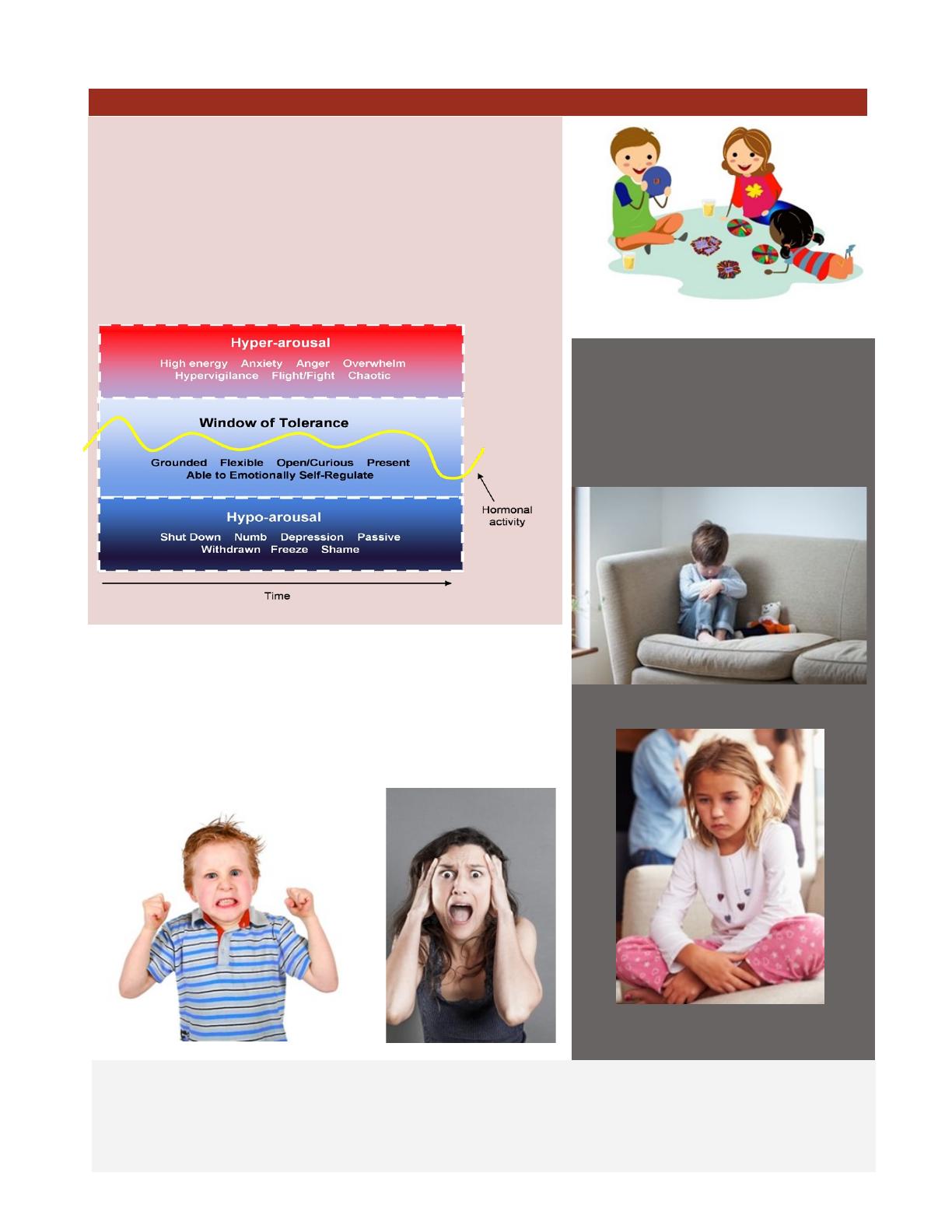
the Window of Tolerance describes the best state of ‘arousal’
or stimulation in which we are able to function and thrive in
everyday life. When we exist within this window, we are able
to learn effectively, play, and relate well to ourselves and
others.
However, if we move outside of our window we can become
hyper-aroused or hypo-aroused.
Hyper-arousal results from the fight or flight response and is
characterised by excessive activation/energy.
It can present as difficulties concentrating, irritability, anger
and angry outbursts, panic, constant anxiety, easily scared or
startled, self-destructive behaviour, etc.
Hypo-arousal results from the
freeze / flop drop response where
there is a sense of shutting down or
dissassociating. This can present as
exhaustion, depression, flat affect,
numbness and disconnection.
We all have different ‘windows’, due to factors such as: significant childhood experiences, our
Neurobiology, social support, environment and coping skills. The size of our windows can change
from day to day but the wider we can make the window, the less likely we are to experience anger,
frustration or feel flat, low and lacking energy.
The River of Wellbeing
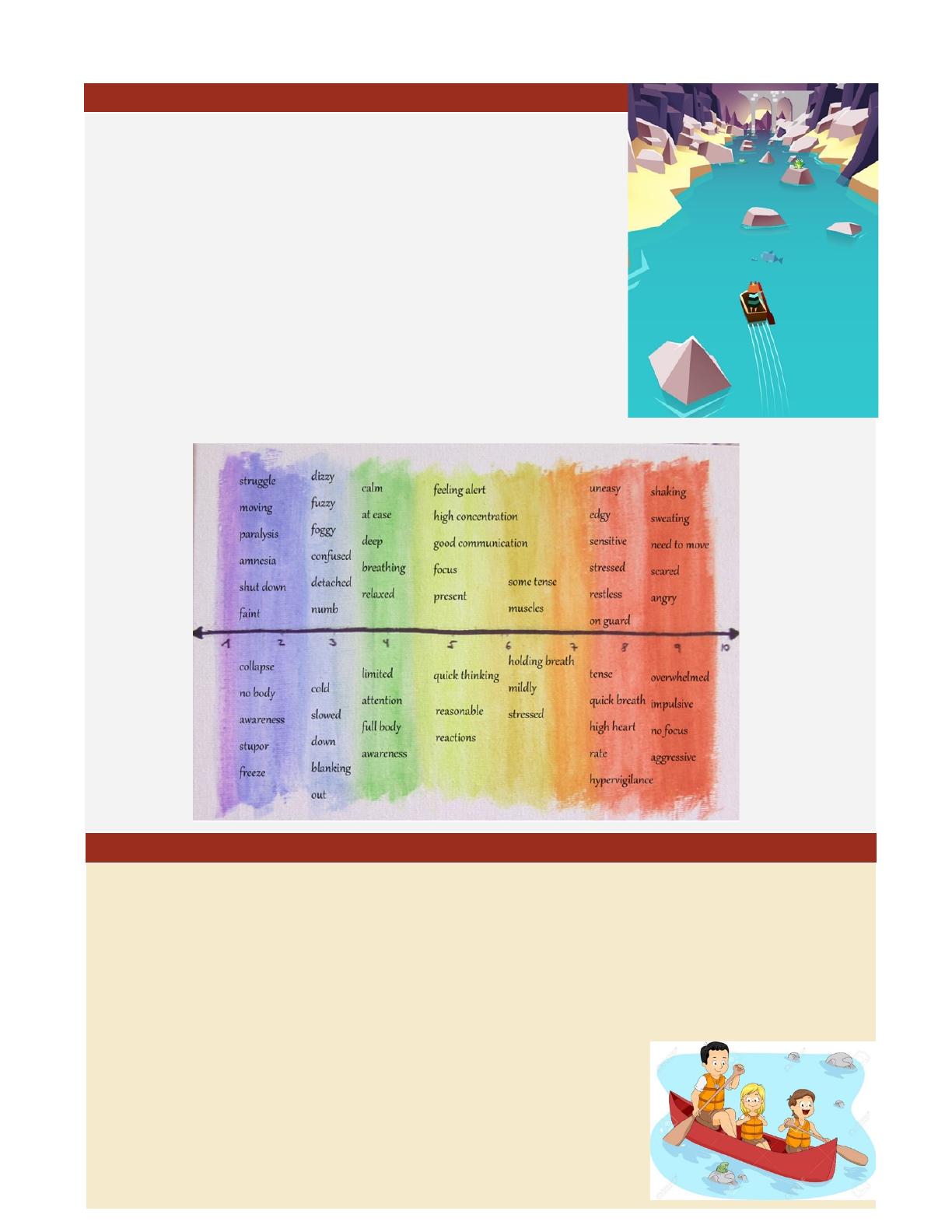
To think about these issues in another way, imagine canoeing down a
river; the River of Wellbeing. On one side of the river is the bank of
hyperarousal and chaos, and on the other side of the river is the bank
of hypoarousal and rigidity. Some children and young people can
‘bounce’ from one bank to the other, experiencing difficulty finding the
middle of the river. And this affects their ability to function effectively.
The wider the river, the more safe space is created the easier it is to
deal with obstacles and challenges that arise.
One of the challenges is to help children develop self-awareness of
their position in the river; sometimes the river will feel very narrow or
be full of obstacles that tend to push them into a state of feeling
overwhelmed or unable to regulate their emotions well (i.e. the banks
of chaos or rigidity).
One technique to help children expand the river, and therefore give themselves greater opportunity to
be resilient and stay calm and focussed, is by developing their self-awareness and with this, greater
levels of adaptability, flexibility and independence. These are called Process Interventions. This would
be like the canoeist having an idea of what obstacles to expect and the skills to be able to negotiate
them. The more they practise their ability to anticipate and navigate obstacles, the more confident and
empowered they will feel, and over time the river seems to get wider.
Another technique is to provide external supports and strategies, such as adapting the environment
(e.g. sensory accommodations); building in predictability (e.g. visual
timetables, structure, routines); and / or providing keyworker support
(e.g. school-based ELSA time). These are called Compensation
Interventions. Rather than the focus being on the canoeist developing
their inner resources and skills, embankments would be built up; the
canoe stabilised or perhaps a guide would work with them.
How to expand the river—using different techniques
/ 12
End of Document
332
You May Also Like

FAQs of The Window of Tolerance Framework for Emotional Regulation

What is the Window of Tolerance and why is it important?
The Window of Tolerance is a concept developed by Dan Siegel that describes the optimal state of arousal for functioning effectively in daily life. When individuals are within this window, they can learn, play, and relate well to others. However, when they move outside this window, they may experience hyper-arousal, characterized by anxiety and irritability, or hypo-arousal, which can lead to feelings of numbness and disconnection. Understanding this model helps caregivers and educators support children's emotional regulation.
How can breathing techniques help in emotional regulation?
Breathing techniques, such as diaphragmatic breathing and 7/11 breathing, are effective tools for regulating emotions. These methods activate the parasympathetic nervous system, promoting relaxation and reducing stress. For instance, 7/11 breathing involves inhaling for a count of 7 and exhaling for a count of 11, which helps calm the body. Incorporating these exercises into daily routines can empower children to manage their emotions more effectively.
What strategies can help expand the Window of Tolerance?
Expanding the Window of Tolerance involves developing self-awareness and adaptability. Techniques such as sensory accommodations, visual timetables, and structured routines can create a supportive environment for children. Additionally, practicing mindfulness and grounding techniques can enhance emotional resilience. By recognizing triggers and implementing coping strategies, children can learn to navigate their emotional landscapes more effectively.
What role does self-awareness play in emotional regulation?
Self-awareness is crucial for emotional regulation as it allows individuals to recognize their emotional states and triggers. By understanding when they are outside their Window of Tolerance, children can employ strategies to return to a more balanced state. This awareness fosters greater emotional intelligence and resilience, enabling them to respond to stressors more effectively. Encouraging self-reflection and mindfulness practices can enhance this self-awareness.
How does the River of Wellbeing metaphor relate to emotional health?
The River of Wellbeing metaphor illustrates the balance between hyper-arousal and hypo-arousal. It suggests that individuals can 'bounce' between these states, impacting their ability to function effectively. A wider river represents a greater capacity for emotional regulation, allowing individuals to navigate challenges with resilience. Techniques to expand this river include developing self-awareness and utilizing external supports, creating a safer emotional space.

Related of The Window of Tolerance Framework for Emotional Regulation