Transforming Functions Chapter 4 Example 15

Transforming Functions Chapter 4 Example 15

Transforming Functions in Chapter 4 explores key mathematical transformations of functions, including vertical and horizontal translations, stretches, and reflections. This chapter provides detailed explanations and visual representations of transformations like y = f(x) ± a and y = f(ax). Ideal for A-Level mathematics students, it includes practice questions to reinforce understanding. The content is structured to aid in mastering function transformations, crucial for higher-level math courses and exams.

Key Points

  • Explains vertical and horizontal translations of functions.
  • Covers vertical and horizontal stretches and reflections.
  • Includes practice questions for hands-on learning.
  • Designed for A-Level mathematics students preparing for exams.

37
/ 3
A2400 ch4o | Version 1.1 | September 2020
Transforming functions
A LEVEL LINKS
Scheme of work: 1f. Transformations transforming graphs f(x) notation
Key points
The transformation y = f(x) ± a is a
translation of y = f(x) parallel to the y-axis;
it is a vertical translation.
As shown on the graph,
o y = f(x) + a translates y = f(x) up
o y = f(x) a translates y = f(x) down.
The transformation y = f(x ± a) is a
translation of y = f(x) parallel to the x-axis;
it is a horizontal translation.
As shown on the graph,
o y = f(x + a) translates y = f(x) to the left
o y = f(xa) translates y = f(x) to the right.
The transformation y = f(ax) is a horizontal
stretch of y = f(x) with scale factor
parallel to the x-axis.
The transformation y = f(ax) is a
horizontal stretch of y = f(x) with scale
factor parallel to the x-axis and then a
reflection in the y-axis.
The transformation y = af(x) is a vertical
stretch of y = f(x) with scale factor a
parallel to the y-axis.
The transformation y = af(x) is a vertical
stretch of y = f(x) with scale factor a
parallel to the y-axis and then a reflection
in the x-axis.
1
a
1
a
A2400 ch4o | Version 1.1 | September 2020
Practice questions
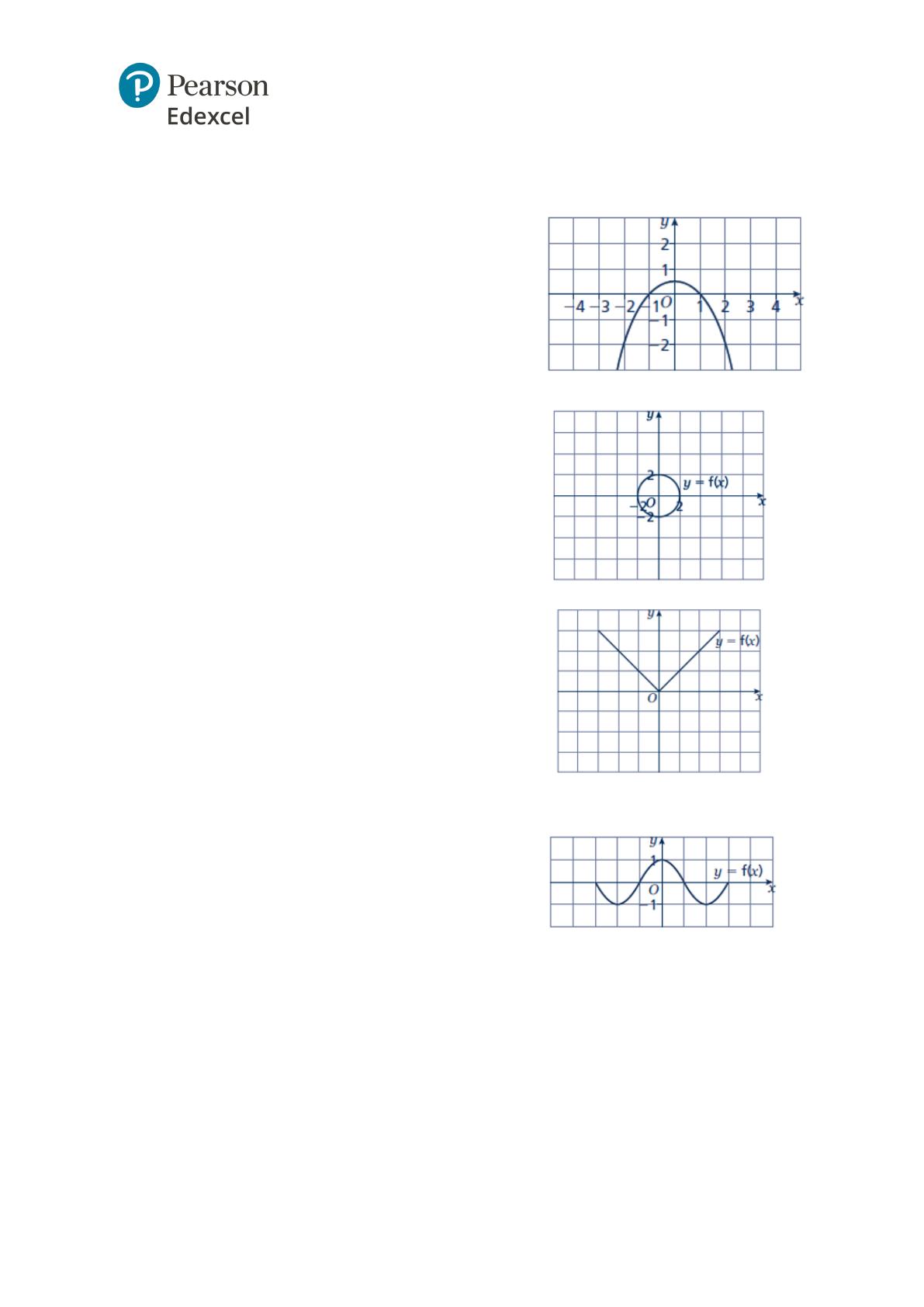
1 The graph shows the function y = f(x).
a Sketch the graph of y = f(x) + 2
b Sketch the graph of y = f(x + 2)
2 The graph shows the function y = f(x).
a Copy the graph and on the same axes
sketch and label the graph of y = 3f(x).
b Make another copy of the graph and on
the same axes sketch and label the graph
of y = f(2x).
3 The graph shows the function y = f(x).
Copy the graph and on the same axes
sketch and label the graphs of
y = 2f(x) and y = f(3x).
4 The graph shows the function y = f(x).
Copy the graph and, on the same axes,
sketch the graph of y = f(2x).
A2400 ch4o | Version 1.1 | September 2020
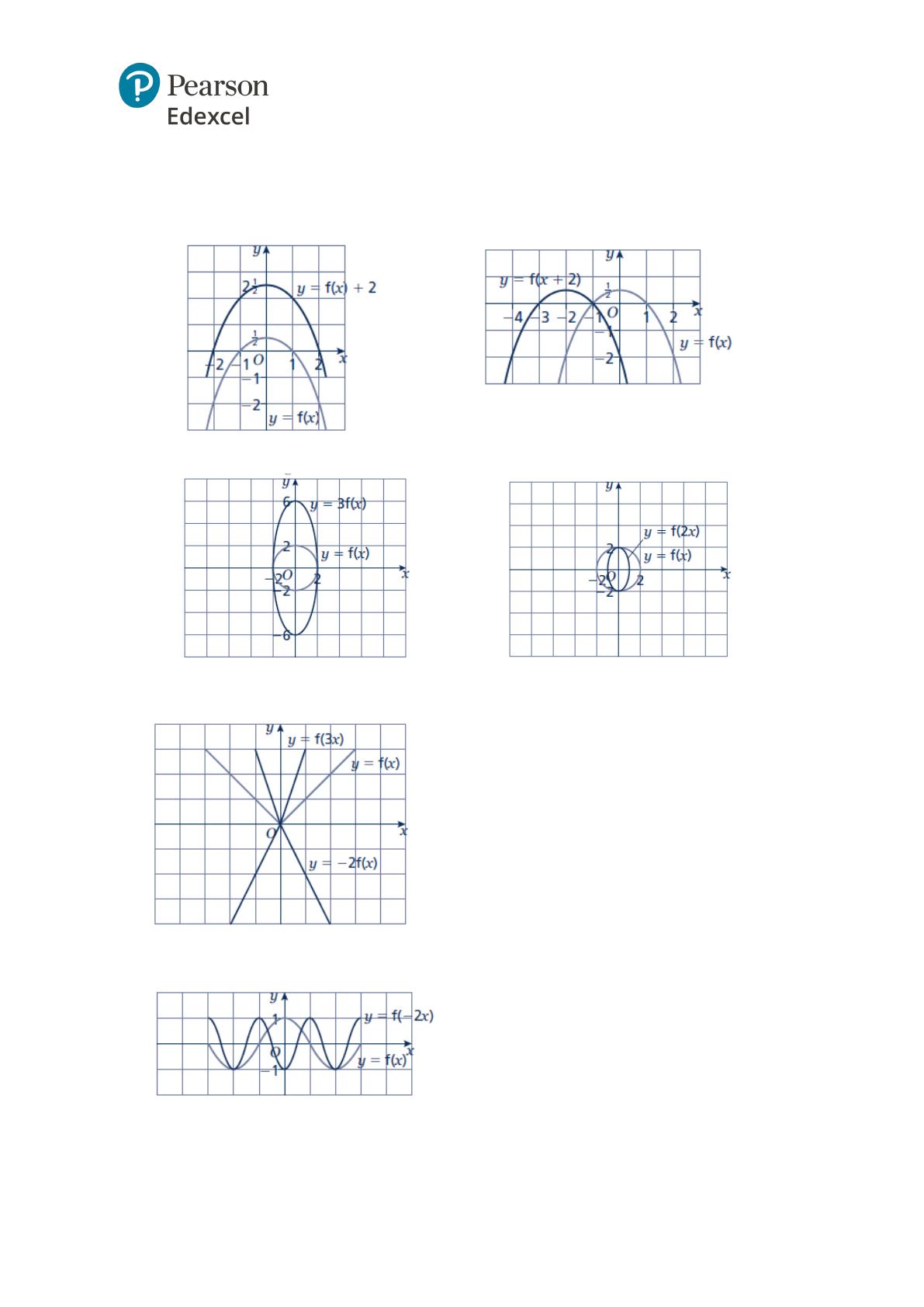
Answers
1 a b
2 a b
3
4
/ 3
End of Document
37
You May Also Like

FAQs of Transforming Functions Chapter 4 Example 15

What are the main types of transformations covered in Chapter 4?
Chapter 4 focuses on several key types of transformations, including vertical translations represented by y = f(x) ± a, which shift the graph up or down. Horizontal translations are also discussed, shown by y = f(x ± a), moving the graph left or right. Additionally, the chapter covers vertical and horizontal stretches, as well as reflections across the axes, providing a comprehensive overview of how these transformations affect the function's graph.
How does the transformation y = f(ax) affect the graph?
The transformation y = f(ax) results in a horizontal stretch of the graph of y = f(x). The scale factor is determined by the value of 'a'; if 'a' is greater than 1, the graph compresses horizontally, while if 'a' is between 0 and 1, it stretches. This transformation is crucial for understanding how changes in the function's input affect its output and visual representation.
What practice questions are included in this chapter?
The chapter includes several practice questions designed to reinforce the concepts of function transformations. For instance, students are asked to sketch graphs of transformed functions like y = f(x) + 2 and y = 3f(x), which help in visualizing the effects of vertical shifts and stretches. These questions not only test comprehension but also encourage students to apply the transformation rules to various functions.
What is the significance of understanding function transformations?
Understanding function transformations is essential for A-Level mathematics as it lays the groundwork for more complex topics in calculus and algebra. Mastery of these concepts enables students to analyze and interpret graphs effectively, which is crucial for solving real-world problems. Additionally, these skills are frequently tested in exams, making them vital for academic success.
How do reflections in transformations work?
Reflections in transformations are represented by equations such as y = -f(x) and y = f(-x). The transformation y = -f(x) reflects the graph across the x-axis, while y = f(-x) reflects it across the y-axis. These transformations are important for understanding symmetry in graphs and how functions behave under different conditions.
What are the implications of vertical stretches in function transformations?
Vertical stretches, represented by y = af(x), where 'a' is a positive constant, increase the distance of points on the graph from the x-axis. If 'a' is greater than 1, the graph is stretched away from the x-axis, making it taller. This transformation affects the function's maximum and minimum values, which is significant for analyzing the function's behavior and its applications in various mathematical contexts.
What is the role of horizontal translations in function transformations?
Horizontal translations, shown by the equations y = f(x ± a), shift the graph left or right on the coordinate plane. A positive value of 'a' shifts the graph to the left, while a negative value shifts it to the right. Understanding these translations is crucial for graphing functions accurately and for solving equations involving shifted functions.

Related of Transforming Functions Chapter 4 Example 15