Utility and Elasticity Concepts for Economics Revision

Utility and Elasticity Concepts for Economics Revision

Utility and elasticity are key concepts in economics, essential for understanding consumer behavior and market dynamics. This revision material covers the calculation of utility, consumer equilibrium, and the elasticity of demand, providing examples and formulas for practical application. It is designed for students preparing for economics exams, particularly those focusing on consumer theory and market analysis. The document includes detailed explanations of marginal utility, price elasticity, and the implications of demand changes in response to price fluctuations.

Key Points

  • Explains the concept of utility and its significance in consumer choice.
  • Covers the calculation of price elasticity of demand with practical examples.
  • Includes consumer equilibrium analysis using marginal utility principles.
  • Discusses the implications of demand changes due to price variations.
413
/ 2
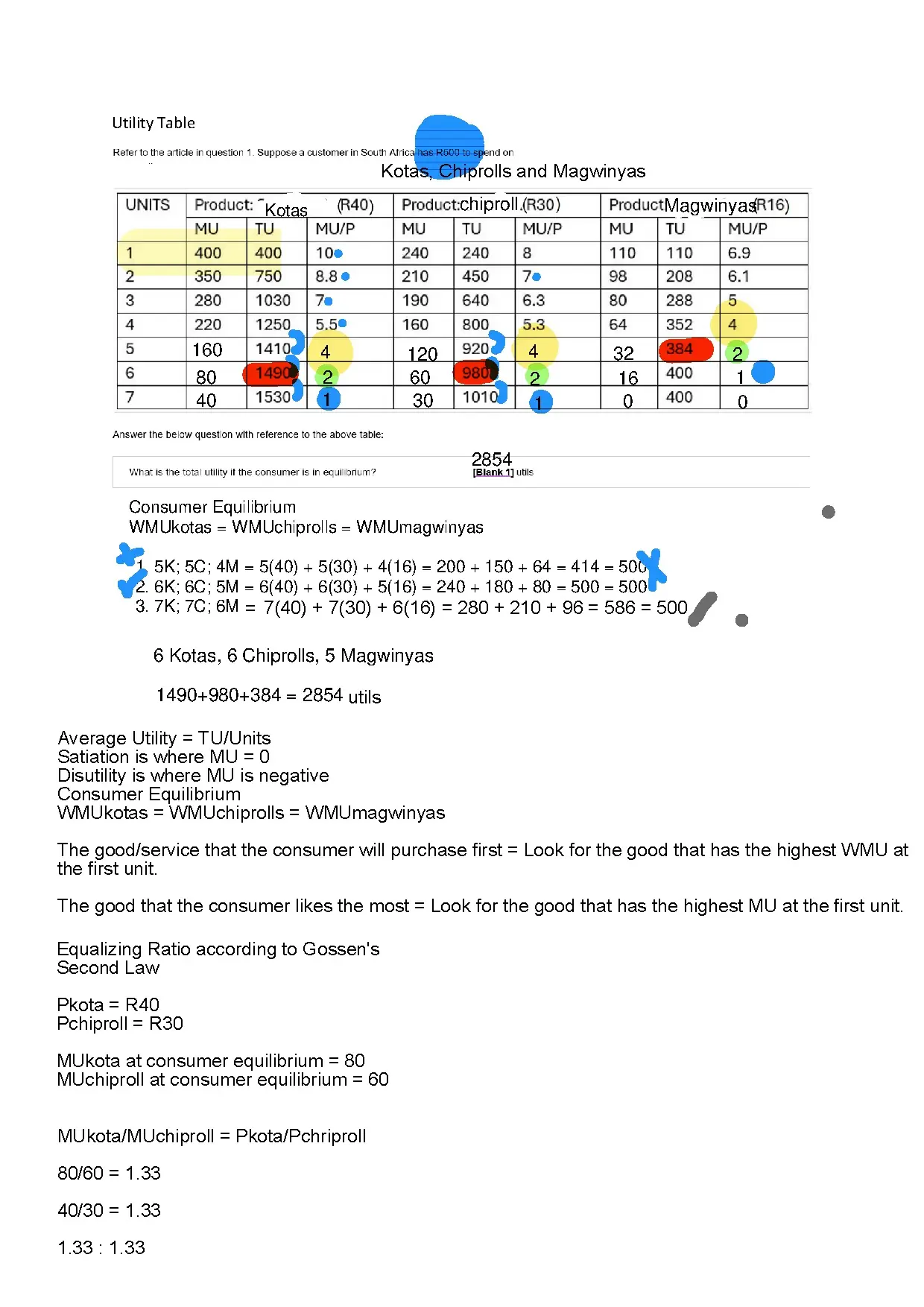
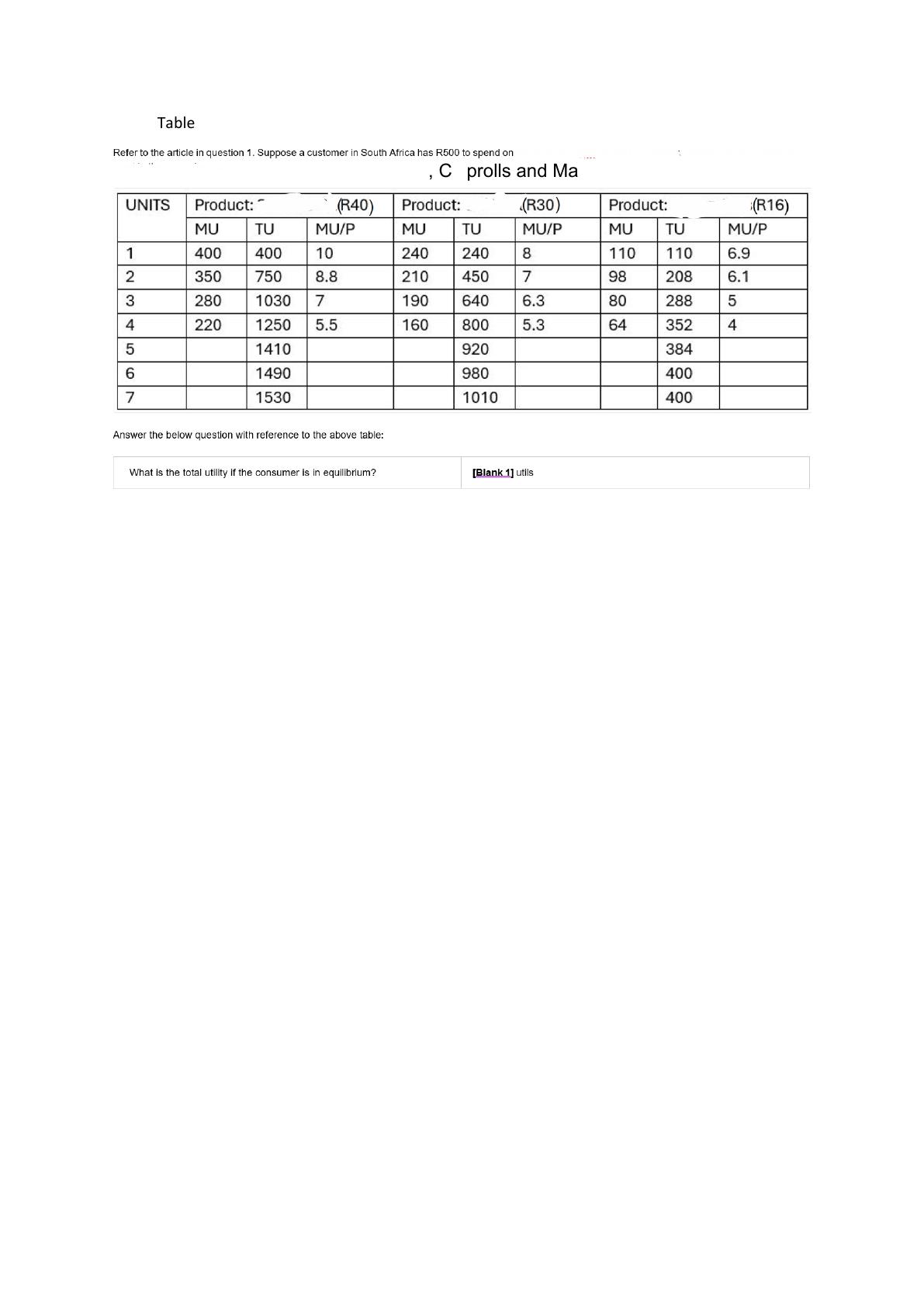
Utility Table
Kotas, Chiprolls and Magwinyas
K
Average Utility = TU/Units
Satiation is where MU = 0
Disutility is where MU is negative
Consumer Equilibrium
WMUkotas = WMUchiprolls = WMUmagwinyas
The good/service that the consumer will purchase first = Look for the good that has the highest WMU at
the first unit.
The good that the consumer likes the most = Look for the good that has the highest MU at the first unit.
Equalizing Ratio according to Gossen's
Second Law
Pkota = R40
Pchiproll = R30
MUkota at consumer equilibrium = 80
MUchiproll at consumer equilibrium = 60
MUkota/MUchiproll = Pkota/Pchriproll
80/60 = 1.33
40/30 = 1.33
1.33 : 1.33
=
7(40) + 7(30) + 6(16) = 280 + 210 + 96 = 586 = 500
utils
Kotas
2
6 Kotas, 6 Chiprolls, 5 Magwinyas
chiproll
Magwinyas
160
1
4
120
0
4
2
2
1
1
0
Consumer Equilibrium
WMUkotas = WMUchiprolls = WMUmagwinyas
1. 5K; 5C; 4M = 5(40) + 5(30) + 4(16) = 200 + 150 + 64 = 414 = 500
2. 6K; 6C; 5M = 6(40) + 6(30) + 5(16) = 240 + 180 + 80 = 500 = 500
3. 7K; 7C; 6M
1490+980+384 = 2854
2854
Elasticity
Refer to the article in question 1. Assume that there has been an increase in the
demand for kotas in South Africa. In response, the South African supermarkets
increases the price of a Kota from R70 to R85. As a result, the quantity demanded for
Kotas decreases from 290000 to 200000.
1.
Calculate the price elasticity of demand at the original
price of R70. Use the point formula in
your calculation.
2.
What type of price elasticity of demand is calculated
in the question immediately above?
3.
Calculate the price elasticity of demand at the new
price of R85. Use the point formula in
your calculation.
4.
What type of price elasticity of demand is calculated
in the question immediately above?
5.
Calculate the price elasticity of demand over the price
range. Use the arc formula in your
calculation.
6.
What type of price elasticity of demand is calculated
in the question immediately above?
Elastic Demand
ep = Change in Quantity/Change Price x Average Price/Average Quantity
Average Price = (P1+P2)/2 = (70+85)/2 = 155/2 = 77.5
Average Quantity = (Q1+Q2)/2 = (290000+200000)/2 = 490000/2 = 245000
= -6000 x 77.5/245000 = -1.9 = 1.9
P1 = 70; Q1 = 290000; P2 = 85; Q2 = 200000
ep = Change in Quantity/Change in Price x Price/Quantity
ep = Q2-Q1/P2-P1 x P1/Q1 = 200000-290000/85-70 x 70/290000
= -90000/15 x 70/290000 = -6000 x 70/290000 = -1.4 = 1.4
Elastic Demand
-6000 x 85/200000 = -2.6 = 2.6
Elastic
Demand
ep = infinity: Perfectly Elastic
ep = 0: Perfectly Inelastic
ep = 1: Unitary Elastic / Unit Elastic
0 < ep < 1: Inelastic Demand
1 < ep < infinity: Elastic Demand
/ 2
End of Document
413
You May Also Like

FAQs of Utility and Elasticity Concepts for Economics Revision

What is the definition of utility in economics?
Utility in economics refers to the satisfaction or pleasure derived from consuming goods and services. It is a fundamental concept that helps explain consumer choices and preferences. Economists often differentiate between total utility, which is the overall satisfaction from consumption, and marginal utility, which is the additional satisfaction gained from consuming one more unit of a good. Understanding utility is crucial for analyzing consumer behavior and market demand.
How is price elasticity of demand calculated?
Price elasticity of demand measures how much the quantity demanded of a good responds to a change in its price. It is calculated using the formula: % Change in Quantity Demanded / % Change in Price. A value greater than one indicates elastic demand, where consumers are sensitive to price changes, while a value less than one indicates inelastic demand, where quantity demanded is less responsive to price changes. This concept is vital for businesses and policymakers to understand consumer behavior.
What factors influence the elasticity of demand?
Several factors influence the elasticity of demand, including the availability of substitutes, the proportion of income spent on the good, and the time frame considered. Goods with many substitutes tend to have more elastic demand, as consumers can easily switch to alternatives if prices rise. Conversely, necessities tend to have inelastic demand since consumers will continue to purchase them regardless of price changes. Additionally, over time, consumers may find substitutes, making demand more elastic in the long run.
What is consumer equilibrium and how is it achieved?
Consumer equilibrium occurs when a consumer maximizes their utility given their budget constraint. It is achieved when the ratio of the marginal utility of each good to its price is equal across all goods consumed. This means that consumers allocate their resources in a way that equalizes the marginal utility per dollar spent on each good, ensuring that they derive the maximum satisfaction from their purchases. Understanding consumer equilibrium is essential for analyzing consumer choices in economics.
What is the significance of the Gossen's Second Law in economics?
Gossen's Second Law states that consumers will allocate their spending among different goods to equalize the marginal utility per unit of currency spent. This principle is fundamental to understanding consumer behavior and market demand. It implies that consumers will continue to purchase additional units of a good until the marginal utility of the last unit consumed is equal to the price paid. This law helps explain how consumers make choices in a constrained budget environment.

Related of Utility and Elasticity Concepts for Economics Revision