This document is a reading practice resource focused on the history of solar panels at the White House, highlighting the actions of Presidents Carter, Reagan, and Obama. It includes comprehension questions and a timeline of events related to solar energy policies. This educational material is designed for TEAS exam preparation.
/ 4

ATI TEAS Reading Practice
White House Solar Panels
Reading Passage
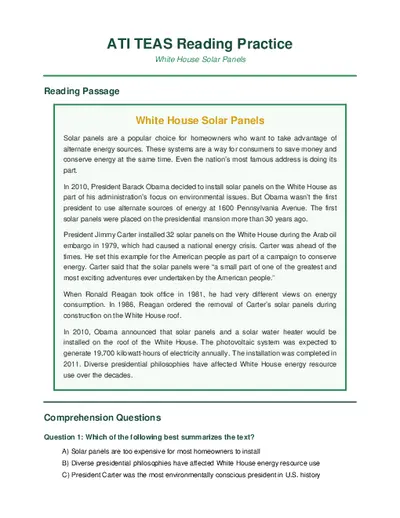
White House Solar Panels
Solar panels are a popular choice for homeowners who want to take advantage of
alternate energy sources. These systems are a way for consumers to save money and
conserve energy at the same time. Even the nation’s most famous address is doing its
part.
In 2010, President Barack Obama decided to install solar panels on the White House as
part of his administration’s focus on environmental issues. But Obama wasn’t the first
president to use alternate sources of energy at 1600 Pennsylvania Avenue. The first
solar panels were placed on the presidential mansion more than 30 years ago.
President Jimmy Carter installed 32 solar panels on the White House during the Arab oil
embargo in 1979, which had caused a national energy crisis. Carter was ahead of the
times. He set this example for the American people as part of a campaign to conserve
energy. Carter said that the solar panels were “a small part of one of the greatest and
most exciting adventures ever undertaken by the American people.”
When Ronald Reagan took office in 1981, he had very different views on energy
consumption. In 1986, Reagan ordered the removal of Carter’s solar panels during
construction on the White House roof.
In 2010, Obama announced that solar panels and a solar water heater would be
installed on the roof of the White House. The photovoltaic system was expected to
generate 19,700 kilowatt-hours of electricity annually. The installation was completed in
2011. Diverse presidential philosophies have affected White House energy resource
use over the decades.
Comprehension Questions
Question 1: Which of the following best summarizes the text?
A) Solar panels are too expensive for most homeowners to install
B) Diverse presidential philosophies have affected White House energy resource use
C) President Carter was the most environmentally conscious president in U.S. history

D) President Obama was the first president to install solar panels on the White House
Answer: B) Diverse presidential philosophies have affected White House energy resource
use
The passage traces how different presidents (Carter, Reagan, Obama) had contrasting approaches to
solar energy at the White House, reflecting their different energy philosophies.
Question 2: Which of the following is a logical conclusion based on this passage?
A) The White House was the first building in America to have solar panels
B) President Carter’s conservation efforts significantly reduced energy waste in America
C) Presidential energy policies are influenced by political philosophy and current events
D) Solar panels are not cost-effective for residential use
Answer: C) Presidential energy policies are influenced by political philosophy and current
events
The passage shows Carter installing panels during an energy crisis, Reagan removing them due to
different views, and Obama reinstalling them as part of environmental priorities—demonstrating how
philosophy and current events shape policy.
Question 3: Carter said that the solar panels were "a small part of one of the greatest and
most exciting adventures ever undertaken by the American people." Which of the following
inferences can be made from this section of the passage?
A) Carter believed solar panels would completely solve the energy crisis
B) Carter was ahead of the times and set this example as part of a campaign to conserve energy
C) Carter was only interested in solar panels for political gain
D) Carter wanted every American household to install solar panels
Answer: B) Carter was ahead of the times and set this example as part of a campaign to
conserve energy
The passage states directly that Carter was ahead of the times and set this example as part of a
campaign to conserve energy. His quote shows he saw solar power as part of a larger national effort,
not the complete solution itself.

Question 4: According to the passage, which of the following events occurred second in
the sequence?
A) Obama announced the installation of solar panels and a solar water heater
B) Carter installed 32 solar panels on the White House
C) Reagan ordered the removal of the solar panels
D) The photovoltaic system installation was completed
Answer: C) Reagan ordered the removal of the solar panels
The chronological sequence is: (1) Carter installed panels in 1979, (2) Reagan removed them in 1986,
(3) Obama announced reinstallation in 2010, and (4) installation completed in 2011.
Question 5: Which of the following sentences from the passage includes biased language?
A) "Solar panels are a popular choice for homeowners who want to take advantage of alternate
energy sources."
B) "In 2010, President Barack Obama decided to install solar panels on the White House as part
of his administration’s focus on environmental issues."
C) "Carter said that the solar panels were 'a small part of one of the greatest and most exciting
adventures ever undertaken by the American people.'"
D) "In 1986, Reagan ordered the removal of Carter’s solar panels during construction on the
White House roof."
Answer: C)
Carter's quoted words contain subjective, enthusiastic language (“greatest and most exciting
adventures”), which reflects personal opinion and bias rather than objective reporting. The other
options present factual statements without evaluative language.
Question 6: Instead of following a chronological sequence, the author discusses Obama’s
reinstallation of solar panels first. Which of the following describes the purpose of this
order of events?
A) To confuse the reader about the timeline
B) To engage the reader with a current event before providing historical context
C) To argue that Obama’s installation was more important than Carter’s
D) To show that Reagan’s decision was controversial
Answer: B) To engage the reader with a current event before providing historical context
By opening with the more recent event (Obama, 2010), the author hooks the reader with a familiar,
current topic before transitioning to the historical background (Carter in 1979, Reagan in 1986). This is
a common journalistic technique to build reader interest.
Timeline of White House Solar Panel History

Loading document...
/ 4
Upload to Download
Every 3 documents you upload earns 1 download credit.
You have uploaded 0 documents. Upload 3 more to earn a download.
Upload Documents
End of Document
233
Report this document
Why are you reporting this content?
Embed document
* The code will be updated based on your changes.
Upload to Print
Every 3 documents you upload earns 1 print/download credit.
You have uploaded 0 documents. Upload 3 more to earn a credit.
Upload Documents