

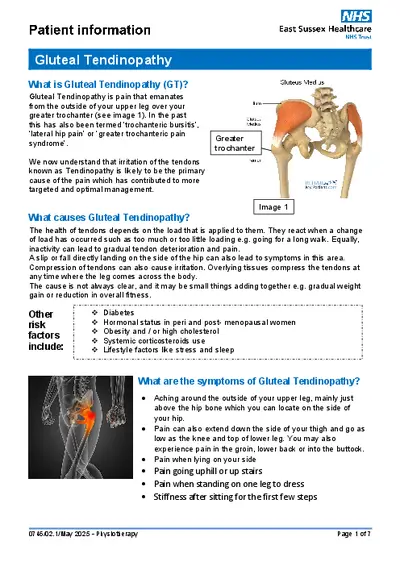
Gluteal Tendinopathy is pain that emanates from the outside of your upper leg over your greater trochanter (see image 1). In the past this has also been termed ‘trochanteric bursitis’, ‘lateral hip pain’ or ‘greater trochanteric pain syndrome’. We now understand that irritation of the tendons known as Tendinopathy is likely to be the primary cause of the pain which has contributed to more targeted and optimal management.

0746/02.1/May 2025 - Physiotherapy Page 1 of 7
Gluteal Tendinopathy
What is Gluteal Tendinopathy (GT)?
Gluteal Tendinopathy is pain that emanates
from the outside of your upper leg over your
greater trochanter (see image 1). In the past
this has also been termed ‘trochanteric bursitis’,
‘lateral hip pain’ or ‘greater trochanteric pain
syndrome’.
We now understand that irritation of the tendons
known as Tendinopathy is likely to be the primary
cause of the pain which has contributed to more
targeted and optimal management.
What causes Gluteal Tendinopathy?
The health of tendons depends on the load that is applied to them. They react when a change
of load has occurred such as too much or too little loading e.g. going for a long walk. Equally,
inactivity can lead to gradual tendon deterioration and pain.
A slip or fall directly landing on the side of the hip can also lead to symptoms in this area.
Compression of tendons can also cause irritation. Overlying tissues compress the tendons at
any time where the leg comes across the body.
The cause is not always clear, and it may be small things adding together e.g. gradual weight
gain or reduction in overall fitness.
Other
risk
factors
include:
What are the symptoms of Gluteal Tendinopathy?
Greater
trochanter
Image 1
Diabetes
Hormonal status in peri and post- menopausal women
Obesity and / or high cholesterol
Systemic corticosteroids use
Lifestyle factors like stress and sleep
• Aching around the outside of your upper leg, mainly just
above the hip bone which you can locate on the side of
your hip.
• Pain can also extend down the side of your thigh and go as
low as the knee and top of lower leg. You may also
experience pain in the groin, lower back or into the buttock.
• Pain when lying on your side
• Pain going uphill or up stairs
• Pain when standing on one leg to dress
• Stiffness after sitting for the first few steps

Page 2 of 7
What are the management options for Gluteal Tendinopathy?
Rest will not cure tendinopathy.
• Keep walking– make your walks slower, shorter and flatter as necessary.
• Limit use of stairs
• Avoid crossing your legs
• Avoid sitting in low chairs
• Applying heat to the area of pain can provide relief
• Gradual loading exercises for the buttock muscles
• Sit down to dress your lower half
• Being a healthy weight can reduce load and improve tissue health. For more support with
weight loss visit-
One You East Sussex | Free Health & Wellbeing Service
(https://oneyoueastsussex.org.uk)
• Sleeping with a pillow between knees (image 2) – 2 pillows in 1 pillowcase works well to
keep your legs apart.
• Avoid standing “off kilter” or with legs crossed when standing (image 3)
How long will it take to get better?
This condition can take several months or longer to improve.
5 out of 10 of cases will improve in a year with no intervention.
7 out of 10 cases will improve within 8 weeks of doing exercises and following best
advice.
Image 3
×
Image 2

Page 3 of 7
Can I try exercises on my own?
Following are some exercises with guidance that you can try. These are based on the most
recent evidence.
Exercises are the best management option for gluteal tendinopathy (with lasting benefits).
Do I need to see a physiotherapist?
Whilst it is safe to try exercises independently if you are struggling a physiotherapist will provide
further advice and education on how to best manage this condition.
They will assess the range of movement of the hip and knee as well as the strength of the
muscles around your legs especially your buttock muscles (gluteals).
Based on a thorough assessment the physiotherapist will tailor a specific graded exercise
programme to help get you back to your usual activity levels.
Why should I exercise?
Exercises will strengthen your gluteal muscles and promote tendon loading, creating tendon
adaptation. The timeframe for improvement is individual. Some need as little as a few weeks for
symptoms to settle by avoiding irritating factors and gentle basic exercises. However, it is
common to need to persevere with exercises for several months to feel a significant change.
This depends on the daily demands on the tendon and muscle; hence a more active population
may need more time and a more intense exercise programme. Exercises need to be
progressed to a level that is appropriate to your activity goals.
How do I balance my exercise and day to day activities?
It is helpful to follow a so-called “traffic light system” to monitor
symptoms and adjust both activity and exercise intensity accordingly. A
green light means safe zone, free of or very mild symptoms. An amber
light means that the symptoms are present but acceptable during
exercise if they ease afterwards and do not result in increased pain
levels that night or the next morning. A red light means symptoms are
intense and not settling after exercise or activity and increase from day
to day and week to week.
Intensity of exercise programmes combined with day-to-
day activity should be symptom guided to enable staying in
green or amber light. Start from light effort and progress
towards hard. When the training becomes more intense
you should give your tendon and muscles more time to
adopt by switching training to alternate days.
A combination of day-to-day activity level and exercises
can influence pain. For example, if you plan to have a busy
day, choosing to exercise less intensely could prevent increasing your symptoms. Don’t worry if
you do aggravate your symptoms: reduce your activity and exercises to allow your pain to
settle. Remember to build up again gently. Please contact your physiotherapist if of any doubt
or pain is not improving.
190