Aggregate Job Destruction and Inventory Liquidation by Robert E. Hall

Aggregate Job Destruction and Inventory Liquidation by Robert E. Hall

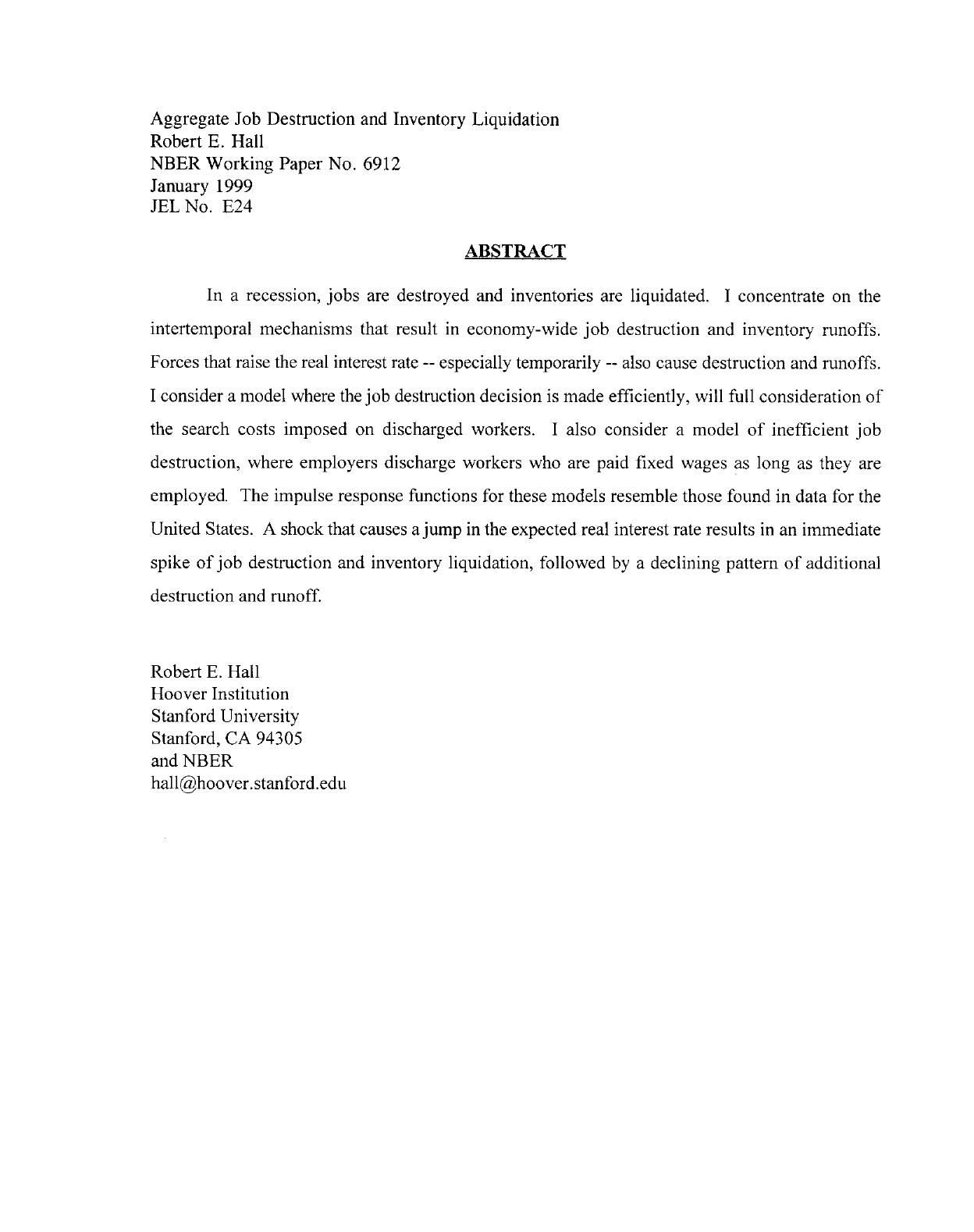
Aggregate job destruction and inventory liquidation are explored in this working paper by Robert E. Hall. The paper examines the intertemporal mechanisms that lead to job losses and inventory runoffs during economic recessions. Hall analyzes the relationship between rising real interest rates and the decision-making processes of firms regarding job destruction. This research is crucial for economists, policymakers, and students studying macroeconomic fluctuations and labor market dynamics. The findings provide insights into how interest rates influence employment and inventory management across various industries.

Key Points

  • Analyzes the relationship between real interest rates and job destruction during recessions.
  • Explores intertemporal economics and its impact on inventory liquidation.
  • Presents empirical evidence linking job destruction rates to changes in interest rates.
  • Discusses the implications of job losses for labor market dynamics and economic policy.
153
/ 31
2
I. Introduction
From time to time, the economy enters a recession and jobs are destroyed
simultaneously in all of the important sectors of the economy. At the same time,
firms liquidate inventories. What mechanism causes job losses and inventory
runoffs throughout the economy? A decline in demand seems a natural part of the
answer. But what does it mean for demand to fall for all the products in the
economy? What relative price adjusts to keep markets in equilibrium if demand
falls? The answers lie in intertemporal economics. Demand for products delivered
today can rise while demand for products tomorrow falls, just as demand for
potatoes can rise while demand for rice declines. The relative price that adjusts to
clear the market for products today against products tomorrow is the interest rate.
Accordingly, this paper explores the relation between the interest rate and job
destruction.
The data show that recessions are often preceded by sharp increases in real
interest rates. This paper builds an intertemporal model to mimic this relationship.
In the model, firms face the question of whether to continue the operation of
marginal plants and other productive units or to shut them down. An increase in
the interest rate shifts the decision toward shutdown because the firm avoids the
immediate costs of holding inventories and other capital, whereas the foregone
profit lies in the future. The burst of job destruction and inventory decumulation
that occurs during the sharp part of the typical contraction results from decisions
to shut down units in firms throughout the economy.
My focus in this paper is primarily on the interest-rate-job-destruction
mechanism and less on the source of demand shifts and accompanying changes in
the interest rate. The model describes the responses of workers and firms to
/ 31
End of Document
153
You May Also Like

FAQs of Aggregate Job Destruction and Inventory Liquidation by Robert E. Hall

What is the main thesis of Robert E. Hall's paper?
The main thesis of Robert E. Hall's paper is that rising real interest rates significantly influence job destruction and inventory liquidation during economic recessions. Hall argues that when interest rates increase, firms are more likely to shut down marginal operations, leading to job losses across various sectors. This mechanism highlights the importance of understanding how monetary policy can trigger widespread economic impacts, particularly in labor markets.
How does the paper relate job destruction to inventory management?
The paper establishes a connection between job destruction and inventory management by suggesting that both phenomena are responses to shifts in economic conditions, particularly rising interest rates. Hall posits that as firms face higher costs of holding inventory due to increased interest rates, they may opt to liquidate inventories, which often coincides with decisions to reduce their workforce. This relationship underscores the interconnectedness of employment and inventory strategies in times of economic contraction.
What empirical evidence does Hall provide regarding job destruction?
Hall provides empirical evidence showing a strong positive correlation between job destruction rates and expected real interest rates across various industries. He utilizes data from the Davis-Haltiwanger measures of job destruction, demonstrating that increases in interest rates often precede significant job losses. This evidence supports his theoretical framework, indicating that monetary policy changes can have immediate and profound effects on employment levels.
What implications does the paper have for policymakers?
The implications of Hall's paper for policymakers are significant, particularly in the context of monetary policy. By illustrating how increases in interest rates can lead to job destruction, the research suggests that policymakers should carefully consider the timing and magnitude of interest rate adjustments. Understanding the potential for job losses can help in designing policies that mitigate the adverse effects of monetary tightening on the labor market.
What economic models does Hall reference in his analysis?
Hall references several economic models in his analysis, particularly those related to intertemporal decision-making and labor market dynamics. He discusses the Diamond-Mortensen framework, which views unemployment as a bilateral search process, and contrasts it with models that assume unilateral decision-making by firms. These models help contextualize the mechanisms behind job destruction and the role of interest rates in influencing firm behavior during economic downturns.

Related of Aggregate Job Destruction and Inventory Liquidation by Robert E. Hall