AP Human Geography Unit 2 FRQ Practice

AP Human Geography Unit 2 FRQ Practice

AP Human Geography Unit 2 FRQ Practice focuses on key concepts related to population growth, demographic transition, and migration patterns. It includes free-response questions that encourage critical thinking and application of geographic principles. Designed for students preparing for the AP Human Geography exam, this resource helps reinforce understanding of population dynamics and their implications. The practice questions cover various topics, including natural increase rates, economic incentives, and social policies aimed at managing population growth.

Key Points

  • Includes free-response questions on population growth and demographic transition.
  • Explains factors contributing to high population growth rates in specific regions.
  • Discusses economic and social strategies to manage population growth.
  • Analyzes migration patterns through core-periphery and distance decay principles.
356
/ 18
AP Human Geography Scoring Guide
Unit 2 FRQ Practice (Digital Learning)
Copyright © 2017. The College Board. These materials are part of a College Board program. Use or distribution of these materials online or
in print beyond your school’s participation in the program is prohibited.
Page 1 of 18
1.
Directions: You have 25 minutes to answer the following question. It is suggested that you
take up to 5 minutes of this time to plan and outline each answer.
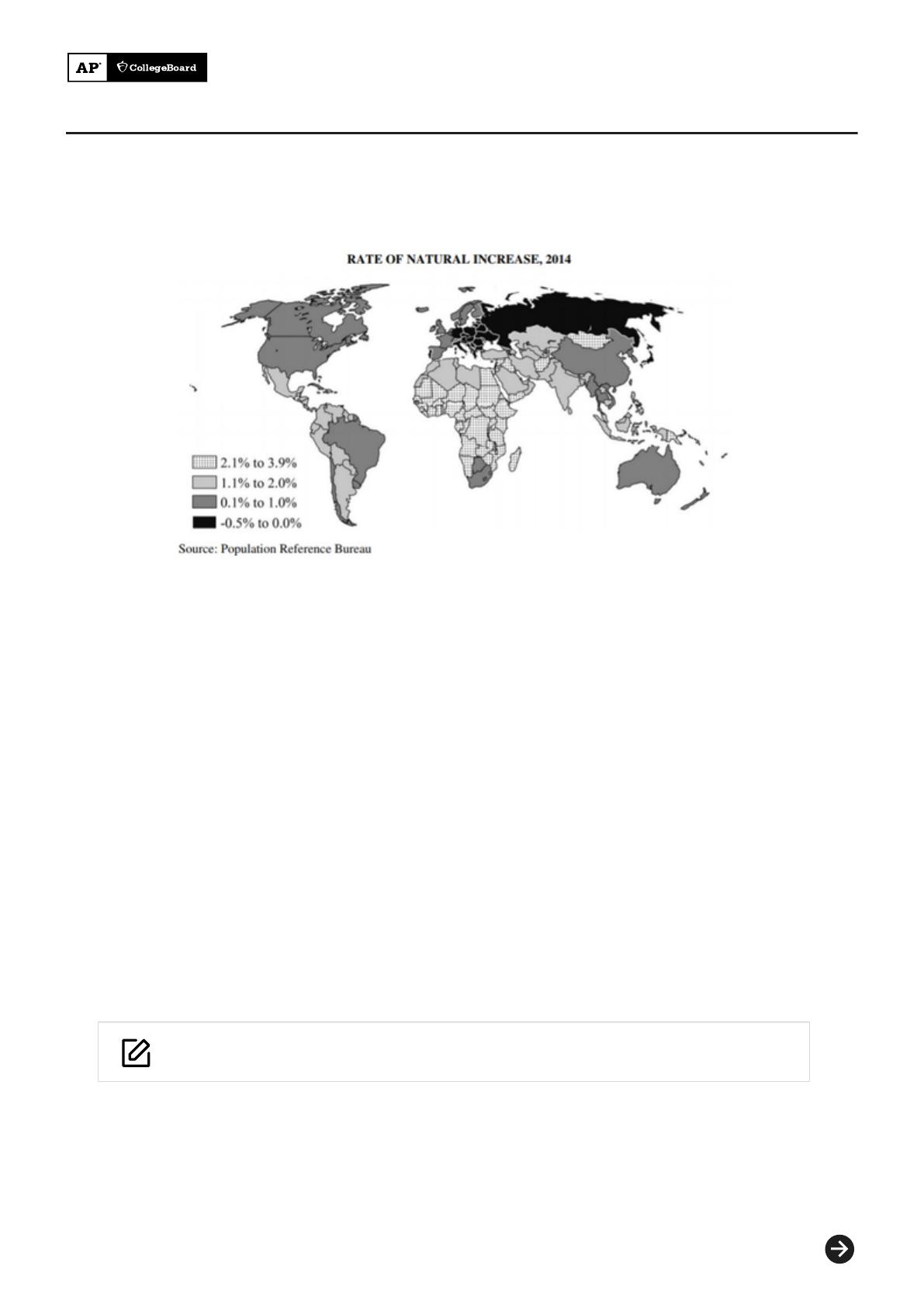
The map shows rates of natural increase in human population.
Identify the world region on the map with the highest rates of natural increase.A.
Using the region identified in part A, explain THREE factors that contribute to highB.
population growth rates.
Describe ONE economic incentive that a country with a high population growth rateC.
could use to decrease population growth, and identify ONE potential impact of this
strategy.
Describe ONE social program or policy that a country with a high population growth rateD.
could use to decrease population growth, and identify ONE potential impact of this
strategy.
Please respond on separate paper, following directions from your teacher.
Part A
AP Human Geography Scoring Guide
Unit 2 FRQ Practice (Digital Learning)
Copyright © 2017. The College Board. These materials are part of a College Board program. Use or distribution of these materials online or
in print beyond your school’s participation in the program is prohibited.
Page 2 of 18
A. Region Identification
(1 point total)
Africa, sub-Saharan Africa, Africa south of the Sahara, West Africa, Southern Africa, Central Africa, East
Africa, or the Sahel, Sahelian
Do not accept: North Africa, South Africa
0
1
The student response earns one of the following points:
A. Region Identification
(1 point total)
Africa, sub-Saharan Africa, Africa south of the Sahara, West Africa, Southern Africa, Central Africa, East
Africa, or the Sahel, Sahelian
Do not accept: North Africa, South Africa
Part B
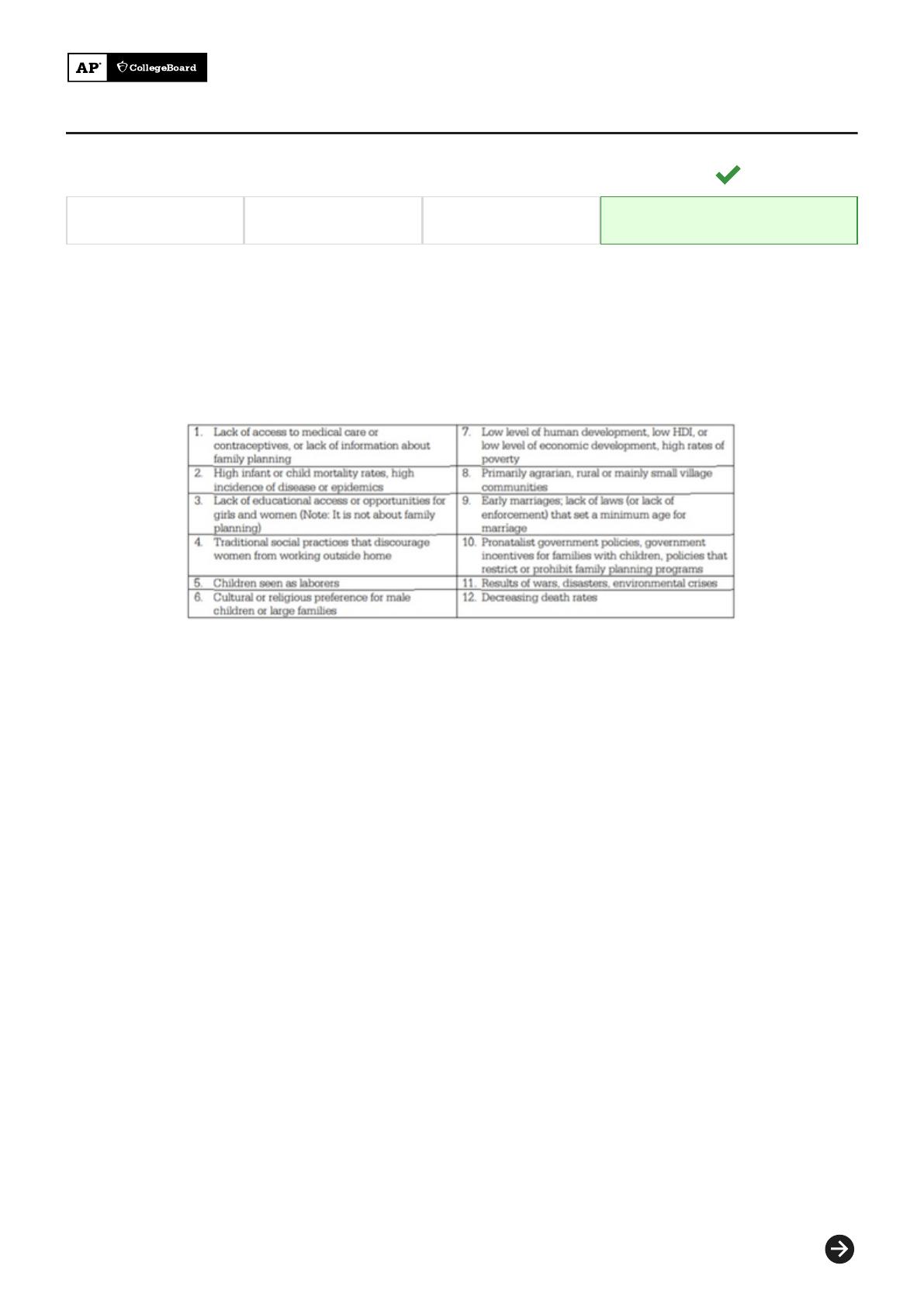
B. Explain three factors that contribute to high population growth rates
(1 point for each factor, 3 points total (1+1+1). Each category may be used only once.)
AP Human Geography Scoring Guide
Unit 2 FRQ Practice (Digital Learning)
Copyright © 2017. The College Board. These materials are part of a College Board program. Use or distribution of these materials online or
in print beyond your school’s participation in the program is prohibited.
Page 3 of 18
0
1 2 3
The student response earns three of the following points:
B. Explain three factors that contribute to high population growth rates
(1 point for each factor, 3 points total (1+1+1). Each category may be used only once.)
Part C
C. One economic incentive to decrease population growth
(1 description + 1 impact = 2 points total)
Economic Incentives (1 pt.)
Increasing distribution, availability, or affordability of contraceptives to men and women1.
Promoting economic development, poverty reduction, sustainable development2.
Promoting female labor force participation or business ownership (e.g., microcredit, access to3.
capital)
Offering incentives for smaller families or disincentives for having larger families4.
Implementing a government economic safety net to support the elderly5.
/ 18
End of Document
356
You May Also Like

FAQs of AP Human Geography Unit 2 FRQ Practice

What are the key factors contributing to high population growth rates?
High population growth rates are often influenced by factors such as high birth rates, declining death rates due to improved healthcare, and cultural norms favoring larger families. In regions like sub-Saharan Africa, these factors combine to create a youthful population with a high natural increase. Additionally, economic conditions, such as limited access to education and family planning resources, further exacerbate these growth rates.
How can economic incentives help reduce population growth?
Economic incentives can play a crucial role in reducing population growth by promoting access to contraceptives and family planning resources. For example, governments can implement programs that subsidize contraceptives or provide financial incentives for families that choose to have fewer children. These strategies can lead to reduced birth rates, improved gender equality, and better allocation of resources for education and healthcare.
What is the significance of the demographic transition model?
The demographic transition model illustrates the transition of a country from high birth and death rates to lower birth and death rates as it develops economically. This model is significant as it helps explain population changes over time and the associated social and economic implications. Countries in different stages of this model exhibit varying population structures, which can impact their economic development and resource allocation.
What is chain migration and how does it affect population dynamics?
Chain migration refers to the process where migrants from a particular area follow others from that area to a new destination. This phenomenon can significantly affect population dynamics by creating established communities that attract further migrants. For instance, as families or friends migrate to a new country, they often encourage others to join them, leading to concentrated immigrant populations and cultural enclaves.
What role does distance decay play in migration patterns?
Distance decay is a geographical principle that suggests the interaction between two places decreases as the distance between them increases. In migration, this means that individuals are more likely to move to locations closer to their home country rather than distant ones. This principle can be observed in migration streams where a higher number of migrants settle in nearby regions, maintaining cultural ties and networks.

Related of AP Human Geography Unit 2 FRQ Practice