Brief Summary of
Atomic Habits
An easy way and proven way to build good habits and break bad ones
James Clear
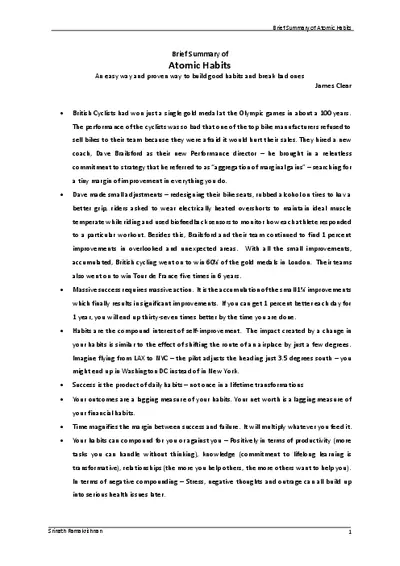
• British Cyclists had won just a single gold medal at the Olympic games in about a 100 years.
The performance of the cyclists was so bad that one of the top bike manufacturers refused to
sell bikes to their team because they were afraid it would hurt their sales. They hired a new
coach, Dave Brailsford as their new Performance director – he brought in a relentless
commitment to strategy that he referred to as “aggregation of marginal gains” – searching for
a tiny margin of improvement in everything you do.
• Dave made small adjustments – redesigning their bike seats, rubbed alcohol on tires to hav a
better grip, riders asked to wear electrically heated overshorts to maintain ideal muscle
temperate while riding and used biofeedback sensors to monitor how each athlete responded
to a particular workout. Besides this, Brailsford and their team continued to find 1 percent
improvements in overlooked and unexpected areas. With all the small improvements,
accumulated, British cycling went on to win 60% of the gold medals in London. Their teams
also went on to win Tour de France five times in 6 years.
• Massive success requires massive action. It is the accumulation of the small 1% improvements
which finally results in significant improvements. If you can get 1 percent better each day for
1 year, you will end up thirty-seven times better by the time you are done.
• Habits are the compound interest of self-improvement. The impact created by a change in
your habits is similar to the effect of shifting the route of an airplace by just a few degrees.
Imagine flying from LAX to NYC – the pilot adjusts the heading just 3.5 degrees south – you
might end up in Washington DC instead of in New York.
• Success is the product of daily habits – not once in a lifetime transformations
• Your outcomes are a lagging measure of your habits. Your net worth is a lagging measure of
your financial habits.
• Time magnifies the margin between success and failure. It will multiply whatever you feed it.
• Your habits can compound for you or against you – Positively in terms of productivity (more
tasks you can handle without thinking), knowledge (commitment to lifelong learning is
transformative), relationships (the more you help others, the more others want to help you).
In terms of negative compounding – Stress, negative thoughts and outrage can all build up
into serious health issues later.