Blue Crab Dissection Guide for Biology Students

Blue Crab Dissection Guide for Biology Students

The Blue Crab Dissection Guide provides detailed instructions for examining the external and internal anatomy of blue crabs. Students will learn about the structure and function of various appendages, including pereopods and pleopods, as well as the respiratory and digestive systems. This resource is ideal for biology students conducting dissections in a laboratory setting. Key topics include the identification of male and female crabs, the function of the antennal glands, and the significance of the crab's anatomy in its ecological role. This guide is essential for understanding crustacean biology and anatomy.

Key Points

  • Explains the external anatomy of blue crabs, including chelipeds and pereopods.
  • Details the internal structures such as the stomach, gills, and heart.
  • Covers the differences between male and female blue crabs, including reproductive anatomy.
  • Includes step-by-step dissection instructions for biology students.
  • Discusses the significance of antennal glands in osmoregulation.
379
/ 6
Name: ___________________________
Blue Crab Dissection
External Anatomy
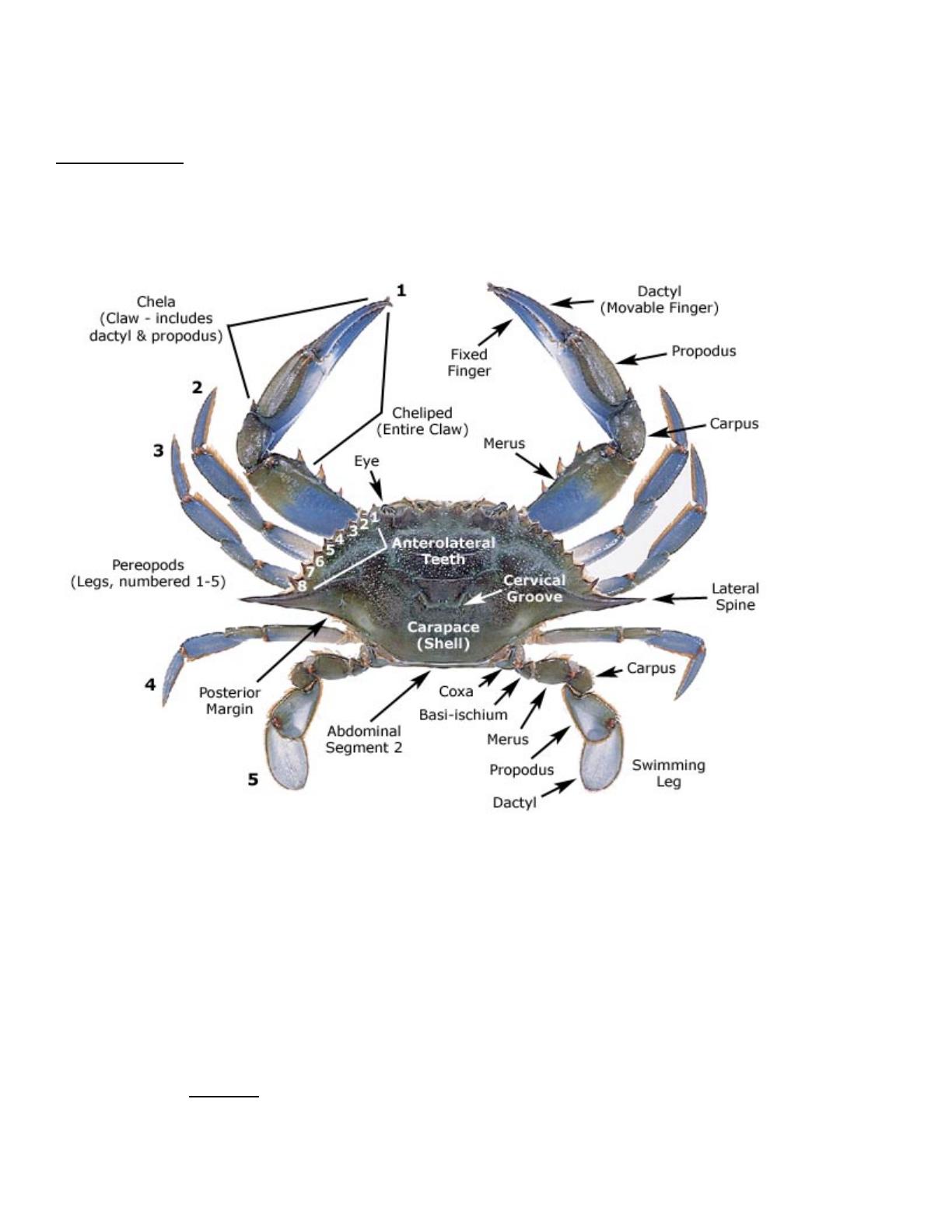
Examine your crab and note that, unlike more primitive decapods such as shrimps and crayfish, the body is very wide
and is dorsoventrally flattened. Most of the body is head and thorax which are covered dorsally by a large hard
carapace.
Examine the external anatomy of your specimen.
Pereopods can be voluntarily autotomized (=self cut) to escape predation, reduce blood loss from a wound, or in
response to physiological stress. Pereopods 2-5 are similar to each other. Pereopod 1 is the cheliped and the pincer at its
distal end is the chela. The cheliped is much more robust than the other pereopods and is constructed so that the dactyl
is a movable finger that opposes an immovable finger. Note the teeth on the fingers.
1. How wide is the body of your crab? (Measure from the point of one lateral spine to the other) _____________
2. Locate the periopods
a. How many are there? __________________
3. The cheliped is the entire claw which is made up of a movable (dactyl) and fixed finger.
a. Can you open and close the dactyl?______________
b. What is the function of these pereopods?_______________
4. Find the last pair of periopods.
a. What is the function of this pair? ________________________
b. How does their shape lend to this function? ________________________
5. Locate the eyes of your specimen
a. How does general position and anatomy differ from a human’s eye?
_____________________________________________________________________________________
6. Locate the anterolateral teeth located on the carapace of your specimen. How many are there? ____________
Turn Over Your Specimen
7. How many body regions does your specimen have? _________________ Name each of the regions below.
a. ________________________
b. ________________________
c. ________________________
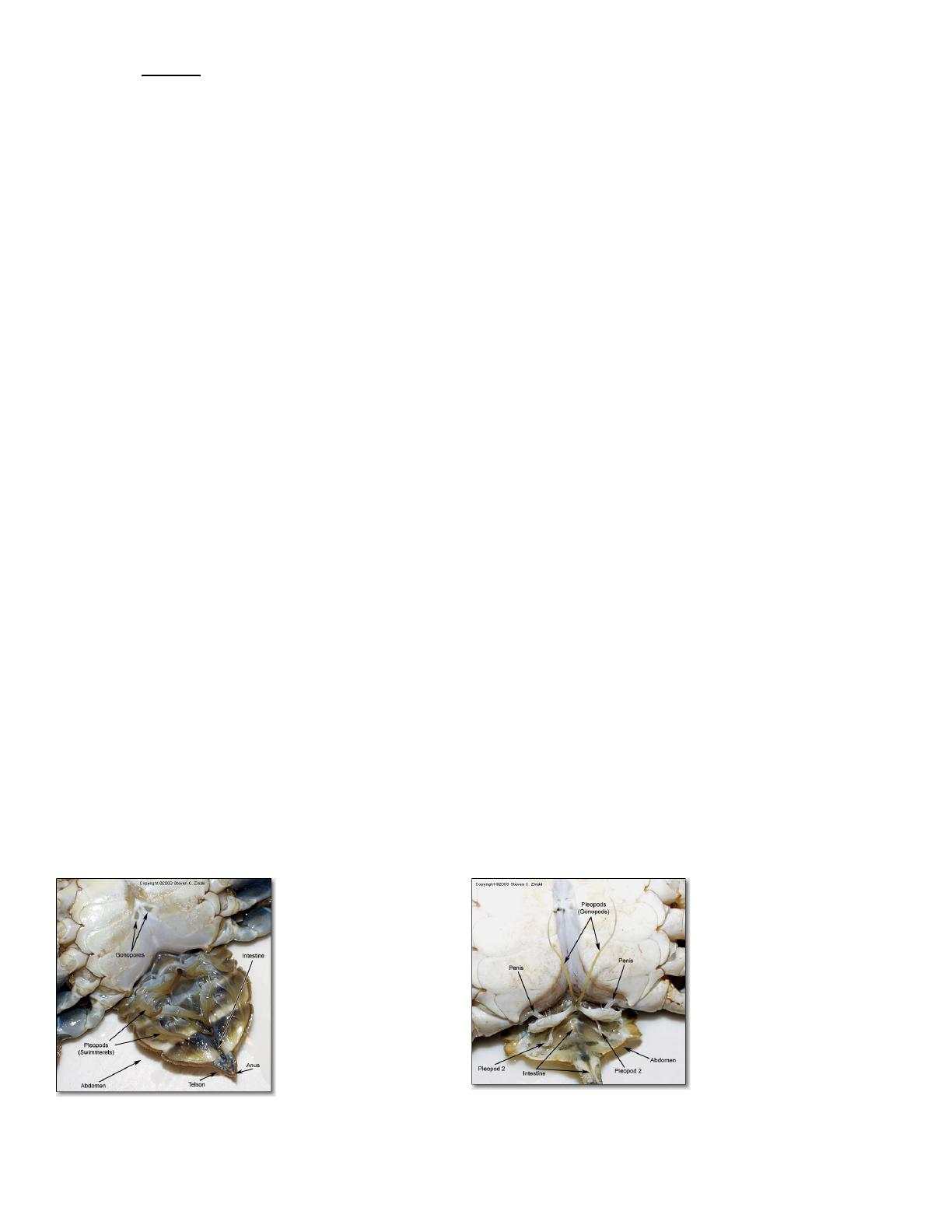
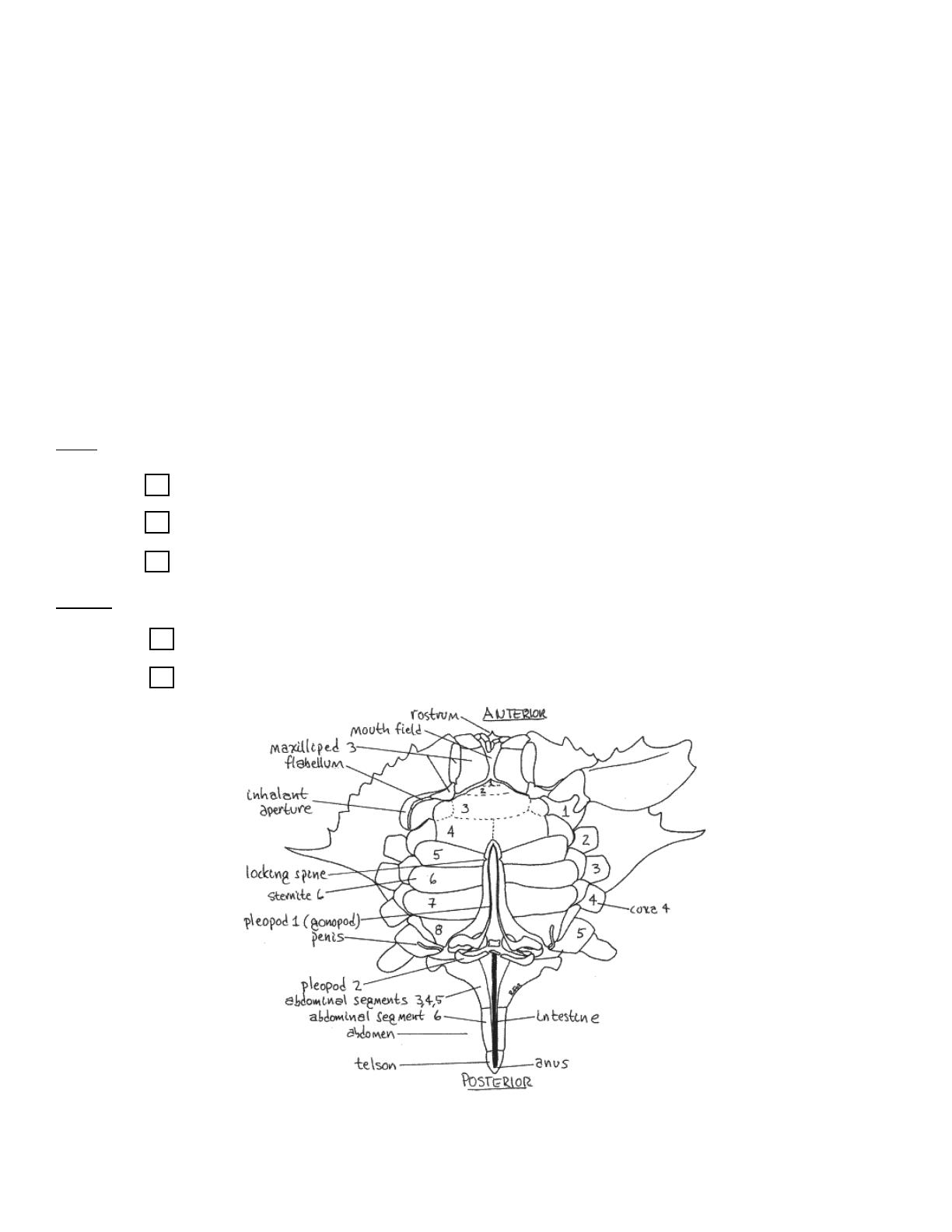
On the ventral surface locate the abdomen folded beneath the thorax. The abdomen is sometimes called the pleon and
its appendages are pleopods. In true crabs (such as Callinectes and Cancer) the abdomen is a small segmented structure
whose shape varies with sex and maturity. In mature females it is broad with convex sides and covers most of the
posterior ventral surface of the thorax. In immature females the abdomen a nearly equilateral triangle whereas the
abdomen of males is narrow with a broad base. Determine the sex of your specimen.
Female Male
8. Is your specimen a male or female? _________________________________
Extend the abdomen so it is no longer folded but points posteriorly from the thorax. The transparent, membranous
intestine runs along the ventral midline of the abdomen and terminates at the anus on the telson. It may be filled with
dark feces in which case it is easier to see.
9. Locate the intestine.
10. Is it filled with feces? ________________
Study the appendages without removing them from the animal. The basic crustacean appendage is biramous, meaning
they have two extensions. Extend the abdomen again, look at its ventral surface, and find the abdominal appendages, or
pleopods. Males have only two pairs of pleopods and they are located anteriorly on the abdomen, on segments 1 and 2.
Both function in the transfer of sperm to the female during copulation. The long, curved, tubular first pleopod is the
gonopod. It, not the penis, is the organ used to deliver spermatophores to the female gonopore. The second pleopod is
much shorter and functions as a piston to push spermatophores through the hollow core of the gonopod.
Check the box once you have identified these structures:
Male:
Gonopod
Pleopod 2
Penis
Female:
Pleopods
Gonopores
/ 6
End of Document
379
You May Also Like

FAQs of Blue Crab Dissection Guide for Biology Students

What are the main functions of the blue crab's appendages?
The blue crab's appendages serve various functions essential for survival. The pereopods, especially the chelipeds, are used for grasping and defense, while the last pair of pereopods aids in swimming. The pleopods are involved in reproduction, with males using specialized pleopods to transfer sperm to females. Understanding these functions is crucial for studying the crab's behavior and ecological role.
How can you differentiate between male and female blue crabs?
Male and female blue crabs can be distinguished by examining their abdominal shapes and coloration. Males typically have a narrow, triangular abdomen, while females possess a broader, rounded abdomen that covers more of the thorax. Additionally, females often display a reddish tint on their claws, whereas males have blue claws. This sexual dimorphism plays a significant role in their reproductive strategies.
What is the role of the antennal glands in blue crabs?
Antennal glands in blue crabs function primarily as osmoregulatory organs, helping the crabs maintain their internal salt balance in varying salinity environments. These glands are located behind the second antenna and are crucial for the crab's survival in coastal habitats. They filter out excess salts from the hemolymph, allowing blue crabs to thrive in both fresh and saltwater conditions.
What are the key anatomical features of the blue crab's digestive system?
The blue crab's digestive system includes a complex stomach divided into two chambers: the cardiac and pyloric stomach. The cardiac stomach is responsible for grinding food, aided by calcareous ossicles and muscles. Digestive glands surrounding the stomach secrete enzymes that facilitate digestion. Understanding this system is vital for studying how blue crabs process their food and obtain nutrients.
What are the steps involved in performing a blue crab dissection?
Performing a blue crab dissection involves several careful steps. First, the crab is positioned dorsal side up, and a cut is made around the carapace to expose the internal organs. Care must be taken to avoid damaging the underlying tissues. Once the carapace is removed, students can examine the digestive system, gills, and heart. Following the dissection, students should identify and label the various anatomical structures for a comprehensive understanding.

Related of Blue Crab Dissection Guide for Biology Students