Heat Shock Response in Hyperthermophilic Microorganisms

Heat Shock Response in Hyperthermophilic Microorganisms

The heat shock response in hyperthermophilic microorganisms explores how these extreme organisms adapt to high temperatures exceeding 90°C. This research highlights the production of chaperonin complexes and thermoprotectants like di-myo-inositol phosphate, essential for protein stabilization under thermal stress. The study also examines the role of hydrostatic pressure in enhancing thermotolerance and the mechanisms of acquired thermotolerance observed in species such as Pyrococcus sp. strain ES4. This work is valuable for microbiologists and researchers studying extremophiles and their applications in biotechnology.

Key Points

  • Examines the heat shock response mechanisms in hyperthermophilic microorganisms.
  • Highlights the role of chaperonin complexes in protein stabilization during thermal stress.
  • Discusses thermoprotectants like di-myo-inositol phosphate and their functions.
  • Explores the impact of hydrostatic pressure on thermotolerance in extremophiles.
  • Analyzes acquired thermotolerance in Pyrococcus sp. strain ES4 under super-optimal temperatures.
254
/ 8
Stress Genes: Role in Physiological Ecology
Microbial Biosystems: New Frontiers
Proceedings of the 8
th
International Symposium on Microbial Ecology
Bell CR, Brylinsky M, Johnson-Green P (eds)
Atlantic Canada Society for Microbial Ecology, Halifax, Canada, 1999.
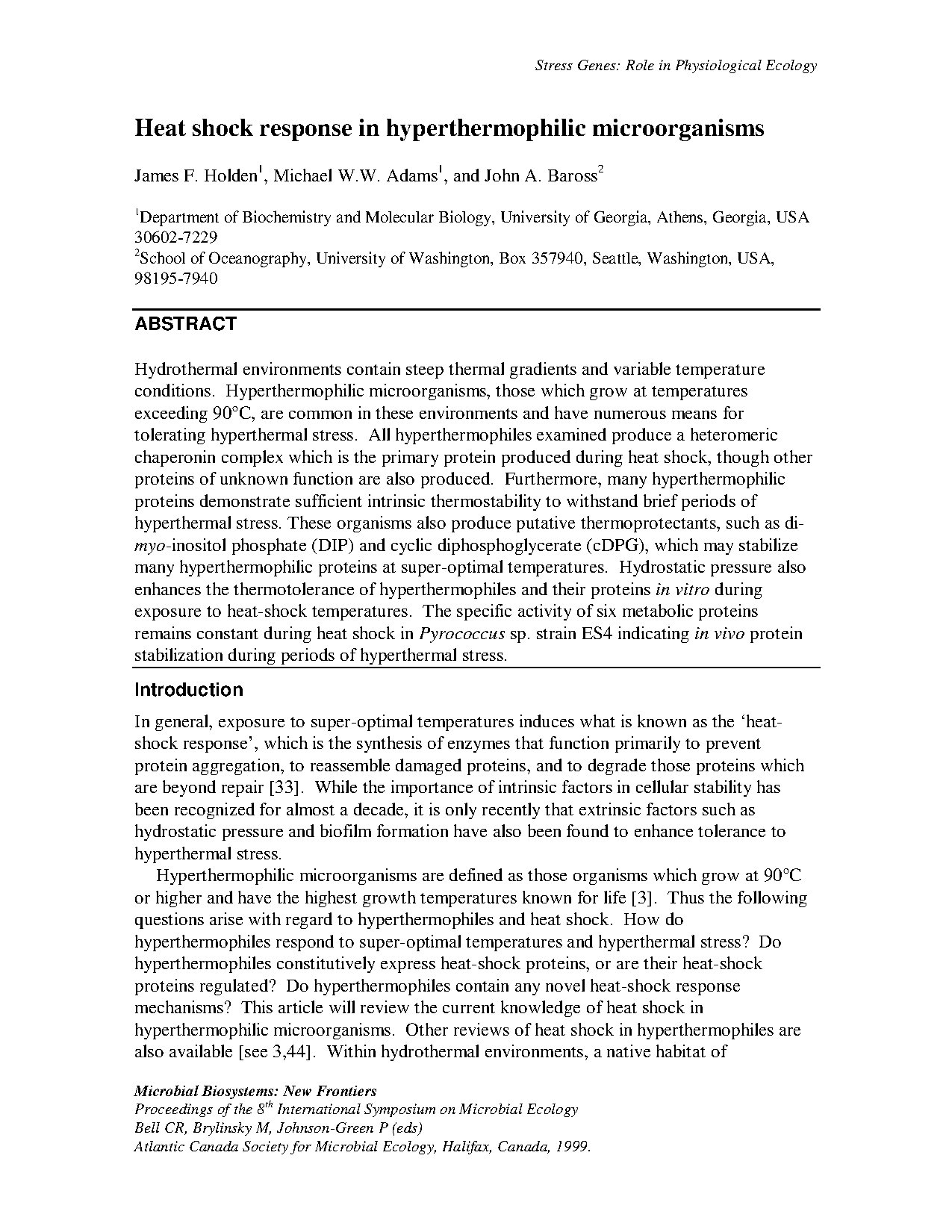
Heat shock response in hyperthermophilic microorganisms
James F. Holden
1
, Michael W.W. Adams
1
, and John A. Baross
2
1
Department of Biochemistry and Molecular Biology, University of Georgia, Athens, Georgia, USA
30602-7229
2
School of Oceanography, University of Washington, Box 357940, Seattle, Washington, USA,
98195-7940
ABSTRACT
Hydrothermal environments contain steep thermal gradients and variable temperature
conditions. Hyperthermophilic microorganisms, those which grow at temperatures
exceeding 90°C, are common in these environments and have numerous means for
tolerating hyperthermal stress. All hyperthermophiles examined produce a heteromeric
chaperonin complex which is the primary protein produced during heat shock, though other
proteins of unknown function are also produced. Furthermore, many hyperthermophilic
proteins demonstrate sufficient intrinsic thermostability to withstand brief periods of
hyperthermal stress. These organisms also produce putative thermoprotectants, such as di-
myo-inositol phosphate (DIP) and cyclic diphosphoglycerate (cDPG), which may stabilize
many hyperthermophilic proteins at super-optimal temperatures. Hydrostatic pressure also
enhances the thermotolerance of hyperthermophiles and their proteins in vitro during
exposure to heat-shock temperatures. The specific activity of six metabolic proteins
remains constant during heat shock in Pyrococcus sp. strain ES4 indicating in vivo protein
stabilization during periods of hyperthermal stress.
Introduction
In general, exposure to super-optimal temperatures induces what is known as the ‘heat-
shock response’, which is the synthesis of enzymes that function primarily to prevent
protein aggregation, to reassemble damaged proteins, and to degrade those proteins which
are beyond repair [33]. While the importance of intrinsic factors in cellular stability has
been recognized for almost a decade, it is only recently that extrinsic factors such as
hydrostatic pressure and biofilm formation have also been found to enhance tolerance to
hyperthermal stress.
Hyperthermophilic microorganisms are defined as those organisms which grow at 90°C
or higher and have the highest growth temperatures known for life [3]. Thus the following
questions arise with regard to hyperthermophiles and heat shock. How do
hyperthermophiles respond to super-optimal temperatures and hyperthermal stress? Do
hyperthermophiles constitutively express heat-shock proteins, or are their heat-shock
proteins regulated? Do hyperthermophiles contain any novel heat-shock response
mechanisms? This article will review the current knowledge of heat shock in
hyperthermophilic microorganisms. Other reviews of heat shock in hyperthermophiles are
also available [see 3,44]. Within hydrothermal environments, a native habitat of
Stress Genes: Role in Physiological Ecology
hyperthermophiles, temperatures are prone to spatial and temporal variations due to tidal
flexing of the earth’s crust which causes diurnal temperature fluctuations [42], dynamic
fluid flow patterns, and steep temperature gradients. Therefore, hyperthermophiles must
employ thermal stress mechanisms to withstand the super-optimal temperatures encountered
from these variations.
In vivo
evidence for heat shock in hyperthermophiles
When a culture of microorganisms is exposed to super-optimal growth temperatures, the
number of viable cells decreases exponentially with time, and this rate of decline increases
exponentially with increasing temperature [32]. However, if a culture is exposed to a mild
hyperthermal stress temperature prior to exposure to a more lethal temperature, then the
number of viable cells in the culture will remain significantly higher for a period of time
before they begin to die. This kinetic display of enhanced tolerance to super-optimal
temperatures is known as ‘acquired thermotolerance’ and is attributed to the expression of
the heat-shock response [33]. Acquired thermotolerance kinetics have been observed in the
sulfur-oxidizing hyperthermophile
Sulfolobus shibatae
and in the anaerobic sulfur reducer
Pyrococcus
sp. strain ES4 [13,47]. ES4 grown at 95°C (optimum growth at 99°C)
demonstrated acquired thermotolerance kinetics at 105°C when cultures were exposed to
102°C for 90 min prior to the shift to 105°C [13].
In both
S. shibatae
and ES4, proteins were produced during exposure to a mild super-
optimal temperature, though the overall rate of protein synthesis decreased [47, J Holden
and J Baross, unpublished results]. The densest protein band produced in both organisms
during heat-shock, as seen by pulse labeling with
35
S-labeled amino acids, had a mass of
approximately 60 kDa and was shown to be a chaperonin [see below]. In ES4, other
proteins of various masses were also produced whose function remains unknown.
Furthermore, during
in vivo
exposure to 102°C for up to 90 min, six metabolic proteins
maintained constant specific activity [J Holden and MWW Adams, unpublished results]
demonstrating that some factor(s), extrinsic or intrinsic, was protecting these proteins at the
super-optimal temperature for this organism.
Hyperthermophilic chaperones
The most abundant protein produced during the heat shock response of hyperthermophiles
is the TF55 chaperone. This well-studied enzyme is composed of two stacked rings made
of either eight or nine protein subunits per ring. The enzyme is a hexadecamer in
Pyrodictium occultum
[34,35] and an octadecamer in
S. shibatae
[25,46], these are
heteromeric proteins, and consist of one of two closely related proteins, each with a mass of
approximately 60 kDa, which are present in a 1:1 ratio [16,35]. This chaperone is
expressed constitutively and is abundant in hyperthermophiles under normal growth
conditions, suggesting that it is used to protect proteins (perhaps intermediates formed
during translation) from high temperatures when the cell is not under duress. The TF55
chaperone, a homolog of the enzyme (as detected by antibodies), or a homolog of the TF55
gene, has been found in all of the major genera of hyperthermophilic archaea
[2,16,17,34,48]. The chaperone from
Sulfolobus
spp. reduced the denaturation rate of a
target protein at high temperatures [46] and hydrolyzed ATP in the presence of K
+
[10,20].
The chaperone from
S. solfataricus
underwent a major conformational change in the
presence of ATP and Mg
2+
, bound to denatured target protein with refolding occurring
Stress Genes: Role in Physiological Ecology
upon addition of K
+
, and released the substrate following hydrolysis of the ATP [10]. Upon
ATP hydrolysis, the chaperone from
S. shibatae
dissociated into free subunits and the
equilibrium between complex and subunits was affected by temperature and ATP levels
[37]. There was an 80% recovery of the activity of heat-denatured lysozyme when
incubated with
S. solfataricus
chaperone, Mg
2+
, K
+
, and ATP [10]. Recently, it has been
suggested that TF55 is also a component of archaeal cytoskeleton [45] and is most closely
related phylogenetically to TCP-1 cytoskeleton protein from mice [16,46]. The protein
shows very little phylogenetic homology with other known mesophilic chaperones, but is
considered part of the GroEL/HSP60 chaperonin family based on functional and structural
similarities [16,44].
Conspicuously absent from hyperthermophilic archaea is a homolog to the other major
heat-shock chaperone typically found in mesophiles, the HSP70/DnaK protein. No
dna
K
homolog has been found in the genome sequences of
Methanococcus jannaschii
,
Archaeoglobus fulgidus
,
Pyrobaculum aerophilum
,
Pyrococcus horikoshii
, or
Pyrococcus
furiosus
[4,9,18,19, R Weiss, personal communication], and Southern blotting using a
dna
K
probe from
Methanosarcina mazei
S-6, a mesophilic archaeon, against genomic DNA from
Methanothermus fervidus
,
M. jannaschii
, and a
Sulfolobus
sp. failed to detect a homolog
[23]. Little is known about the heat-shock response of hyperthermophilic eubacteria;
however, homologs of
dna
K and
gro
EL are present in both the
Thermotoga maritima
and
Aquifex aeolicus
genomes [7, J Holden, www.ncbi.nlm.nih.gov] suggesting that the heat-
shock responses in these organisms are a high-temperature analog of the mesophilic
response.
Other extrinsic factors which lead to thermotolerance
In addition to chaperones, extrinsic non-enzymatic factors, such as stabilizing solutes (or
thermoprotectants), biofilm formation, and hydrostatic pressure might enhance the stability
of hyperthermophiles at super-optimal temperatures. High concentrations of cyclic 2,3-
diphosphoglycerate (cDPG) were found in
Methanothermus fervidus
and
Methanopyrus
kandleri
[12,22] and high concentrations of di-
myo
-inositol phosphate (DIP) were found in
Methanococcus igneus
(but not in other
Methanococcus
spp.),
Pyrococcus woesei
,
P.
furiosus
,
Pyrodictium occultum
,
A. fulgidus
, and
T. maritima
[6,27,38].
In vitro
experiments showed that cDPG acted as a stabilizer of glyceraldehyde-3-phosphate
dehydrogenase (G3PDH) and malate dehydrogenase at denaturing temperatures, but not of
DNA [12], and that DIP also stabilized G3PDH
in vitro
[41]. However, DIP from
T.
maritima
did not stabilize hydrogenase or pyruvate ferredoxin oxidoreductase suggesting
that it is not a general thermoprotectant [38]. The concentration of cDPG increased in
M.
fervidus
with increasing growth temperature [12], and the concentration of DIP increased
up to 20 fold after exposure to super-optimal temperatures in
M. igneus
,
P. furiosus
, and
A.
fulgidus
[6,27,28]. Therefore, these data suggest that: a) cDPG and DIP are part of the
heat-shock response in hyperthermophiles; b) they act specifically to stabilize certain
proteins rather than other macromolecules; and c) the enzymes necessary for their synthesis
may be produced during heat shock.
Biofilms composed of acidic exocellular polysaccharides were formed by the
hyperthermophilic archaea
Thermococcus litoralis
,
A. fulgidus
, and
M. jannaschii
[24,39].
A. fulgidus
cultured under optimal growth conditions do not form a significant biofilm;
/ 8
End of Document
254
You May Also Like

FAQs of Heat Shock Response in Hyperthermophilic Microorganisms

What is the heat shock response in hyperthermophiles?
The heat shock response in hyperthermophiles is a cellular mechanism activated when exposed to temperatures above their optimal growth range. This response involves the synthesis of heat shock proteins, primarily chaperonins, which help prevent protein aggregation and assist in refolding damaged proteins. These proteins are crucial for maintaining cellular function and viability under extreme thermal conditions, allowing hyperthermophiles to thrive in their native hydrothermal environments.
How do thermoprotectants function in hyperthermophilic microorganisms?
Thermoprotectants, such as di-myo-inositol phosphate (DIP) and cyclic diphosphoglycerate (cDPG), play a vital role in stabilizing proteins during periods of heat stress. These compounds help maintain protein structure and function at elevated temperatures, thereby enhancing the organism's overall thermotolerance. Research indicates that the concentration of these thermoprotectants increases significantly when hyperthermophiles are exposed to super-optimal temperatures, suggesting they are part of the heat shock response.
What role does hydrostatic pressure play in thermotolerance?
Hydrostatic pressure has been shown to enhance the thermotolerance of hyperthermophilic microorganisms. Studies indicate that increased pressure can raise the maximum growth temperatures of certain species, allowing them to withstand higher thermal stress. For example, Pyrococcus sp. strain ES4 exhibited improved thermotolerance when subjected to high-pressure conditions, suggesting that pressure may induce conformational changes in proteins that enhance their stability at elevated temperatures.
What is acquired thermotolerance in hyperthermophiles?
Acquired thermotolerance refers to the phenomenon where hyperthermophilic microorganisms exhibit enhanced survival rates when pre-exposed to mild heat stress before facing lethal temperatures. This adaptive response is linked to the expression of heat shock proteins and other protective mechanisms that prepare the cells for subsequent thermal challenges. For instance, Pyrococcus sp. strain ES4 demonstrates acquired thermotolerance when grown at 95°C and then exposed to even higher temperatures.
What are the main findings regarding chaperonins in hyperthermophiles?
Chaperonins, particularly the TF55 complex, are the primary proteins produced during the heat shock response in hyperthermophiles. These proteins are essential for preventing protein denaturation and assisting in the refolding of misfolded proteins under thermal stress. The study reveals that these chaperonins are constitutively expressed, indicating their importance in maintaining cellular integrity not only during stress but also under normal growth conditions.

Related of Heat Shock Response in Hyperthermophilic Microorganisms