Temperature-Substrate Controversy in Bacterial Growth

Temperature-Substrate Controversy in Bacterial Growth

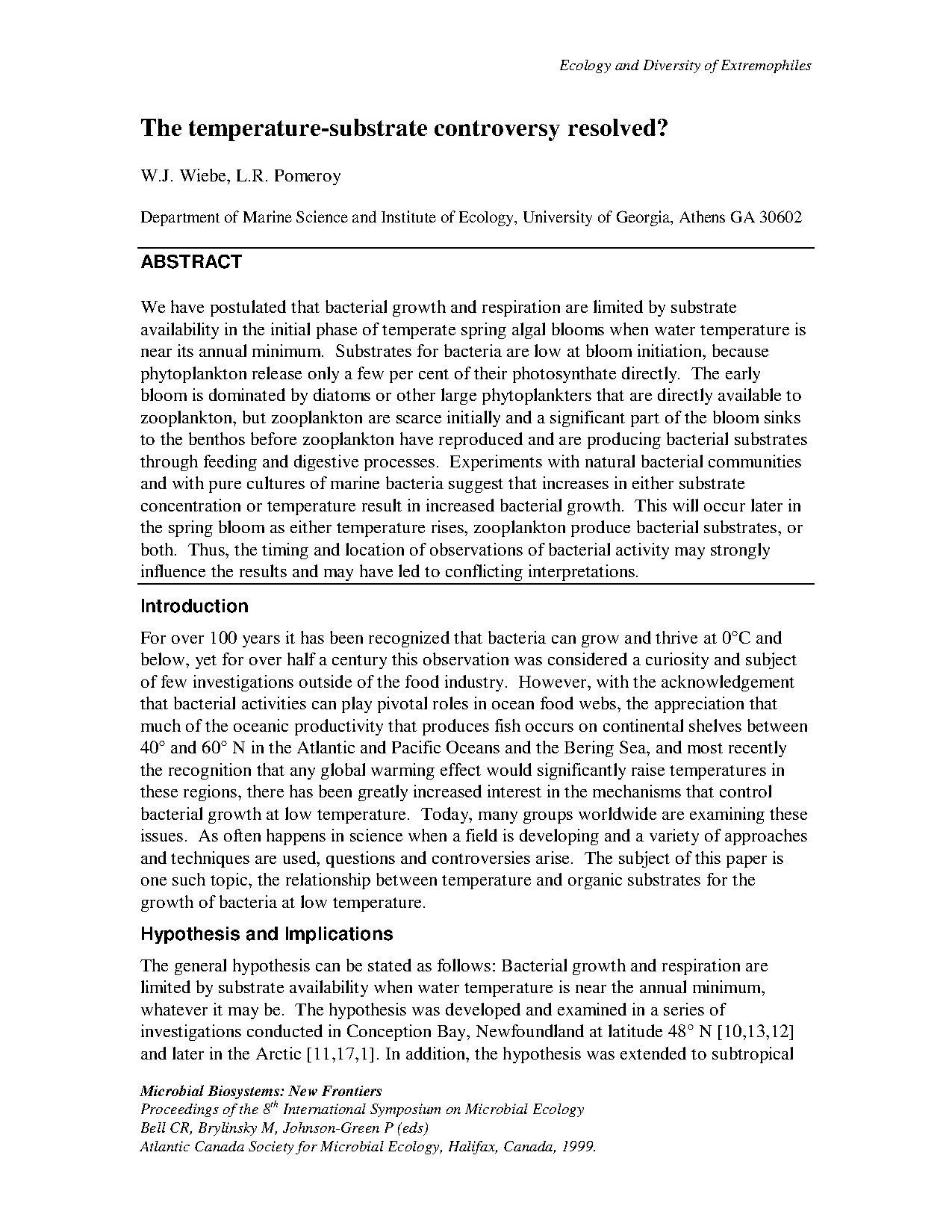
The temperature-substrate controversy explores how bacterial growth and respiration are influenced by substrate availability, particularly during temperate spring algal blooms. Authors W.J. Wiebe and L.R. Pomeroy present evidence suggesting that low substrate levels limit bacterial activity when water temperatures are at their annual minimum. This research is crucial for understanding microbial dynamics in ocean ecosystems, especially in regions experiencing global warming. The findings are significant for marine scientists studying the interactions between phytoplankton, zooplankton, and bacteria. This work is essential for researchers examining the microbial loop and its implications for marine food webs.

Key Points

  • Examines the relationship between temperature and substrate availability for bacterial growth.
  • Discusses the impact of low temperatures on bacterial respiration during spring algal blooms.
  • Highlights the role of zooplankton in generating bacterial substrates in marine ecosystems.
  • Analyzes conflicting studies regarding bacterial activity in cold waters and their implications for oceanic productivity.
251
/ 5
Ecology and Diversity of Extremophiles
Microbial Biosystems: New Frontiers
Proceedings of the 8
th
International Symposium on Microbial Ecology
Bell CR, Brylinsky M, Johnson-Green P (eds)
Atlantic Canada Society for Microbial Ecology, Halifax, Canada, 1999.
The temperature-substrate controversy resolved?
W.J. Wiebe, L.R. Pomeroy
Department of Marine Science and Institute of Ecology, University of Georgia, Athens GA 30602
ABSTRACT
We have postulated that bacterial growth and respiration are limited by substrate
availability in the initial phase of temperate spring algal blooms when water temperature is
near its annual minimum. Substrates for bacteria are low at bloom initiation, because
phytoplankton release only a few per cent of their photosynthate directly. The early
bloom is dominated by diatoms or other large phytoplankters that are directly available to
zooplankton, but zooplankton are scarce initially and a significant part of the bloom sinks
to the benthos before zooplankton have reproduced and are producing bacterial substrates
through feeding and digestive processes. Experiments with natural bacterial communities
and with pure cultures of marine bacteria suggest that increases in either substrate
concentration or temperature result in increased bacterial growth. This will occur later in
the spring bloom as either temperature rises, zooplankton produce bacterial substrates, or
both. Thus, the timing and location of observations of bacterial activity may strongly
influence the results and may have led to conflicting interpretations.
Introduction
For over 100 years it has been recognized that bacteria can grow and thrive at 0°C and
below, yet for over half a century this observation was considered a curiosity and subject
of few investigations outside of the food industry. However, with the acknowledgement
that bacterial activities can play pivotal roles in ocean food webs, the appreciation that
much of the oceanic productivity that produces fish occurs on continental shelves between
40° and 60° N in the Atlantic and Pacific Oceans and the Bering Sea, and most recently
the recognition that any global warming effect would significantly raise temperatures in
these regions, there has been greatly increased interest in the mechanisms that control
bacterial growth at low temperature. Today, many groups worldwide are examining these
issues. As often happens in science when a field is developing and a variety of approaches
and techniques are used, questions and controversies arise. The subject of this paper is
one such topic, the relationship between temperature and organic substrates for the
growth of bacteria at low temperature.
Hypothesis and Implications
The general hypothesis can be stated as follows: Bacterial growth and respiration are
limited by substrate availability when water temperature is near the annual minimum,
whatever it may be. The hypothesis was developed and examined in a series of
investigations conducted in Conception Bay, Newfoundland at latitude 48° N [10,13,12]
and later in the Arctic [11,17,1]. In addition, the hypothesis was extended to subtropical
Ecology and Diversity of Extremophiles
waters [16]. In fact, it applies more generally, even to
Escherichia coli.
The temperature-
substrate response of
E. coli
is nearly flat in its optimal temperature range, but generation
times rise steeply as limiting temperature-substrate conditions are approached (Fig. 1).
There are two implications that can be derived from this hypothesis:
A. As documented by Pomeroy and Deibel [10] and Pomeroy et al. [13], under early
spring bloom conditions at -1 to 0° C in Conception Bay, Newfoundland, the
microbial loop functioned minimally. Only a small percentage (<5%) of the
primary production was being consumed by the bacteria, whereas in other areas of
the ocean or at other times in the areas examined, 20-60% of the primary
production has been estimated to be consumed. Since there is a large area of the
ocean that also develops spring blooms, this behavior may be considered a
quantitatively significant phenomenon.
B. The second implication is that virtually all of the primary production in this initial
period of the bloom is available directly to benthic metazoa. These spring blooms
are dominated by diatoms, which can and do sink to the ocean floor. Jumars et al.
[3] have made a strong case that sinking bloom algae constitute the major—and
pulsed—source of organic matter for benthic animals. Thus the reduced
microzooplankton grazing and resulting reduced activity of the microbial loop
increases food availability to the benthos.
10
20
30
1.5
15
150
1500
15000
0
10
20
30
40
50
°C
mg/liter
Fig. 1. Relation of growth rates of E. coli to substrate concentration and temperature (data from [16]).
Discussion
It would be unnatural, indeed upsetting, if the proposal presented above did not stimulate
some controversy, and it has. A number of published studies dispute the hypothesis and a
number have supported it. In this section we will discuss three major issues that have
arisen and attempt to resolve them or point out areas that need further examination.
The first problem concerns the ability of bacteria to grow at low temperature.
Microbiologists have provided abundant evidence that bacteria in culture and in nature can
grow rapidly at low temperatures [7]. However, in all of these studies, very high
concentrations of substrate have been used, generally on the order of grams per liter. In
Ecology and Diversity of Extremophiles
our culture studies we also found relatively rapid growth rates at 0°C, provided substrate
concentration was high [17]. Similarly, Pomeroy and Deibel [10] and Pomeroy et al. [11]
demonstrated that the respiration of natural populations, while minimal or unmeasureable
in unamended samples, was substantial if amended with substrate, or it the temperature
was elevated from the spring minimum temperature of -1 or 0° to +2 or 3.5°C. Nedwell
and Rutter [1990] have provided evidence for a mechanism that may explain these data.
They found that at temperatures approaching the minimum for growth of two
psychrotolerant Antarctic bacteria, there was a decrease of specific affinity for substrate.
Thus at low temperatures, higher substrate concentrations are required for growth than at
higher temperatures. Figure 1 presents a graphical example of this statement. We find
this same relationship in many cultures of marine bacteria. The problem appears to be not
the lack of growth per se at minimal temperatures, but the lack of sufficient substrate in
the natural environment.
Studies in cold sediments [9] and in sea ice [4], in which bacterial activities approach
those in warmer waters, have also been used to dispute the hypothesis. However, these
environments contain relatively high natural substrate concentrations and thus are not
comparable to the conditions in the water column (It should be noted that the authors
cited do not make this claim.).
A second problem involves the source of substrates for bacteria. As reviewed by
Pomeroy and Wiebe [12], a wide variety of potential sources of substrates exist, among
them the exudates from algae, which should be maximal during blooms. However, since
actively growing phytoplankton usually release ≤10% of their photosynthate as dissolved
products (e. g. [5]), bacteria could not be expected to process more than this amount
unless there were algal cell lysis or cell breakage due to grazing. In the initial period of
the spring blooms in Conception Bay, few zooplankters were present and their
development time at 0° approaches 70 days [6]. There was no evidence of algal cells
lysing. Thus there appears to be a time window at the start of the spring bloom when the
algae are growing rapidly and accumulating, but most of their production is not available
to the bacteria.
The third problem is one of data interpretation. Investigators studying bacterial activity
in cold temperate spring blooms have arrived at different conclusions using apparently
similar methods: direct bacterial counts as a measure of biomass and thymidine or leucine
incorporation as a measure of bacterial activity. For example, van Boekel et al. [15]
reported that the biomass of bacteria and protozoa remained low during a
Phaeocystis
bloom in the North Sea until the bloom started to decline. However, Rivkin et al. [14],
while noting that the biomass of bacteria was low in a Conception Bay spring bloom,
found rapid per-cell growth rates for the bacteria, comparable to those in temperate
waters. Rivkin et al. [14] have compared their bacterial productivity data with those in
Pomeroy et al. [13] and concluded that the discrepancy between the two data sets involves
the conversion factors for uptake of radioactive thymidine to bacterial growth rates rather
than in the data themselves.
Since the bacterial biomass in both studies [14,13] was equally low, the bacterial
productivity data would not necessarily dispute the respiration results of Pomeroy and
Deibel [10] or Pomeroy et al. [13]. Thymidine uptake is an extremely sensitive assay
(nanomoles of uptake), while respiration measurements are orders of magnitude less
/ 5
End of Document
251
You May Also Like

FAQs of Temperature-Substrate Controversy in Bacterial Growth

What is the main hypothesis regarding bacterial growth at low temperatures?
The main hypothesis posits that bacterial growth and respiration are limited by substrate availability when water temperatures are near their annual minimum. This idea is supported by studies conducted in Conception Bay, Newfoundland, where it was observed that during early spring blooms, bacterial consumption of primary production is minimal. The research indicates that as temperatures rise and zooplankton populations increase, bacterial growth rates also improve due to higher substrate availability.
How does substrate availability affect the microbial loop during algal blooms?
Substrate availability plays a critical role in the functioning of the microbial loop during algal blooms. In the early stages of these blooms, phytoplankton release only a small percentage of their photosynthate, limiting the organic matter available for bacteria. As zooplankton populations develop and begin to graze on phytoplankton, they produce additional substrates through their feeding processes. This shift is essential for stimulating microbial activity and enhancing the overall productivity of the marine food web.
What evidence supports the hypothesis about bacterial activity in cold waters?
Evidence supporting the hypothesis includes experiments showing that bacterial respiration is significantly enhanced when substrate concentrations are increased or when temperatures rise slightly above the annual minimum. Studies have demonstrated that in environments with high natural substrate concentrations, such as cold sediments and sea ice, bacterial activities can approach those in warmer waters. However, in the open water column during early spring blooms, substrate scarcity limits bacterial growth, highlighting the importance of timing and environmental conditions.
What implications does this research have for understanding ocean ecosystems?
This research has significant implications for understanding the dynamics of ocean ecosystems, particularly in the context of climate change. As global temperatures rise, the interactions between temperature, substrate availability, and bacterial growth will likely shift, affecting marine food webs. Understanding these relationships is crucial for predicting changes in productivity and biodiversity in oceanic regions, especially those that are already experiencing stress from warming temperatures.
What are the main findings regarding bacterial growth rates in cold environments?
The main findings indicate that while bacteria can grow at low temperatures, their growth rates are significantly influenced by substrate availability. Research shows that at temperatures approaching the minimum for growth, bacteria require higher substrate concentrations for optimal growth. This suggests that in natural cold environments, the lack of sufficient organic matter can severely limit bacterial activity, which in turn affects the entire microbial loop and nutrient cycling in these ecosystems.
How do different studies interpret bacterial activity during spring blooms?
Different studies have reported varying conclusions regarding bacterial activity during spring blooms, often due to differences in methodology. Some researchers have found low bacterial biomass during blooms, while others have noted rapid per-cell growth rates. These discrepancies highlight the complexity of measuring bacterial productivity and the need for standardized methods to assess bacterial activity accurately. Understanding these differences is essential for reconciling conflicting data and improving our knowledge of microbial dynamics in marine environments.
What role do zooplankton play in enhancing bacterial growth?
Zooplankton play a crucial role in enhancing bacterial growth by providing additional substrates through their grazing activities. When zooplankton consume phytoplankton, they not only reduce the algal biomass but also release organic matter that bacteria can utilize. This process is essential for stimulating the microbial loop, particularly in the early stages of algal blooms when bacterial substrate availability is limited. The timing of zooplankton population growth relative to algal blooms is therefore critical for the overall productivity of marine ecosystems.

Related of Temperature-Substrate Controversy in Bacterial Growth