Chemical Oxygen Demand Experiment Methodology

Chemical Oxygen Demand Experiment Methodology

The experiment on Chemical Oxygen Demand (COD) outlines a standardized method for measuring organic pollutants in water and wastewater. It emphasizes the significance of COD in assessing water quality and its environmental implications. The procedure follows IS: 3025 (Part 58) and includes detailed steps for sample preparation, reagent usage, and titration techniques. This guide is essential for environmental science students and professionals conducting water quality assessments. It provides insights into the relationship between COD and BOD, highlighting the importance of these measurements in wastewater treatment processes.

Key Points

  • Describes the procedure for determining Chemical Oxygen Demand in water samples.
  • Explains the environmental significance of COD in assessing water quality.
  • Details the materials and reagents required for the COD experiment.
  • Includes a step-by-step guide for sample preparation and titration.
  • Discusses the relationship between COD and BOD in wastewater treatment.
280
/ 13
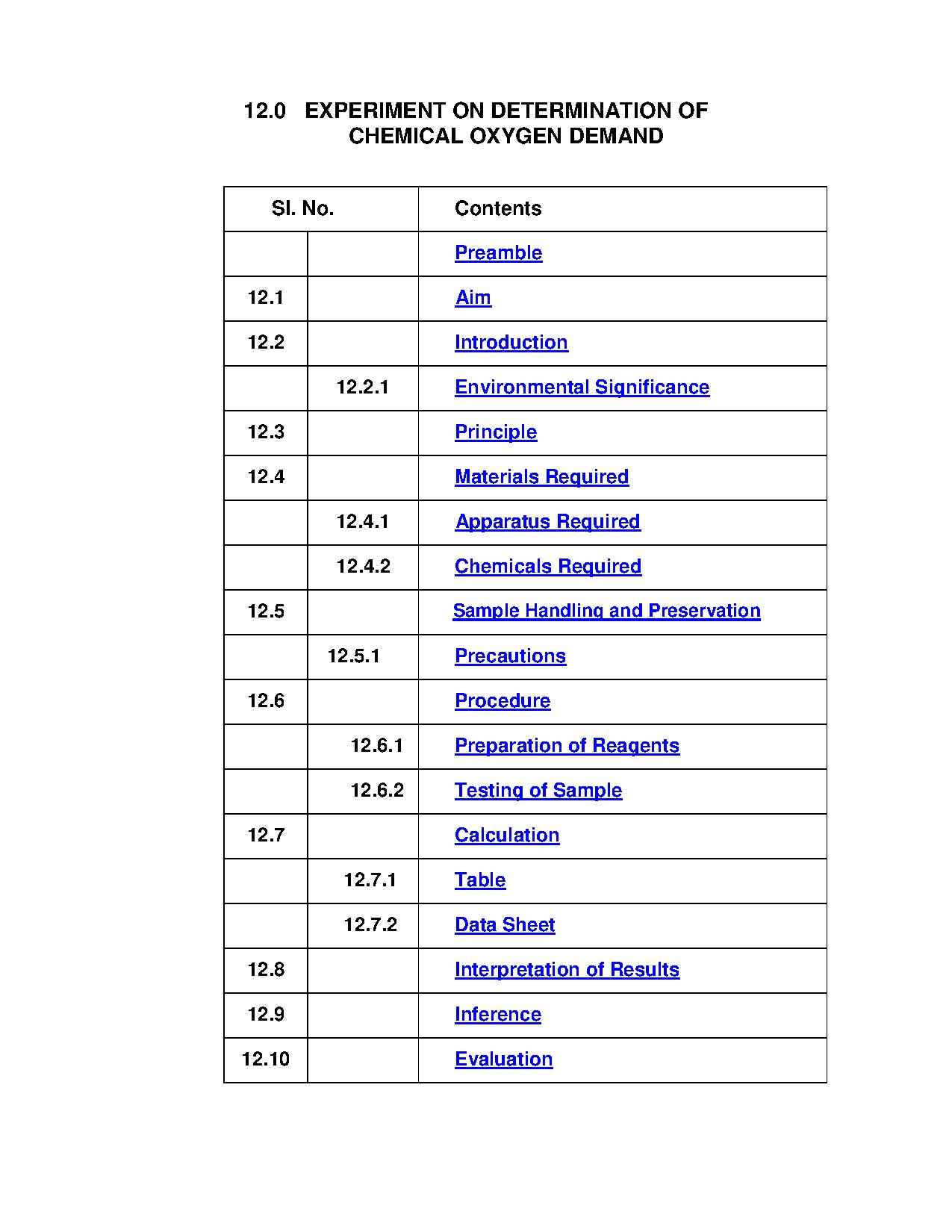
12.0 EXPERIMENT ON DETERMINATION OF
CHEMICAL OXYGEN DEMAND
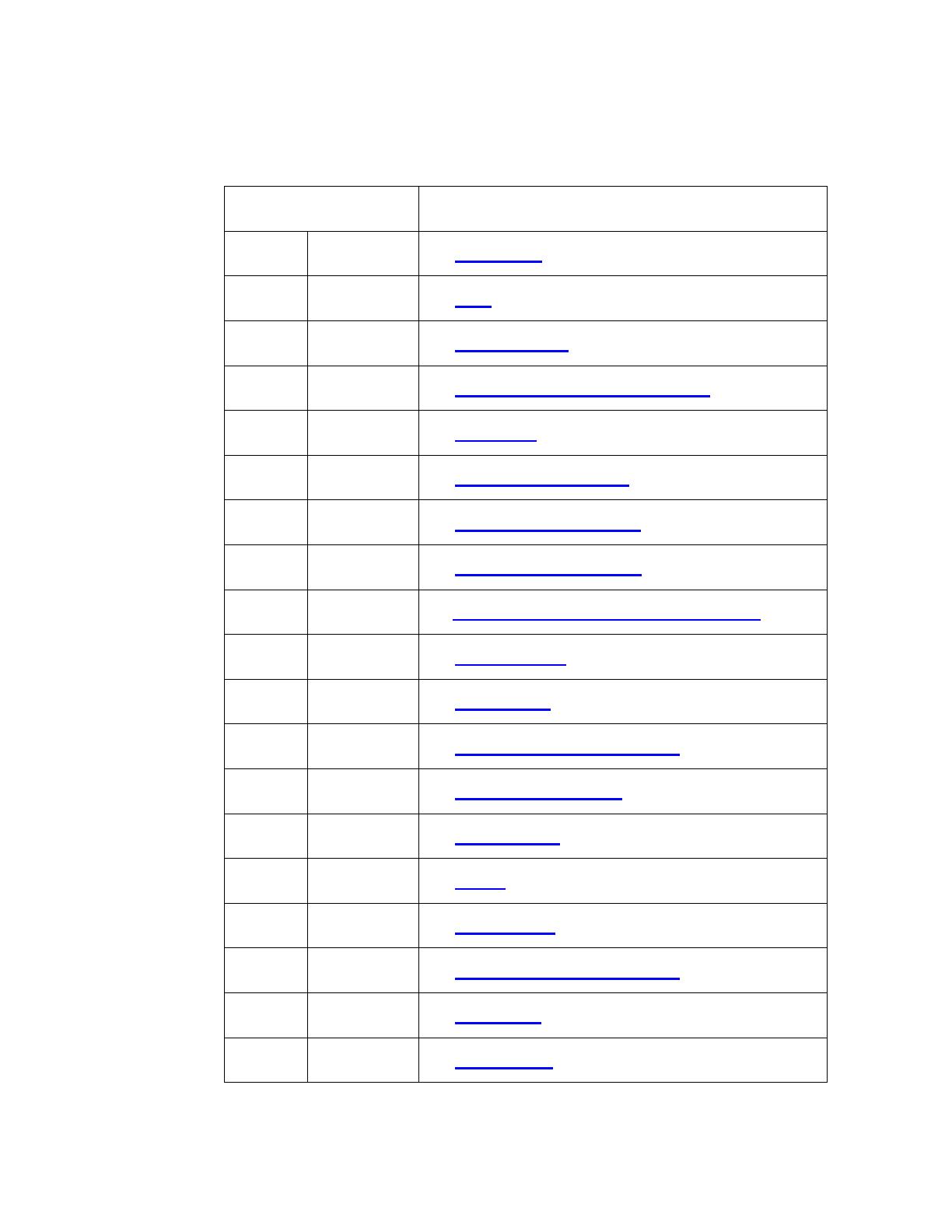
Sl. No. Contents
Preamble
12.1 Aim
12.2 Introduction
12.2.1 Environmental Significance
12.3 Principle
12.4 Materials Required
12.4.1 Apparatus Required
12.4.2 Chemicals Required
12.5
Sample Handling and Preservation
12.5.1 Precautions
12.6 Procedure
12.6.1 Preparation of Reagents
12.6.2 Testing of Sample
12.7 Calculation
12.7.1 Table
12.7.2 Data Sheet
12.8 Interpretation of Results
12.9 Inference
12.10 Evaluation
12.0 EXPERIMENT ON DETERMINATION OF
CHEMICAL OXYGEN DEMAND
PREAMBLE:
How to determine chemical oxygen demand in Water and Wastewater”.
Test procedure is in accordance to IS: 3025 (Part 58) - Reaffirmed 2006.
In addition to our Indian Standard, we also discuss in brief regarding the
procedure stated in
(1) APHA Standard Methods for the Examination of Water and Wastewater - 20
th
Edition. Method 5220 C.
(2) Methods for Chemical Analysis of Water and Wastes, EPA-600/4-79-020,
USEPA, Method 410.1.
12.1 AIM
To determine chemical oxygen demand in the given water sample with the
stipulations as per IS: 3025 (Part 58) - Reaffirmed 2006.
12.2 INTRODUCTION
Before performing this experiment, few questions may arise to the learners:
What is meant by chemical oxygen demand?
Why do we need to determine COD?
What are the methods available to measure COD?
Is it measured in water or wastewater?
Whether is it mandatory to determine COD as per our codal provision?
The chemical oxygen demand (COD) test is commonly used to indirectly
measure the amount of organic compounds in water. Most applications of COD
determine the amount of organic pollutants found in surface water (e.g. lakes and
rivers), making COD a useful measure of water quality. It is expressed in
milligrams per liter (mg/L), which indicates the mass of oxygen consumed per
liter of solution.
COD is the measurement of the amount of oxygen in water consumed for
chemical oxidation of pollutants.
COD determines the quantity of oxygen required to oxidize the organic matter in
water or waste water sample, under specific conditions of oxidizing agent,
temperature, and time.
This method covers the determination of COD in ground and surface waters,
domestic and industrial wastewaters. The applicable range is 3-900 mg/L.
12.2.1 ENVIRONMENTAL SIGNIFICANCE
COD values are particularly important in the surveys designed to determine and
control the losses to sewer systems.
The ratio of BOD to COD is useful to assess the amenability of waste for
biological treatment. Ratio of BOD to COD greater than or equal to 0.8 indicates
that wastewater highly polluted and amenable to the biological treatment.
It is useful to assess strength of wastes, which contain toxins and biologically
resistant organic substances.
COD can be related to TOC, however, does not account for oxidation state of the
organic matter.
BOD value is always lower than COD value. For domestic and some industrial
wastewater, COD value is about 2.5 times BOD value.
12.3 PRINCIPLE
The organic matter present in sample gets oxidized completely by potassium
dichromate (K
2
Cr
2
O
7
) in the presence of sulphuric acid (H
2
SO
4
), silver sulphate
(AgSO
4
) and mercury sulphate (HgSO
4
) to produce CO
2
and H
2
O. The sample is
refluxed with a known amount of potassium dichromate (K
2
Cr
2
O
7
) in the sulphuric
acid medium and the excess potassium dichromate (K
2
Cr
2
O
7
) is determined by
titration against ferrous ammonium sulphate, using ferroin as an indicator. The
dichromate consumed by the sample is equivalent to the amount of O
2
required
to oxidize the organic matter.
12.4 MATERIALS REQUIRED
12.4.1 APPARATUS REQUIRED
1. COD Digester
2. Burette & Burette stand
3. COD Vials with stand
4. 250 mL conical flask (Erlenmeyer Flask)
5. Pipettes
6. Pipette bulb
7. Tissue papers
8. Wash Bottle
/ 13
End of Document
280
You May Also Like

FAQs of Chemical Oxygen Demand Experiment Methodology

What is Chemical Oxygen Demand and why is it important?
Chemical Oxygen Demand (COD) is a measure of the amount of oxygen required to chemically oxidize organic compounds in water. It is crucial for assessing water quality, as it indicates the level of organic pollutants present. High COD values suggest significant pollution, which can affect aquatic life and water usability. Understanding COD helps in evaluating the effectiveness of wastewater treatment processes and the potential impact on the environment.
What are the key steps in the COD determination procedure?
The COD determination procedure involves several key steps: First, a water sample is mixed with potassium dichromate and sulfuric acid in a digestion vial. The mixture is then heated in a COD digester at 150°C for two hours. After cooling, the excess dichromate is titrated with ferrous ammonium sulfate using ferroin as an indicator. The volume of titrant used allows for the calculation of COD based on the amount of oxygen consumed during the oxidation of organic matter.
How does COD relate to BOD in wastewater treatment?
COD and Biochemical Oxygen Demand (BOD) are both measures of organic matter in water, but they differ in what they assess. COD measures the total oxygen required to oxidize all organic material, while BOD specifically measures the oxygen consumed by microorganisms during the decomposition of organic matter. Typically, COD values are higher than BOD values, with a ratio of about 2.5 for domestic wastewater. This relationship helps in evaluating the amenability of wastewater to biological treatment.
What precautions should be taken during the COD experiment?
Several precautions are essential when conducting the COD experiment to ensure accurate results. Chlorides can interfere with the COD measurement, so mercuric sulfate is added to complex them. Additionally, nitrites can also affect results, requiring the addition of sulfuric acid to the potassium dichromate solution. Care must be taken to avoid contamination from organic materials in glassware or the atmosphere, as these can lead to positive errors in the measurements.
What materials are required for the COD determination experiment?
The materials required for the COD determination experiment include a COD digester, burette, COD vials, conical flasks, and various reagents such as potassium dichromate, sulfuric acid, ferrous ammonium sulfate, silver sulfate, and mercury sulfate. Each of these components plays a critical role in the oxidation process and the subsequent titration, which are essential for accurately measuring the Chemical Oxygen Demand in water samples.

Related of Chemical Oxygen Demand Experiment Methodology