This document contains graded questions and answers from the SimBio Darwinian Snails lab, which explores evolution by natural selection through a simulation of crab predation on flat periwinkle snails. It covers key concepts such as variation, heritability, and differential survival, providing insights into the requirements for natural selection. Ideal for students studying biology and evolution.
/ 7

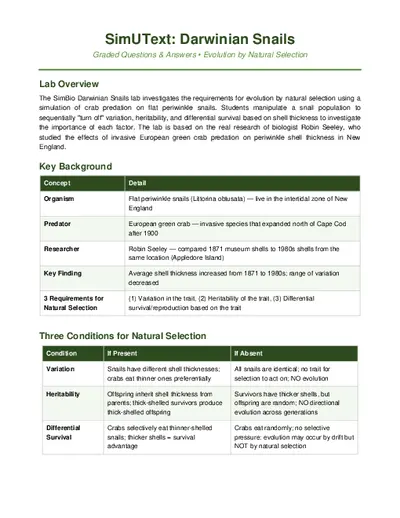
SimUText: Darwinian Snails
Graded Questions & Answers • Evolution by Natural Selection
Lab Overview
The SimBio Darwinian Snails lab investigates the requirements for evolution by natural selection using a
simulation of crab predation on flat periwinkle snails. Students manipulate a snail population to
sequentially "turn off" variation, heritability, and differential survival based on shell thickness to investigate
the importance of each factor. The lab is based on the real research of biologist Robin Seeley, who
studied the effects of invasive European green crab predation on periwinkle shell thickness in New
England.
Key Background
Concept Detail
Organism Flat periwinkle snails (Littorina obtusata) — live in the intertidal zone of New
England
Predator European green crab — invasive species that expanded north of Cape Cod
after 1900
Researcher Robin Seeley — compared 1871 museum shells to 1980s shells from the
same location (Appledore Island)
Key Finding Average shell thickness increased from 1871 to 1980s; range of variation
decreased
3 Requirements for
Natural Selection
(1) Variation in the trait, (2) Heritability of the trait, (3) Differential
survival/reproduction based on the trait
Three Conditions for Natural Selection
Condition If Present If Absent
Variation Snails have different shell thicknesses;
crabs eat thinner ones preferentially
All snails are identical; no trait for
selection to act on; NO evolution
Heritability Offspring inherit shell thickness from
parents; thick-shelled survivors produce
thick-shelled offspring
Survivors have thicker shells, but
offspring are random; NO directional
evolution across generations
Differential
Survival
Crabs selectively eat thinner-shelled
snails; thicker shells = survival
advantage
Crabs eat randomly; no selective
pressure; evolution may occur by drift but
NOT by natural selection

Graded Questions with Answers
These are the end-of-module graded questions (Section 6) from the SimUText Darwinian Snails lab.
Q6.1. If there is NO VARIATION in shell thickness within a population of snails, and no mutations
occur, what happens to shell thickness in response to crab predation?
A) All snails in the population grow thicker shells
B) Some snails in the population evolve thick shells
C) The average shell thickness evolves to be much thicker over several generations
D) There is no change in shell thickness within the population
Answer: D
Without variation, all snails have the same shell thickness. Crabs cannot selectively eat thinner-shelled snails
because there are none. Every snail is equally vulnerable, so the average shell thickness remains unchanged
across generations. Natural selection requires variation to operate.
Q6.2. If there is NO SELECTIVE SURVIVAL based on shell thickness within a population of snails,
what happens to shell thickness in response to crab predation?
A) The average shell thickness increases within each generation, but there is no change from generation
to generation
B) There is evolution by natural selection, and average shell thickness increases every generation
C) There may be evolution of shell thickness, but not through natural selection and not necessarily toward
thicker shells
D) There is no change in shell thickness within the population
Answer: C
Without selective survival (crabs eat snails randomly regardless of shell thickness), there is no directional
selection pressure. Shell thickness may still change due to random genetic drift, but this change would not be
driven by natural selection and would not necessarily favor thicker shells.
Q6.3. If mutations arise that affect shell thickness within a snail population, then with crabs
present, those mutations:
A) Will result in offspring having thicker shells than their parents
B) Will result in offspring having thicker or thinner shells than their parents
C) Will happen because the parents choose to give them to their offspring
D) Will occur because crabs are present and snails need protection against predation
Answer: B
Mutations are random and can produce either thicker or thinner shells. Mutations are not directed by
need—they do not occur "because" crabs are present. Natural selection then acts on this variation, favoring
thicker shells, but the mutations themselves are random in direction.
Q6.4. The 14 species of finches on the Galapagos Islands evolved from a single species several
million years ago. Different finch species live on different islands. A major difference among
species is in their beaks. Assuming a population is undergoing evolution by natural selection with
respect to beak size/shape, what changes occur gradually over time?
A) Within their lifetimes, some individual finches' beaks change in size or shape
B) The proportions of finches having different beak sizes/shapes change across generations
C) Each finch's learned ability to use its beak is automatically passed on to its offspring


D) All finches in each new generation develop the same new, improved beak size and shape
Answer: B
Evolution by natural selection changes the proportions of traits in a population across generations. Individual
organisms do not change within their lifetimes (A is wrong). Learned behaviors are not inherited (C is wrong).
Not all individuals evolve the same trait (D is wrong).
Loading document...
/ 7
Upload to Download
Every 3 documents you upload earns 1 download credit.
You have uploaded 0 documents. Upload 3 more to earn a download.
Upload Documents
End of Document
256
Report this document
Why are you reporting this content?
Embed document
* The code will be updated based on your changes.
Upload to Print
Every 3 documents you upload earns 1 print/download credit.
You have uploaded 0 documents. Upload 3 more to earn a credit.
Upload Documents