DNA and Chromosomes Year 10 Science Resources

DNA and Chromosomes Year 10 Science Resources

DNA and chromosomes are fundamental concepts in genetics, crucial for understanding inheritance and biological traits. This resource provides a comprehensive overview for Year 10 students, covering the structure of DNA, the role of chromosomes, and the significance of genes and alleles. Key topics include the double helix structure of DNA, complementary base pairing, and the process of sex determination through karyotypes. Students will also learn about Punnett squares and their application in predicting genetic outcomes. Ideal for Year 10 science curricula, this material supports students in mastering essential genetic concepts.

Key Points

  • Explains the double helix structure of DNA and its components.
  • Covers the role of chromosomes in genetic inheritance and sex determination.
  • Describes the significance of genes and alleles in trait expression.
  • Includes practical applications of Punnett squares for predicting offspring traits.
63
/ 6
21 | Page GZ Science Resources
Genes are the sources of inherited information
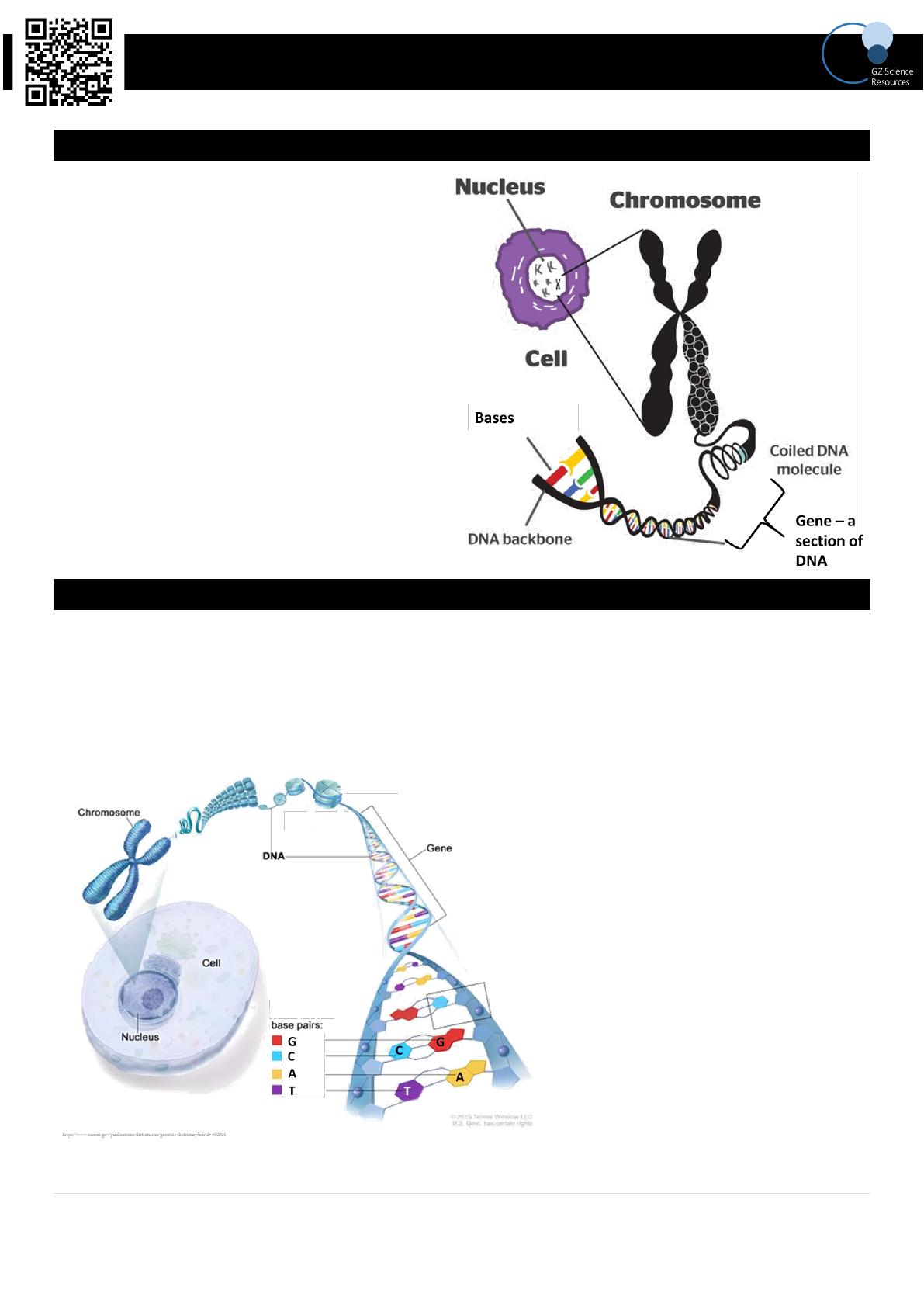
DNA forms a Double Helix shape
DNA is arranged in a double helix shape. The up rights of the “ladder” consist of alternating sugar and phosphate
molecules bonded together. Making up the “rungs” are
two base molecules bonded to each other.
A nucleotide is one unit of DNA. DNA (deoxyribonucleic acid) is made from smaller repeating units called
nucleotides, which consist of a sugar, a triphosphate and a base.
The sequence of bases coding for a specific protein, leading onto a trait, is called a gene.
DNA and Chromosomes
All living things are made of cells. The
nucleus
of a cell contains
chromosomes
,
which carry instructions for the physical
characteristics of an organism. The
chromosomes are made of long strands of
DNA.
The instructions are called the
genetic
code
. A segment of the DNA that codes for
a specific trait is called a
gene
.
There are 4 bases
A, T, C, G
Complementary base-pairing rule
G bonds with C
A bonds with T
The order of these bases is the
code
for a
characteristic
.
22 | Page GZ Science Resources
DNA is organised into chromosomes and genes
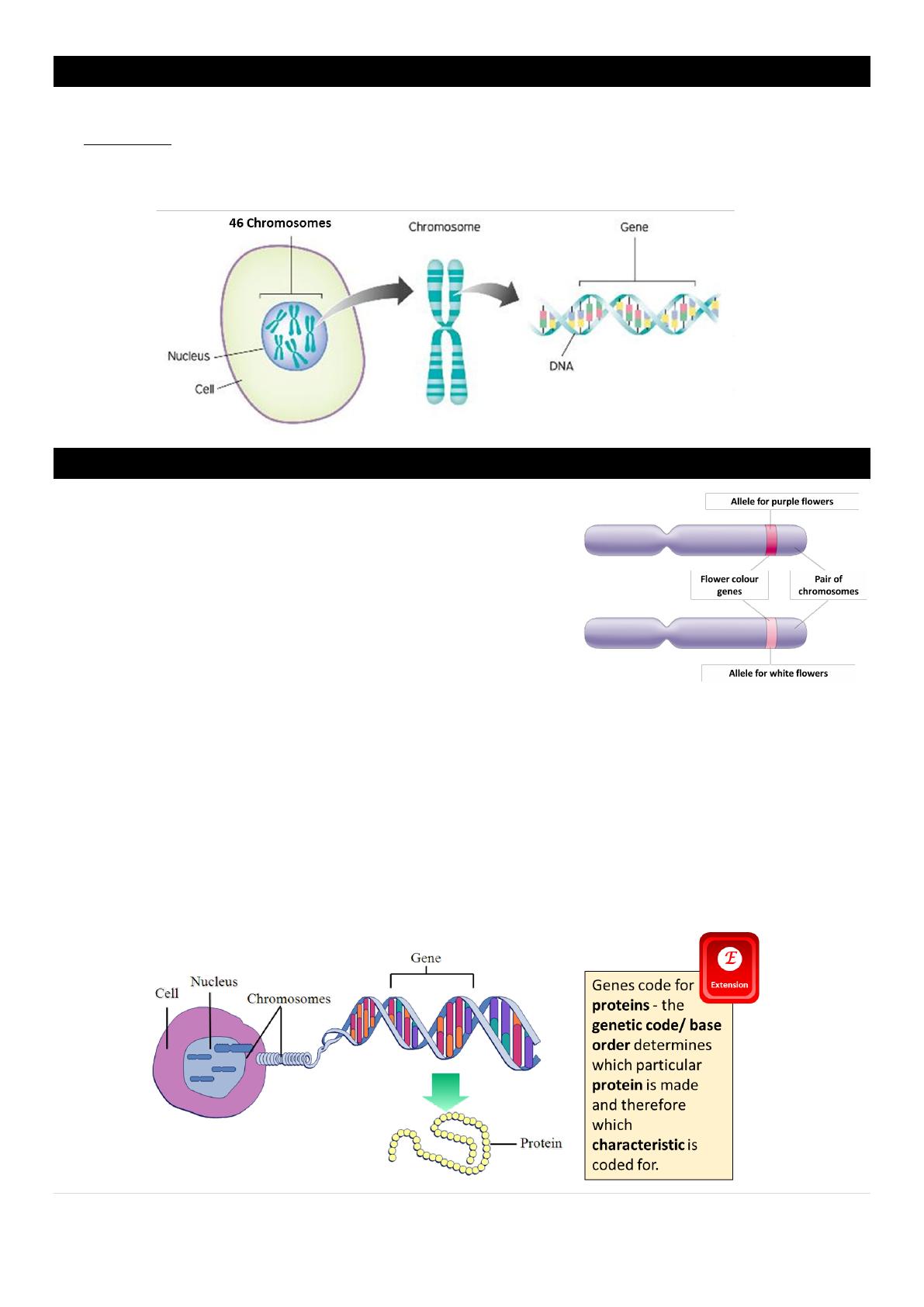
The human cell has 46 chromosomes arranged into 23 pairs of chromosomes. Each chromosome in a pair has
the same genes, (called
homologous pairs) although there may be variation between the genes of each pair, as
one comes from the father and one comes from the mother. Each gene is represented by two alleles, which are
different varieties. The alleles can be the same or different, but the body only uses one.
Alleles are different forms of the same gene
Summary: Cell, nucleus, chromosome, DNA, gene and protein
Chromosomes are found in the nucleus of each cell and are made up of DNA. DNA is a large molecule that is
coiled into a double helix (twisted ladder structure). Along this molecule are
bases. These bases pair up; A always
pairs with T, and G with C.
A sequence of bases, which codes for a particular trait/characteristic (e.g., eye colour) is called a gene. The
different versions of each gene are called
alleles, and these show the different variations of each characteristic,
e.g. brown / blue eyes. Because chromosomes come in pairs for each trait, there will be two possible alleles.
These different versions of genes (alleles) occur because the DNA base sequence is different.
Chromosomes occur in pairs. These pairs of chromosomes have
the same genes in them at the same place. The versions of genes
are called
alleles
and they may be different from each other.
23 | Page GZ Science Resources
Chromosomes come in pairs
Sex determination
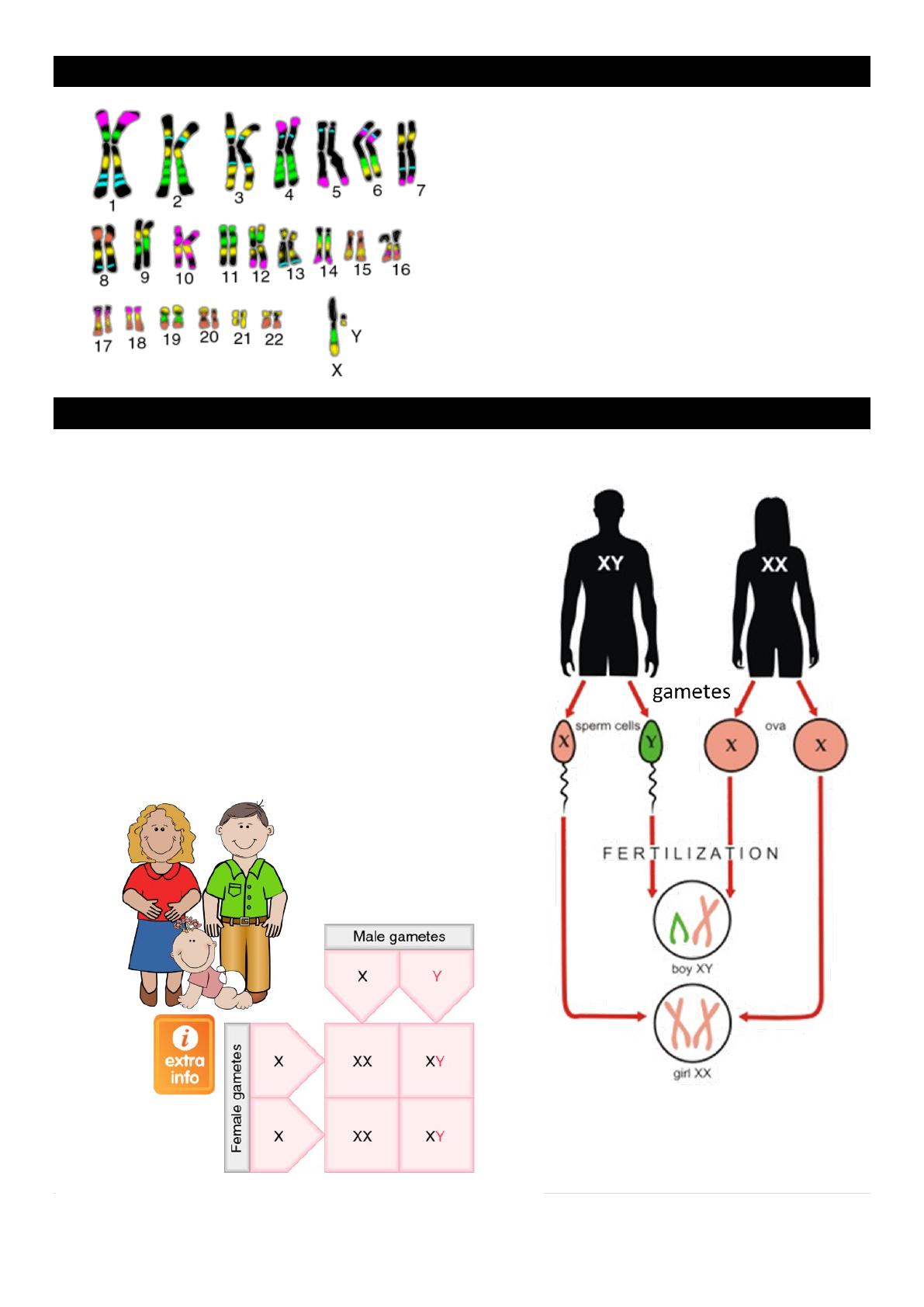
Chromosomes come in pairs. One pair is the sex
chromosomes XX in females and XY in males. A
complete set of chromosomes of an organism
placed into pairs of matching chromosomes is
called a
karyotype
. The human karyotype consists
of
23 pairs
of chromosomes.
A pair of chromosomes are called the sex chromosomes. The
female always has a homologous pair of two x chromosomes.
The female can only donate a x chromosome. The male has a x
and y chromosome. He can donate either an x or y
chromosome to form a gamete.
The male determines the sex
of any children.
A Punnett square can be used to demonstrate that in any
fertilisation there will be a 50% chance of either a boy or a girl.
If there are a small number of offspring, then there is less
chance that the actual ratio of male to female offspring will be
the same as the predicted ratio.
Each new fertilisation is
independent of any previous fertilisation episodes.
/ 6
End of Document
63
You May Also Like

FAQs of DNA and Chromosomes Year 10 Science Resources

What is the structure of DNA and how does it function?
DNA is structured as a double helix, resembling a twisted ladder. The sides of the ladder are made up of alternating sugar and phosphate molecules, while the rungs consist of paired nitrogenous bases. The sequence of these bases encodes genetic information, determining the traits of an organism. This structure allows DNA to replicate accurately during cell division, ensuring that genetic information is passed on.
How do chromosomes relate to genes and alleles?
Chromosomes are long strands of DNA that contain many genes, which are segments of DNA that code for specific traits. Each gene can have different forms known as alleles, which may result in variations of a trait, such as eye color. Humans have 46 chromosomes arranged in 23 pairs, with one chromosome of each pair inherited from each parent. This pairing allows for genetic diversity and the potential for different traits to be expressed.
What is the significance of sex chromosomes in humans?
In humans, sex chromosomes determine an individual's sex, with females having two X chromosomes (XX) and males having one X and one Y chromosome (XY). The male's contribution during fertilization determines the sex of the offspring, as he can donate either an X or a Y chromosome. This genetic mechanism is crucial for understanding inheritance patterns related to sex-linked traits and disorders.
What is a Punnett square and how is it used?
A Punnett square is a diagram used to predict the genetic outcomes of a cross between two organisms. It allows students to visualize the possible combinations of alleles from each parent, helping to determine the probabilities of specific traits being expressed in the offspring. By filling in the square with the alleles from each parent, one can easily see the likelihood of producing males or females, as well as other traits.
What are the four bases of DNA and their pairing rules?
DNA consists of four nitrogenous bases: adenine (A), thymine (T), cytosine (C), and guanine (G). The bases pair specifically, with adenine always bonding with thymine and cytosine bonding with guanine. This complementary base pairing is essential for the accurate replication of DNA and the transmission of genetic information during cell division.

Related of DNA and Chromosomes Year 10 Science Resources