Grade 9 Chemistry Review Guide for Students

Grade 9 Chemistry Review Guide for Students

Grade 9 Chemistry Review focuses on essential concepts in chemistry, including the classification of matter, atomic structure, and the periodic table. Students will explore physical and chemical properties, changes, and the formation of ions. This comprehensive guide includes activities for drawing Bohr-Rutherford and Lewis dot diagrams, as well as practice questions on subatomic particles and the periodic table. Ideal for Grade 9 students preparing for exams or seeking to reinforce their understanding of chemistry topics.

Key Points

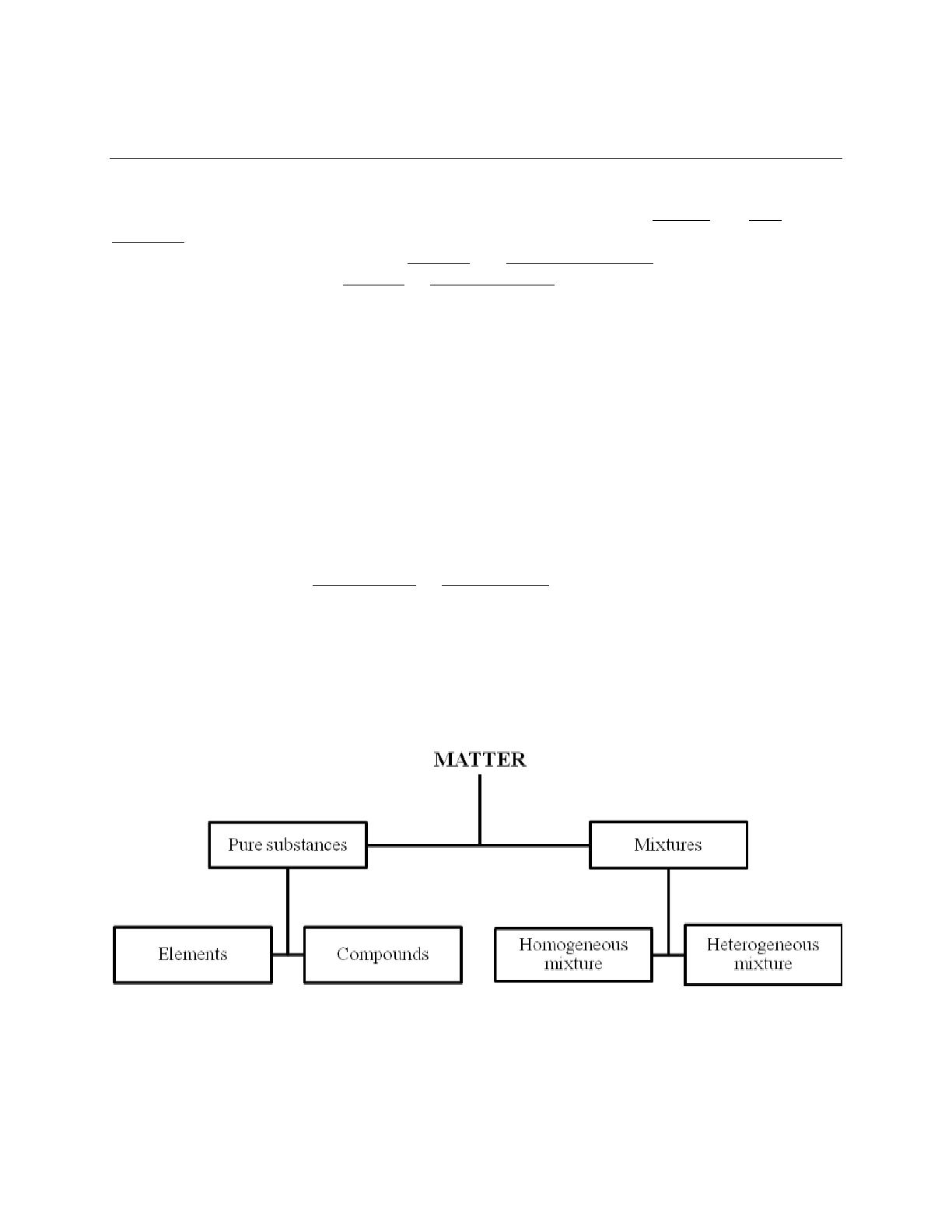
  • Explains the classification of matter, including pure substances and mixtures.
  • Covers atomic structure, including subatomic particles and their properties.
  • Includes activities for drawing Bohr-Rutherford and Lewis dot diagrams.
  • Discusses the organization of the periodic table and the properties of different element groups.
423
/ 6
SNC-2D1 Grade 9 Review
Review of Grade 9 Chemistry
Part A: Classification of Matter
Matteris anything that has ________ and takes up _______________.
- Matter can be classified according to its composition, e.g., as a mixture or a pure
substance
- Matter can be described by its physical and chemical properties
- Matter can undergo a physical or chemical change
Pure substance: A substance in which all particles making up the substance are the same.
An element is a pure substance that is made of atoms, and thus cannot be broken down
into simpler substances.
e.g., gold, carbon, hydrogen, etc. (see periodic table of elements)
A compound is a pure substance that is made of two or more atoms combined in a fixed
proportion.
e.g. H
2
O (is always 2 hydrogens and 1 oxygen)
e.g. CO
2
(is always 1 carbon and 2 oxygens)
Mixture: A substance in which there are two or more types of particles
- A mixture can be homogeneous or heterogeneous.
A homogeneous mixture is a mixture in which the particles are uniformly scattered.
Only one phase is visible (e.g., solutions such as Kool-Aid)
A heterogeneous mixture is a mixture in which the particles are not uniformly scattered
and therefore have more than one phase. (e.g., oil and water, or trail mix)
Date: ________________________________________
SNC-2D1 Grade 9 Review
Physical property: a characteristic of a substance, observed using either one of the five senses,
or a scientific instrument. May be either qualitative or quantitative. (e.g.,
physical state; colour; odour; taste; lustre; freezing/boiling point;
electrical conductivity)
Chemical property: a characteristic of a substance that describes its ability to react with other
substances (e.g., reaction with water; combustibility; toxicity; stability)
Physical change: involves a substance changing its physical properties. No new substances
are formed, and the change may be reversible. (e.g., freezing water,
dissolving salt in water)
Chemical change: involves a change in matter in which at least one new substance, having new
properties, is formed.
Clues a chemical change has occurred:
1. _______________________________________________________________
2. _______________________________________________________________
3. _______________________________________________________________
4. _______________________________________________________________
5. _______________________________________________________________
Types of Elements:
Metals
conduct electricity and
heat
malleable
ductile
usually solid at room
temperature (except
mercury)
left side of periodic table
Metalloids
properties of both metals
and non-metals
adjacent to staircase line
on periodic table
(exception: Aluminum is
a metal)
Non-metals
poor conductors of
electricity and heat
brittle
may be solid, gas, or liquid
(bromine) at room temp.
right side of periodic table
Part B: Atomic structure
Subatomic particles
Particle
Charge
Mass
Location in atom
SNC-2D1 Grade 9 Review
Activity #1: Find the numbers of subatomic particles:
Rules: 1. Atomic number = Number of protons
2. Mass number = Number of protons + Number of neutrons
3. Number of protons = Number of electrons (in a neutral atom)
Element
Atomic
Number
Mass
Number
# of
protons
# of
electrons
# of
neutrons
a.
Oxygen
b.
c.
Barium
d.
79
e.
14
f.
18
18
g.
h.
29
i.
19
j.
16
The Bohr-Rutherford model of the atom
protons and neutrons in the nucleus
electrons in shells, orbiting the nucleus
1
st
shell: ____ electrons 3
rd
shell: ____ electrons
2
nd
shell: ____ electrons 4
th
shell: ____electrons
Bohr-Rutherford diagrams
can be drawn for the first 20 elements only
#protons and #neutrons in nucleus; electrons placed in shells
Example: Bohr-Rutherford diagram of a Boron atom
Boron has ____ protons, ____ electrons, and ____ neutrons.
Complete diagram: Simplified diagram:
/ 6
End of Document
423
You May Also Like

FAQs of Grade 9 Chemistry Review Guide for Students

What are the main types of matter covered in this review?
The review outlines two main types of matter: pure substances and mixtures. Pure substances are further divided into elements and compounds, while mixtures can be homogeneous or heterogeneous. Understanding these classifications is crucial for students as they study the properties and behaviors of different materials in chemistry.
What is the significance of the periodic table in chemistry?
The periodic table organizes elements based on their atomic number and properties, making it a vital tool for chemists. It groups elements into families, such as alkali metals and noble gases, which share similar characteristics. This organization helps students predict chemical behavior and understand trends in reactivity and bonding.
How do physical changes differ from chemical changes?
Physical changes involve alterations in the state or appearance of a substance without changing its chemical composition, such as melting or dissolving. In contrast, chemical changes result in the formation of new substances with different properties, often indicated by color changes, gas production, or temperature shifts. Recognizing these differences is essential for understanding chemical reactions.
What are Bohr-Rutherford diagrams and their purpose?
Bohr-Rutherford diagrams visually represent the structure of an atom, showing protons and neutrons in the nucleus and electrons in shells around it. These diagrams help students understand atomic structure and electron configuration, which are fundamental concepts in chemistry. They are particularly useful for illustrating how atoms interact during chemical reactions.
What activities are included for practicing chemistry concepts?
The review includes various activities, such as drawing Bohr-Rutherford and Lewis dot diagrams for different elements. These exercises reinforce students' understanding of atomic structure and electron arrangements. Additionally, practice questions on subatomic particles and the periodic table help solidify knowledge and prepare for assessments.

Related of Grade 9 Chemistry Review Guide for Students