Gravity on Inclined Planes: Acceleration and Friction Analysis

Gravity on Inclined Planes: Acceleration and Friction Analysis

Gravity on inclined planes involves complex physics due to the tilt of the surface. This document provides a detailed analysis of how gravity affects a 15 kg box on a 30° slope with a coefficient of friction of 0.13. It includes step-by-step calculations for gravitational force, friction, and acceleration, making it ideal for physics students. The content emphasizes the importance of free body diagrams and the breakdown of forces acting on the box. Perfect for high school and college-level physics courses focusing on mechanics and motion.

Key Points

  • Analyzes the effect of gravity on a 15 kg box on a 30° slope.
  • Calculates the acceleration considering a coefficient of friction of 0.13.
  • Includes detailed free body diagrams to illustrate force components.
  • Explains the relationship between gravitational force, normal force, and friction.
48
/ 3
Lesson 27: Gravity on Inclined Planes
You need to be especially careful when you are doing problems involving gravity pulling something
down a slope.
The physics involved is considerably more complex than it might first seem, mostly because
everything is tilted.
Let’s look at a standard question of gravity on an inclined plane (slope) to see how we would
figure it out.
Example 1:Determine the acceleration of a 15 kg box down a 30° slope if the coefficient of friction is
0.13 on this surface.
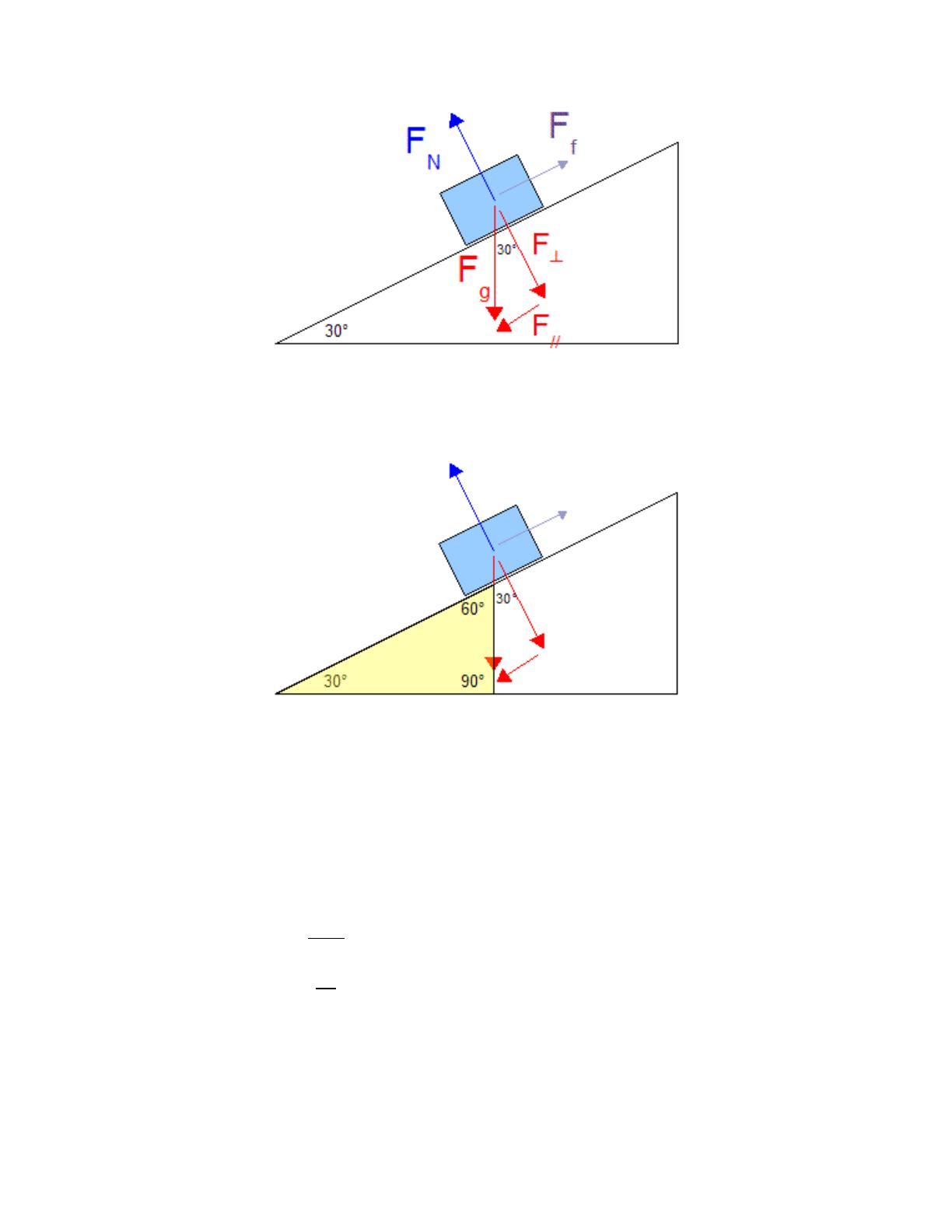
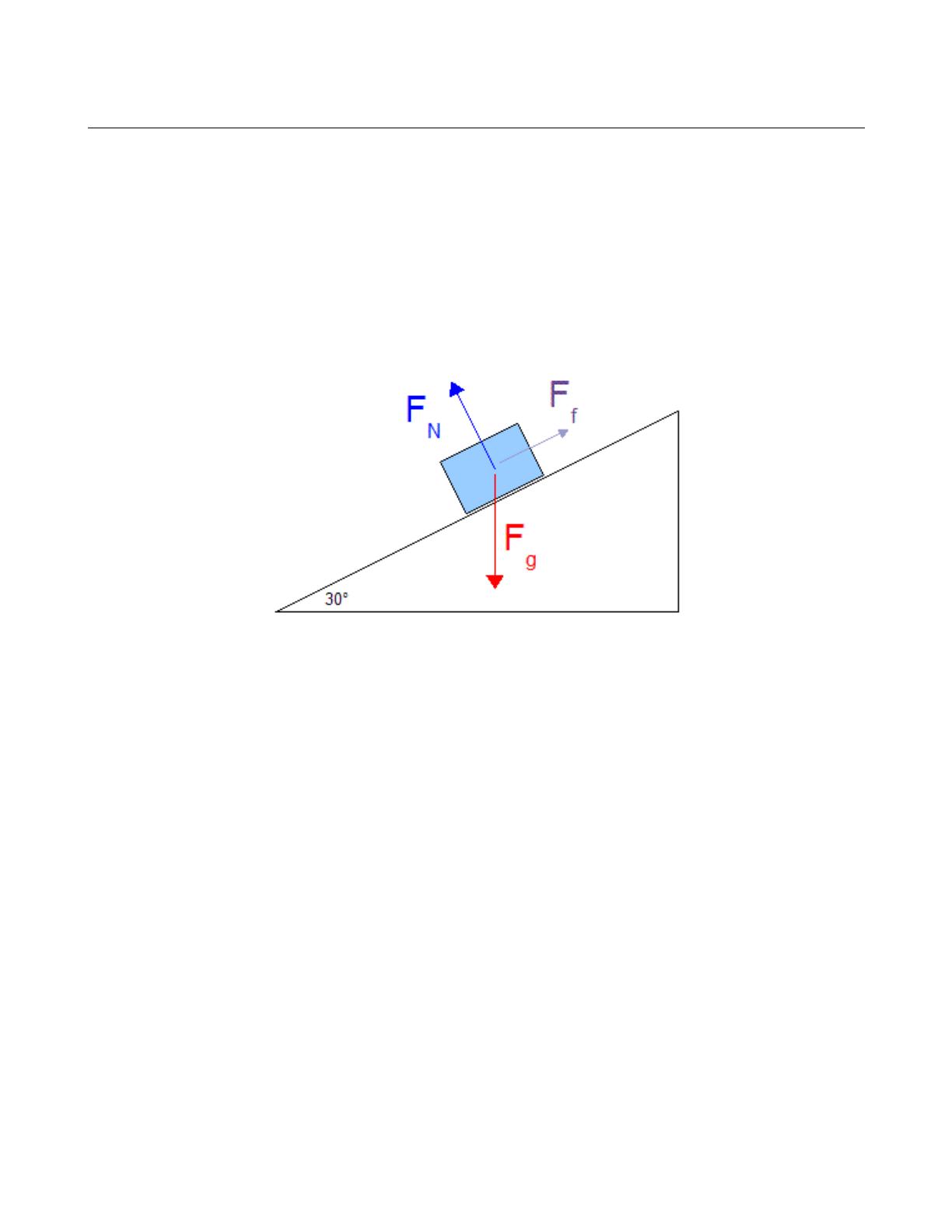
The first thing we should do is sketch a free body diagram of the situation.
There are a few special things you have to notice about this diagram:
Force due to Gravity (F
g
) is pointing straight down. Even though we are on a slope
nothing will ever change that gravity points straight down. The only reason for this box
to move down the slope will be a component of gravity's force.
Normal Force (F
N
) Remember that a normal force is always perpendicular to the
surface that you are on. Since this surface is slanted at a bit of an angle, the normal force
will also point at a bit of an angle. In these questions F
g
F
N
Force due to Friction (F
f
) will always be opposite to the direction that something is
moving. In this situation the object is moving down the slope, so friction points back up
the slope.
There is no applied force (F
a
), since this would mean that there was something other
than gravity actually trying to shove it down the slope. In some questions you might
have an applied force also, but not in this question.
We can calculate the force due to gravity...
F
g
=mg=159.81=147.15 N
We need to break F
g
up into components that point down parallel to the slope (F
//
) and
perpendicular to the slope (F
).
7/27/2011 © studyphysics.ca Page 1 of 3 / Section 3.5
Illustration 1: Box on an inclined plane.
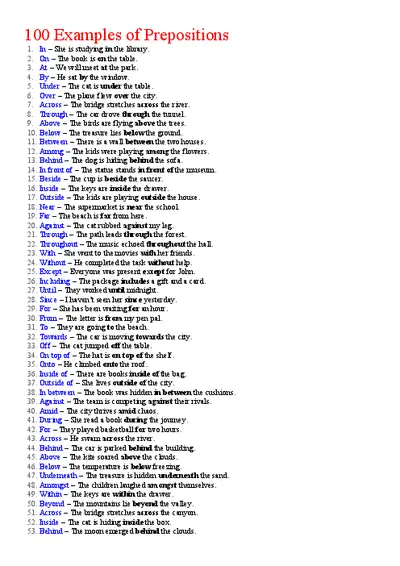
If you are wondering how I figured out that the 30°angle is at the top of the red triangle, take a
look at this...
I created the yellow triangle by just extending the line of F
g
down a bit.
Since this makes a nice right angle triangle, I know that the angle at the top of the
yellow triangle must be 60° (since the angles have to add up to 180°).
Since F
is perpendicular to the slope, the angle in the top of the red triangle must be
30° so that they will add up to 90°.
Since we know F
g
and an angle on the triangle, we can use basic trig to calculate the
other two sides.
Determine F
//
, the force pulling the box down along the slope...
sin=
opp
hyp
sin =
F
l l
F
g
F
l l
=sin F
g
F
l l
=sin30
O
147.15
F
ll
=73.575 N
7/27/2011 © studyphysics.ca Page 2 of 3 / Section 3.5
Illustration 2: F
g
broken into components.
Illustration 3: Angle of slope to angle in components.
Determine F
...
cos =
adj
hyp
cos =
F
F
g
F
=cosF
g
F
=cos30
O
147.15
F
=127.436N
Look back at Illustration 3 and you should notice that the force perpendicular F
is equal in
magnitude to the normal force F
N
(although they point in opposite directions).
Determine the force due to friction F
f
using the value you just got for normal force.
F
f
=μ F
N
F
f
=0.13(127.436)
F
f
=16.5667 N
Now you know the force that is taking it down the slope, and the friction
that is slowing it down. Determine the net force F
NET
...
F
NET
=F
l l
+F
f
F
NET
=73.575+16.5667
F
NET
=57.008N
Now, finally we can determine the acceleration of the box...
F
NET
=ma
a=
F
NET
m
a=
57.008
15
a=3.8006=3.8 m/ s
2
Our final answer is 3.8 m/s
2
, and yes, we round it off.
Notice that in each step I had you sketch or determine something.
I bet you can see how each of those could be a part of a multistep question like (a), (b), (c), etc.
In fact, I could have about 7 or 8 parts to this question.
If you ever do a question like that, then yes, you must round off your final answer for each
step to the correct number of sig digs.
You should still keep the unrounded number written at least somewhere, since you should
be using unrounded numbers for the questions that follow.
Re-read through this example a few times. It's long and confusing at some parts, but try to look at each
individual tiny calculation. Taken in little bits, each part isn't as hard.
Homework p192 #1,3,9,14,17
7/27/2011 © studyphysics.ca Page 3 of 3 / Section 3.5
I've made F
f
negative because it
is working against
the F
//
. One of them
must be negative if
the other is positive.
/ 3
End of Document
48
You May Also Like

FAQs of Gravity on Inclined Planes: Acceleration and Friction Analysis

How is the gravitational force calculated for an inclined plane?
The gravitational force acting on an object on an inclined plane is calculated using the formula Fg = mg, where m is the mass of the object and g is the acceleration due to gravity (approximately 9.81 m/s²). For a 15 kg box, the gravitational force would be Fg = 15 kg * 9.81 m/s², resulting in 147.15 N. This force must then be broken down into components parallel and perpendicular to the slope to analyze motion accurately.
What role does friction play in the motion of the box down the slope?
Friction opposes the motion of the box as it moves down the slope. The force due to friction (Ff) can be calculated using the formula Ff = μFN, where μ is the coefficient of friction and FN is the normal force. In this case, with a coefficient of 0.13 and a normal force of approximately 127.436 N, the frictional force is calculated to be 16.57 N. This frictional force reduces the net force acting on the box, thereby affecting its acceleration.
What is the significance of the normal force in inclined plane problems?
The normal force is crucial in inclined plane problems as it acts perpendicular to the surface and balances the component of gravitational force acting perpendicular to the slope. It is not equal to the gravitational force but is influenced by the angle of the incline. Understanding the normal force helps in calculating friction and the net force acting on the object, which are essential for determining acceleration down the slope.
How do you determine the acceleration of the box on the slope?
To determine the acceleration of the box on the slope, first calculate the net force (FNET) acting on it. This is done by summing the force pulling the box down the slope (F//) and the frictional force (Ff). The net force is then divided by the mass of the box using the formula a = FNET/m. For the given scenario, the calculated net force leads to an acceleration of approximately 3.8 m/s².
What is the formula for calculating the force parallel to the slope?
The force parallel to the slope (F//) can be calculated using the sine function in trigonometry. The formula is F// = sin(θ) * Fg, where θ is the angle of the slope and Fg is the gravitational force. For a 30° slope and a gravitational force of 147.15 N, the calculation yields F// = sin(30°) * 147.15 N, resulting in a force of 73.575 N acting down the slope.

Related of Gravity on Inclined Planes: Acceleration and Friction Analysis