Henri Fayol’s 14 Principles of Management Explained

Henri Fayol's 14 Principles of Management Explained

Henri Fayol's 14 principles of management provide a foundational framework for effective organizational management. These principles, developed by the French engineer and management theorist Henri Fayol, emphasize the importance of division of work, authority, discipline, and unity of command among others. Each principle aims to enhance efficiency and productivity within organizations, making them relevant for managers across various sectors. This guide is essential for business students and professionals seeking to understand classical management theories and their application in modern workplaces.

Key Points

  • Explains Fayol's principle of division of work for increased efficiency.
  • Describes the balance between authority and responsibility in management.
  • Highlights the importance of discipline for systematic organizational functioning.
  • Outlines the principle of unity of command to avoid employee confusion.
  • Discusses the significance of subordination of individual interests to organizational goals.
  • Covers the role of remuneration in employee satisfaction and productivity.
  • Examines centralization versus decentralization in management structures.

383
/ 6
Henri Fayol’s 14 principles of management:
Henri Fayol ( 29 July 1841 19 November 1925) was a French mining
engineer & director of mines who developed a general theory of business
administration. Fayol's work was one of the first comprehensive
statements of a general theory of management. Fayol was a successful
mining engineer and senior executive prior to publishing his principle of
administrative science. He was not primarily a theorist , but rather a
successful senior manager who sought to bring order to his personal
experiences.
Fayol’s five principle roles of management are still actively practised
today. He has founded “Plan , organise, command, co-ordinate and
control “ written on more than one manager’s whiteboard during his
career.
Fayol ideas had a major effect on how management functions in most
established organisations .
In many ways, they are the bible of management and the source of idea
is even today is certainly used by all managers
1. Division of work:
According to this principle, the whole work must be divided into small task
or units and instead of assigning the whole work to one person. One task
or job should be assigned to one person according to the capability,
qualification and experience of the person.
When a person is performing a part of job again and again he will become
perfect and specialised in that job and efficiency will improve. This
principle is very useful for any organisation be it private or public. It
enhances overall performance of an organisation because specialists
perform consistently.
For example an organisation having different departments.
2. Authority and Responsibility:
Authority means power take decision. Responsibility means obligation to
complete the job on time. So according to principle there should balance
and parity between authority and responsibility . Excess of authority may
bring negative results and Excess of responsibility will not allow the
worker to complete the work on time.
Balance b/w both of them will result in no misuse of authority and it also
helps in meeting responsibility on tie without any delay.
3. Discipline:
Discipline refers to general rules , regulation for systematic working of an
organisation. It doesn't mean only rules and regulation but it also means
developing commitment in the employees towards organisation . It also
means obedience to organisational rules that are necessary for
functioning of an organisation. It includes
Good supervision at all level
Clear and fair agreement
Application of penalties judiciously
Employees must honor the commitment made by them and management
must meet its promises. On one hand it enforces orderliness and
motivates on other side.
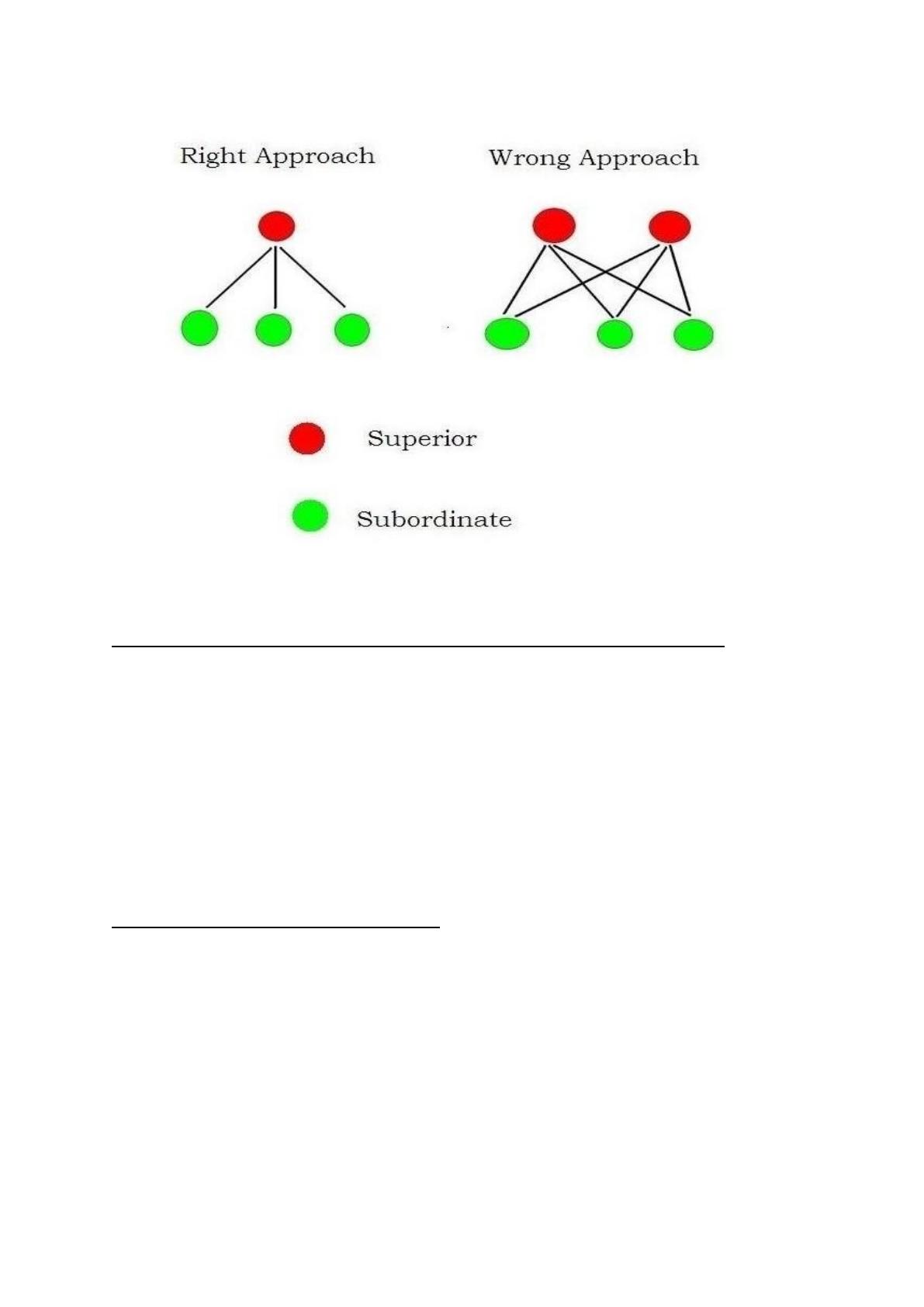
4. Unity of Command:
There should be one & only one boss for every individual employees
working in an organisation. If employees get order from 2 superiors at
same time then they will get confused and not able to understand that
whose orders must be executed.
Thus unity of command avoids confusion and conflicts. It also helps in
harmonious relations and fixation of responsibility. If this principle is
violated then there will be ego clashes as employees should receive order
from one boss only. This principle helps to create peace in same as well
as lower levels.
5. Subordination of individual interest to general interest:
The interest of an organisation should take priority over the interest of
any individual employee. If objectives of both organisation and individual
are in different directions then managers must try to reconcile individual
interest with organisation goal and if it is not possible then individual goal
must be sacrificed for achieving organisational goal.
Employees are required to give up carelessness, selfishness, lethargy and
personal interest. it ensures no ego clashes as credit goes to group and
coordination between individual and organisation.
6. Remuneration to employees:
The overall pay and compensation should be fair to employees and
workers to give them at least a reasonable standard of living.
Remuneration paid to employees must be fair because if employees are
unpaid they will not be satisfied and an unsatisfied person can never
contribute his maximum. Dissatisfaction will lead to increase in
employees’ turnover.
This ensures congenial atmosphere b/w the management and workers. In
healthy atmosphere, workers put their best efforts to contribute
maximum. it ensures smooth functioning and motivates them.
/ 6
End of Document
383
You May Also Like

FAQs of Henri Fayol’s 14 Principles of Management Explained

What are Henri Fayol's 14 principles of management?
Henri Fayol's 14 principles of management include key concepts such as division of work, authority and responsibility, discipline, unity of command, and subordination of individual interests to general interest. Each principle serves to enhance organizational efficiency and effectiveness. For example, the division of work allows employees to specialize in tasks, leading to improved performance. Unity of command ensures that each employee has one direct supervisor, reducing confusion and conflict in the workplace.
How does the principle of authority and responsibility function?
The principle of authority and responsibility emphasizes the need for a balance between the two in management. Authority refers to the power to make decisions, while responsibility is the obligation to complete tasks. When authority exceeds responsibility, it can lead to misuse of power, whereas excessive responsibility without adequate authority can hinder task completion. This balance is crucial for maintaining order and efficiency within an organization.
What is the significance of discipline in management?
Discipline in management refers to the adherence to rules and regulations that govern organizational behavior. It fosters a culture of commitment among employees and ensures systematic functioning. Fayol highlights that good supervision, clear agreements, and fair penalties are essential for maintaining discipline. When employees honor their commitments and management fulfills its promises, it creates a motivated workforce and promotes overall organizational success.
Why is unity of command important in an organization?
Unity of command is vital because it establishes a clear line of authority within an organization. When employees receive orders from multiple supervisors, it can lead to confusion and conflicting instructions. By ensuring that each employee has only one direct superior, unity of command helps to streamline communication and clarify responsibilities. This principle not only reduces potential conflicts but also enhances teamwork and accountability.
How does Fayol's principle of remuneration affect employee performance?
Fayol's principle of remuneration emphasizes the need for fair compensation to ensure employee satisfaction and productivity. When employees feel they are compensated fairly, they are more likely to be motivated and committed to their work. Conversely, inadequate remuneration can lead to dissatisfaction, increased turnover, and a negative work environment. By prioritizing fair pay, organizations can foster a positive atmosphere that encourages employees to perform at their best.
What role does centralization play in management according to Fayol?
Centralization refers to the concentration of decision-making authority at the top levels of management. Fayol argues that organizations should find a balance between centralization and decentralization based on their size and nature. Centralization can lead to faster decision-making and tighter control, while decentralization allows for greater flexibility and responsiveness at lower levels. The key is to achieve an optimal mix that enhances organizational effectiveness.

Related of Henri Fayol’s 14 Principles of Management Explained