Page | 2
0. Introduction - A Classroom Story and an Inspiration
Several years ago, I was teaching an introductory Statistics course at De Anza College where I had
several achieving students who were dedicated to learning the material and who frequently asked me
questions during class and office hours. Like many students, they were able to understand the material
on descriptive statistics and interpreting graphs. Unlike many introductory Statistics students, they had
excellent math and computer skills and went on to master probability, random variables and the Central
Limit Theorem.
However, when the course turned to inference and hypothesis testing, I watched these students’
performance deteriorate. One student asked me after class to again explain the difference between the
Null and Alternative Hypotheses. I tried several methods, but it was clear these students never really
understood the logic or the reasoning behind the procedure. These students could easily perform the
calculations, but they had difficulty choosing the correct model, setting up the test, and stating the
conclusion.
These students, (to their credit) continued to work hard; they wanted to understand the material, not
simply pass the class. Since these students had excellent math skills, I went deeper into the explanation
of Type II error and the statistical power function. Although they could compute power and sample size
for different criteria, they still didn’t conceptually understand hypothesis testing.
On my long drive home, I was listening to National Public Radio’s Talk of the Nation
1
and heard
discussion on the difference between the reductionist and holistic approaches to the sciences. The
commentator described this as the Western tradition vs. the Eastern tradition. The reductionist or
Western method of analyzing a problem, mechanism or phenomenon is to look at the component
pieces of the system being studied. For example, a nutritionist breaks a potato down into vitamins,
minerals, carbohydrates, fats, calories, fiber and proteins. Reductionist analysis is prevalent in all the
sciences, including Inferential Statistics and Hypothesis Testing.
Holistic or Eastern tradition analysis is less concerned with the component parts of a problem,
mechanism or phenomenon but rather with how this system operates as a whole, including its
surrounding environment. For example, a holistic nutritionist would look at the potato in its
environment: when it was eaten, with what other foods it was eaten, how it was grown, or how it was
prepared. In holism, the potato is much more
than the sum of its parts.
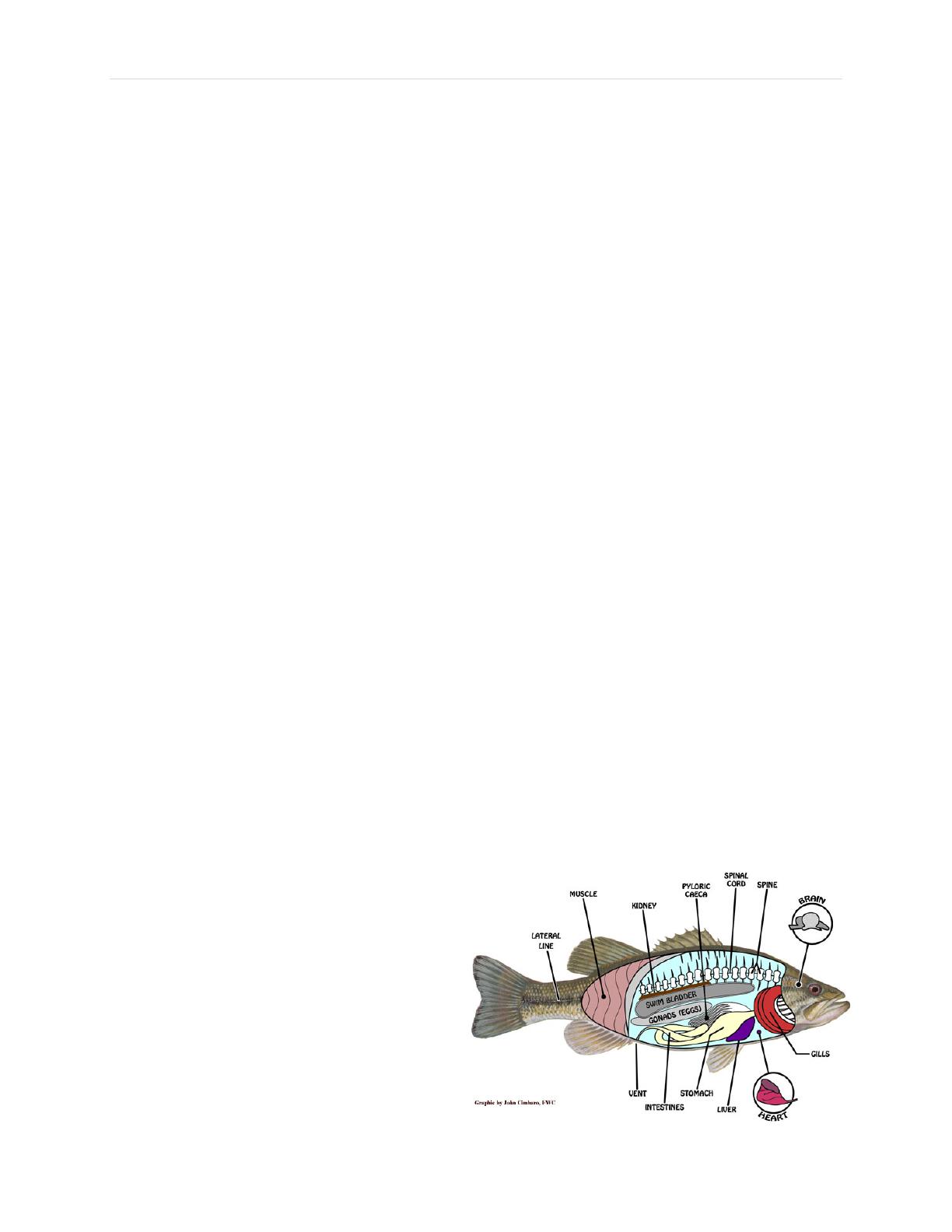
Consider these two renderings of fish:
The first image is a drawing of fish anatomy by
John Cimbaro used by the La Crosse Fish Health
Center.
2
This drawing tells us a lot about how a
fish is constructed, and where its vital organs are





