Lewis Formulas and Resonance Structures Study Guide PDF

Lewis Formulas and Resonance Structures Study Guide PDF

This document provides a comprehensive overview of Lewis formulas, structural isomerism, and resonance structures in organic chemistry. It discusses the characteristics of Lewis formulas, including bonding sequences, formal charges, and unshared electrons. The document outlines common bonding patterns for first and second-row elements, detailing how elements like hydrogen, carbon, nitrogen, oxygen, and halogens bond. It emphasizes the importance of resonance structures and their limitations, explaining how multiple valid Lewis structures can represent a single compound. The content is structured to facilitate understanding of key concepts and includes examples to illustrate the principles discussed. This study guide is essential for students and educators in chemistry, providing valuable insights into molecular structure and bonding. The document serves as a useful resource for anyone looking to deepen their knowledge of organic chemistry.

403
/ 7
LEWIS FORMULAS, STRUCTURAL ISOMERISM,
AND RESONANCE STRUCTURES
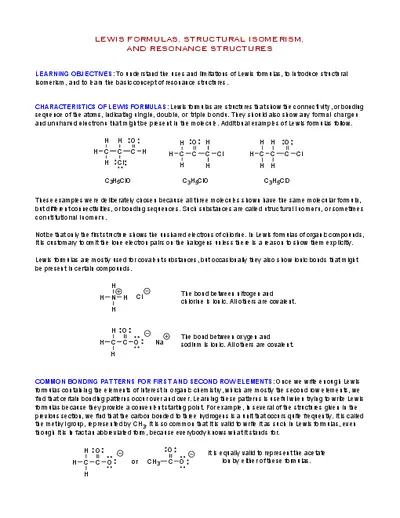
CHARACTERISTICS OF LEWIS FORMULAS: Lewis formulas are structures that show the connectivity, or bonding
sequence of the atoms, indicating single, double, or triple bonds. They should also show any formal charges
and unshared electrons that might be present in the molecule. Additional examples of Lewis formulas follow.
H C C
H
H
H C C
H
H
C
H
Cl
H
O
C
3
H
5
ClO
C
3
H
5
ClO C
3
H
5
ClO
H C C
H
H
C
O
Cl
H
H
C Cl
H
H
O
These examples were deliberately chosen because all three molecules shown have the same molecular formula,
but different connectivities, or bonding sequences. Such substances are called structural isomers, or sometimes
constitutional isomers.
Notice that only the first structure shows the unshared electrons of chlorine. In Lewis formulas of organic compounds,
it is customary to omit the lone electron pairs on the halogens unless there is a reason to show them explicitly.
Lewis formulas are mostly used for covalent substances, but occasionally they also show ionic bonds that might
be present in certain compounds.
H N
H
H
H
Cl
The bond between nitrogen and
chlorine is ionic. All others are covalent.
H C
H
C O
O
Na
The bond between oxygen and
sodium is ionic. All others are covalent.
COMMON BONDING PATTERNS FOR FIRST AND SECOND ROW ELEMENTS: Once we write enough Lewis
formulas containing the elements of interest in organic chemistry, which are mostly the second row elements, we
find that certain bonding patterns occur over and over. Learning these patterns is useful when trying to write Lewis
formulas because they provide a convenient starting point. For example, in several of the structures given in the
previous section, we find that the carbon bonded to three hydrogens is a unit that occurs quite frequently. It is called
the methyl group, represented by CH
3
. It is so common that it is valid to write it as such in Lewis formulas, even
though it is in fact an abbreviated form, because everybody knows what it stands for.
H C
H
C O
O
It is equally valid to represent the acetate
ion by either of these formulas.
CH
3
C O
O
or
LEARNING OBJECTIVES: To understand the uses and limitations of Lewis formulas, to introduce structural
isomerIsm, and to learn the basic concept of resonance structures.
H
H
HYDROGEN: Usually forms only one bond.
H F
H
O
H
H C H
H
Cl
CARBON: Forms four bonds when neutral, but it can also have only three bonds by bearing a positive or a negative
charge. When it bears a negative charge it should also carry a pair of unshared electrons.
H C H
H
Cl
C C
H
H H
H
C C HH
Neutral carbon
H
3
C
C
CH
3
CH
3
A carbocation has a central carbon with
an incomplete octet and a formal +1 charge.
H
3
C
C
CH
3
CH
3
A carbanion has a central carbon with an
unshared electron pair and a formal -1 charge.
NITROGEN: Forms three bonds and carries a lone pair of electrons when neutral. It can also form four bonds by
bearing a positive charge, in which case it carries no unshared electrons. Finally, it can also form two bonds as it
carries two unshared electron pairs and a negative charge.
C N
H
3
C
H
3
C
H
C NH
Neutral nitrogen
H
N
H
H
N
H
H
HH C N
H
3
C
H
3
C
H
H
Positively charged nitrogen
N HH
Negatively charged nitrogen
Other common bonding patterns are shown below.
OXYGEN: Forms two bonds and carries two lone pairs when neutral. It can form three bonds with a positive charge,
or one bond with a negative charge. In each case it must carry the appropriate number of unshared electron pairs
to complete the octet.
H
O
H
H
O
H
H
O H
water
hydronium ion hydroxide ion
HALOGENS: Form one bond and carry three electron pairs when neutral. Can carry a negative charge with no
bonds. They are rarely seen with positive charges.
H F
Cl
THIRD ROW ELEMENTS: They behave like their second-row counterparts, except that they can expand their
valence shells if needed.
H
S
H
H O S O H
O
O
Electron pairs on oxygen
are not shown for clarity.
P
Cl
Cl Cl
ClCl
Br P Br
Br
ELECTRON DEFICIENCY IN SECOND ROW ELEMENTS: One thing worth noting is that, in the second row, only
boron and carbon can form relatively stable species in which they bond with an incomplete octet. Examples have
already been discussed. Boron has no choice but to be electron deficient. Carbon can bond with a complete octet
or with an incomplete octet. Obviously bonding with a complete octet provides higher stability.
F
B
F
F
H
3
C
C
CH
3
CH
3
Boron has no choice but
to have an incomplete octet
An electron deficient
carbon in a carbocation
It is however very rare to observe species where nitrogen or oxygen bond with incomplete octets. Their high
electronegativity renders such situation high energy, and therefore very unstable. For all intents and purposes, avoid
writing formulas where oxygen or nitrogen are shown with incomplete octets, even if they carry a positive charge.
CH
3
O
CH
3
CH
3
To write this structure without the lone pair
of electrons on oxygen is unacceptable.
CH
3
O
This structure is unacceptable
and indeed it looks quite awkward
H
N
H
H
This species might exitst in the high energy environment
of a mass spectrometer, but it is not frequently observed
in common organic reactions.
/ 7
End of Document
403

You May Also Like

Related of Lewis Formulas and Resonance Structures Study Guide PDF