Molecular Modeling Activity for Chemistry Students

Molecular Modeling Activity for Chemistry Students

Molecular modeling activities engage students in understanding molecular shapes and structures. This activity focuses on constructing 3D models of various molecules, including H2O, NH3, and CH4, using ball and stick model kits. Students will learn to draw Lewis structures, determine valence electrons, and apply VSEPR theory to predict molecular geometry. Ideal for high school chemistry students, this hands-on approach enhances comprehension of molecular interactions and bonding. The activity includes detailed procedures and analysis questions to reinforce learning outcomes.

Key Points

  • Constructs 3D models of 14 different molecules including H2O and CH4
  • Utilizes VSEPR theory to predict molecular shapes and geometries
  • Incorporates Lewis structures and valence electron calculations
  • Designed for high school chemistry students to enhance understanding of molecular bonding
301
/ 5
Name: _________________________
Period:______
Molecular Modeling Activity
Essential question: Does the electrons in a molecule have any effect on the over all shape of the molecule?
Introduction:
A molecule can be represented on paper by either a formula or a dot structure. A molecular formula
indicates the number and kind of each atom present in a molecule. Some molecular formula’s are:
H
2
O NH
3
CH
4
These molecular formulas do not provide any information concerning the actual arrangement of the atoms in a
molecule. Such information is given by (Lewis) dot structures, such as the following
H
|
H O H H N H H C H
| |
H H
These dot structures are two-dimensional. The angles shown are not true to the shape of the molecule. Dot
structures can be made to convey more information by using the following symbolism.
______
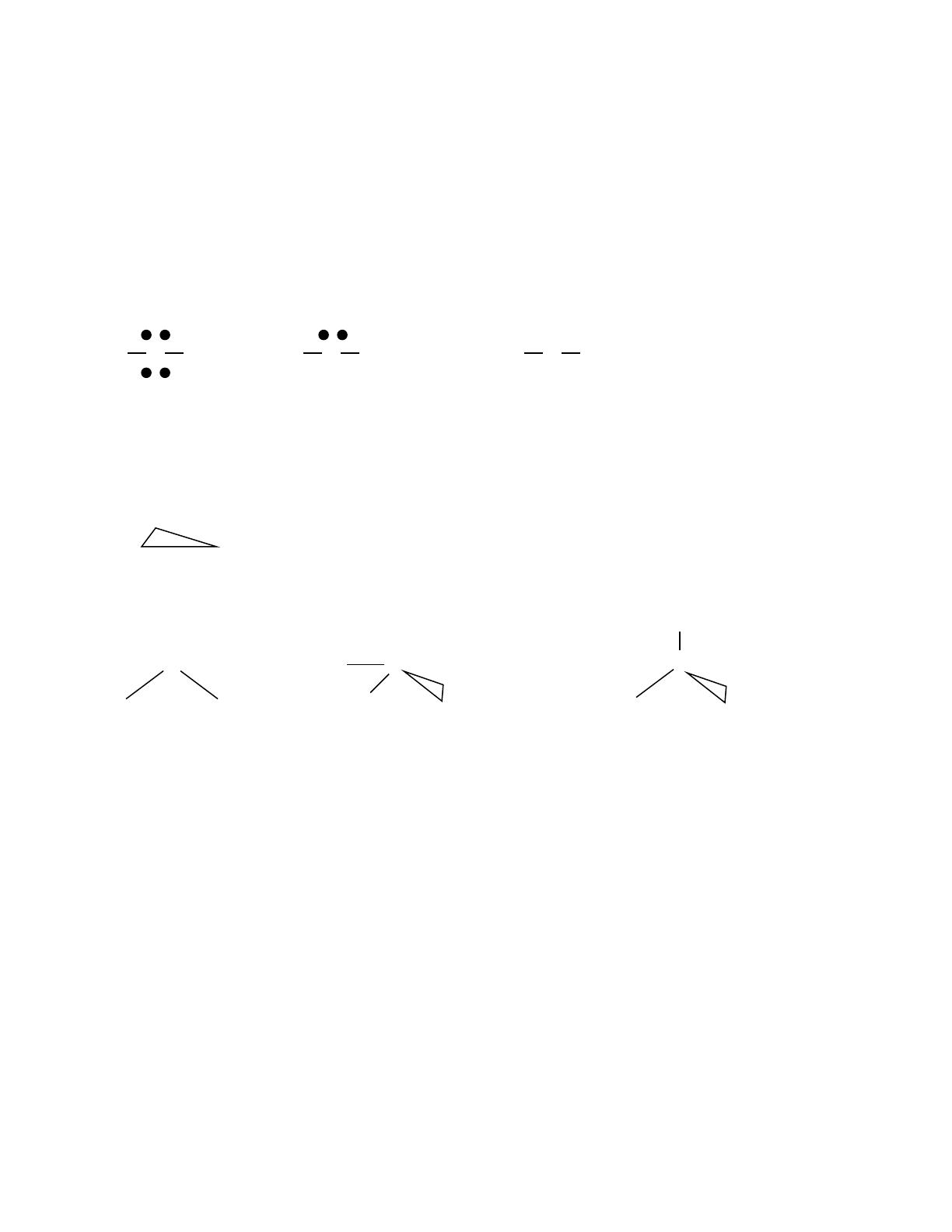
For a bond in the plane of the paper
--------- For a bond below the plane of the paper (going into the paper)
For a bond above the plane of the paper (coming out of the paper)
Using this symbolism, the structural formulas shown above can be redrawn in the following fashion.
H
O H N C- - - - - H
H H H H H H
In this experiment, you will construct three dimensional models to help you visualize shapes of molecules. You
will use ball and stick model kits, in which painted plastic balls represent atoms and short plastic sticks
represent the bonds. Double and triple bonds are represented by the bendable sticks. The wooden balls are
drilled with holes to accept the sticks. The number of holes in the ball represents the maximum number of
bonds that a given atom can have. The balls are also color coded so that elements of different groups can be
distinguished.
Objective:
1. Determine the correct Lewis structures and number of valence electrons.
2. To construct molecular models, using a ball and stick model set.
Procedure:
1. Construct the following 14 compounds:
1. H
2
O 5. NH
3
9. CH
4
12. C
2
H
6
2. H
2
S 6. CCl
4
10. CCl
2
F
2
13. CO(NH
2
)
2
3. O
2
7. CO
2
11. N
2
14. F
2
4. Cl
2
8. Br
2

2. As you build the models, draw structural formulas of the molecules you study using the symbolism discussed
in the introduction. Include the Lewis dot structure for each atom, Lewis structure of the molecule,
number of valence electrons in the atom, the 3D structure, and the VSEPR shapes.
3. Once you are completed the charts below except for VSEPR see me to get it checked off before you start the
box titled VSEPR theory.
4. After getting your table checked off use the chart on the 4
th
page of your packet to determine the correct
VSEPR. IT MAY BE HELPFUL TO USE THE MODEL KITS TO VISUALIZE THE 3D STRUCTURE.
5. Once the chart below is completed answer the analysis questions.
Data:
Lewis Dot
Structure for
each atom
Lewis structure
of the molecule
# of val. e- in the
atom. (does the # number
of val. e- = the # of val. e- in
the Lewis structure)
3D structure
using correct
symbolism
VSEPR Shapes
(the name, not a
drawing)
1
2
3
4
5
6
7
8
9
10
11
/ 5
End of Document
301
You May Also Like

FAQs of Molecular Modeling Activity for Chemistry Students

What is the purpose of the molecular modeling activity?
The molecular modeling activity aims to help students visualize and understand the shapes of molecules through hands-on construction. By using ball and stick model kits, students can create 3D representations of various compounds, which aids in grasping complex concepts such as molecular geometry and bonding. This activity also reinforces the application of VSEPR theory, allowing students to predict molecular shapes based on electron pair repulsion.
How does VSEPR theory apply to molecular modeling?
VSEPR theory, or Valence Shell Electron Pair Repulsion theory, is used to predict the 3D shapes of molecules based on the repulsion between electron pairs. In the molecular modeling activity, students learn to apply this theory by constructing models and observing how the arrangement of atoms and lone pairs affects molecular geometry. For example, molecules with two bonding pairs and no lone pairs adopt a linear shape, while those with four bonding pairs take on a tetrahedral configuration.
What types of molecules are included in the activity?
The activity includes a diverse range of molecules such as H2O, NH3, CH4, and C2H6, among others. Each molecule presents unique bonding characteristics and shapes, providing students with a comprehensive understanding of molecular structures. By constructing models of these compounds, students can explore the differences in molecular geometry and the implications of these shapes on chemical behavior.
What skills do students develop through this activity?
Students develop critical skills in molecular visualization, structural representation, and chemical reasoning through the molecular modeling activity. By constructing 3D models and drawing Lewis structures, they enhance their understanding of chemical bonding and molecular interactions. Additionally, the activity fosters teamwork and problem-solving skills as students collaborate to build models and analyze their findings.
How are Lewis structures used in this activity?
Lewis structures are integral to the molecular modeling activity as they provide a visual representation of the bonding and lone pairs of electrons in a molecule. Students are tasked with drawing the Lewis structures for each molecule they construct, which helps them understand the arrangement of atoms and the distribution of electrons. This foundational knowledge is crucial for predicting molecular shapes and understanding chemical reactivity.
What is the significance of valence electrons in molecular modeling?
Valence electrons play a crucial role in determining how atoms bond and the overall shape of molecules. In the molecular modeling activity, students calculate the number of valence electrons for each atom in the molecules they build. This understanding is essential for constructing accurate Lewis structures and applying VSEPR theory, as the arrangement of valence electrons influences molecular geometry and chemical properties.
What analysis questions are included in the activity?
The activity includes analysis questions that prompt students to reflect on their findings and deepen their understanding of molecular shapes. These questions encourage students to explain how VSEPR theory predicts molecular geometry and how electron repulsion influences the 3D structure of molecules. By answering these questions, students reinforce their learning and connect theoretical concepts to practical modeling.

Related of Molecular Modeling Activity for Chemistry Students

