Properties Of The Gaussian Function

Properties Of The Gaussian Function

The Gaussian function is a critical mathematical concept with applications in statistics, physics, and engineering. It features a bell-shaped curve characterized by its mean and standard deviation, which define its position and spread. This document explores its properties, including the probability density function, inflection points, and the significance of the area under the curve. Ideal for students and professionals seeking a deeper understanding of Gaussian functions and their applications in various fields, this resource also includes mathematical derivations and examples. Learn how the Gaussian function relates to real-world phenomena such as IQ distribution and temperature variations.

Key Points

  • Explains the Gaussian function's mathematical properties and applications in statistics.
  • Describes the significance of the probability density function in data analysis.
  • Includes detailed derivations of the Gaussian function's area under the curve.
  • Covers the relationship between the Gaussian function and real-world phenomena like IQ distribution.
336
/ 5
PROPERTIES OF THE GAUSSIAN FUNCTION
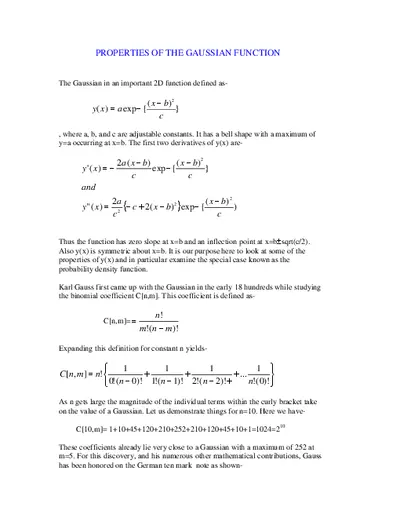
The Gaussian in an important 2D function defined as-
}
)(
{exp)(
2
c
bx
axy
, where a, b, and c are adjustable constants. It has a bell shape with a maximum of
y=a occurring at x=b. The first two derivatives of y(x) are-

)
)(
{exp)(2
2
)("
}
)(
{exp
)(2
)('
2
2
2
2
c
bx
bxc
c
a
xy
and
c
bx
c
bxa
xy
Thus the function has zero slope at x=b and an inflection point at x=bsqrt(c/2).
Also y(x) is symmetric about x=b. It is our purpose here to look at some of the
properties of y(x) and in particular examine the special case known as the
probability density function.
Karl Gauss first came up with the Gaussian in the early 18 hundreds while studying
the binomial coefficient C[n,m]. This coefficient is defined as-
C[n,m]=
)!(!
!
mnm
n
Expanding this definition for constant n yields-
)!0(!
1
...
)!2(!2
1
)!1(!1
1
)!0(!0
1
!],[
nnnn
nmnC
As n gets large the magnitude of the individual terms within the curly bracket take
on the value of a Gaussian. Let us demonstrate things for n=10. Here we have-
C[10,m]= 1+10+45+120+210+252+210+120+45+10+1=1024=2
10
These coefficients already lie very close to a Gaussian with a maximum of 252 at
m=5. For this discovery, and his numerous other mathematical contributions, Gauss
has been honored on the German ten mark note as shown-
If you look closely, it shows his curve.
The Gaussian contains certain built-in length dimensions. These include its height
at x=b, the distance from x=b to the two symmetrically located inflection points
and the area under the curve. Only two of these dimensions are needed to specify
the values of a and c. The b can be chosen to begin with. It centers the curve at
x=b. When b=0 the Gaussian is symmetric about x=0. the area under the Gaussian
can readily be calculated . It equals-
cadx
c
bx
aArea
x

}
)(
{exp
2
If we now let the area be unity and let the distance from x=b to the inflection points
be defined as the standard deviation , we have –
2
2
2
1
canda
Also we change b to and call this distance from the origin the Gaussian mean.
Substituting these constants into the original Gaussian we arrive at the Probability
Density Function-
}
2
)(
{exp
2
1
)(
2
2
x
xP
It plays a major role in statistics and also finds applications in areas such as the
temperature along a long bar away from a local hot spot. In addition it enters the
discussion on the IQ distribution of a group of individuals. Setting the standard
deviation to =1 and letting =0, produces the famous Bell curve Z(x) -
The total area under this curve remains at one and each digit increase in x represents
an extra standard deviation. The inflection points on the graph lie at x=1. The
number of individuals with an IQ lying between x=0 and x=1 is given by the
fraction-
..3413447.0)
2
1
(
2
1
)
2
(exp
2
1
1
0
2
erf
x
of the population. The fraction lying between the (n-1) and (n)th standard deviation
will be-
)
2
1
()
2
(
2
1 n
erf
n
erf
So the first few values , given in table form, become-
N 1 2 3 4
Fraction 0.341344 0.135905 0.0214002 0.00131822
These values add up to 0.499967 meaning that the total area under the remaining
values for positive x add up to a miniscule amount . The error function appearing in
the solution is defined as-
/ 5
End of Document
336
You May Also Like

FAQs of Properties Of The Gaussian Function

What is the Gaussian function and its significance?
The Gaussian function is a mathematical function that describes the normal distribution of data, characterized by its bell-shaped curve. It is defined by its mean (µ) and standard deviation (σ), which determine the curve's center and width, respectively. This function is significant in statistics as it models various natural phenomena, including measurement errors and population distributions. Understanding the Gaussian function is essential for data analysis, as it provides insights into probabilities and trends within datasets.
How is the area under the Gaussian curve calculated?
The area under the Gaussian curve is calculated using the integral of the function over its entire range. For the standard Gaussian function, this area equals one, representing the total probability. The formula involves integrating the exponential function defined in the Gaussian equation, which results in the area being expressed in terms of the standard deviation and the height of the curve at its peak. This property is crucial for statistical applications, as it allows for the determination of probabilities associated with different ranges of values.
What are inflection points in the context of the Gaussian function?
Inflection points in the Gaussian function occur where the curvature of the graph changes direction. For the standard Gaussian curve, these points are located at one standard deviation away from the mean, specifically at x = µ ± σ. At these points, the slope of the curve is zero, indicating a transition from concave up to concave down. Understanding inflection points is important for interpreting the behavior of the Gaussian function, especially in statistical analysis where they help identify ranges of data that are less likely to occur.
What role does the Gaussian function play in statistics?
In statistics, the Gaussian function serves as the foundation for the normal distribution, which is a key concept in probability theory. It helps in understanding how data is distributed around the mean, allowing statisticians to make predictions and infer conclusions from sample data. Many statistical tests and methods, such as hypothesis testing and confidence intervals, rely on the properties of the Gaussian function. Its prevalence in natural and social sciences makes it essential for analyzing real-world data.

Related of Properties Of The Gaussian Function