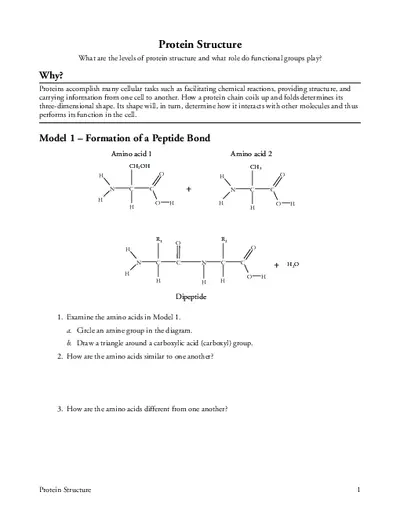
Protein structure is essential for understanding biological functions and processes. This document explores the four levels of protein structure: primary, secondary, tertiary, and quaternary, detailing how amino acid sequences determine a protein's shape and function. It covers the significance of peptide bonds, hydrogen bonds, and hydrophobic interactions in stabilizing protein structures. Ideal for AP Biology students, this resource provides insights into protein folding and the impact of environmental factors on protein stability. Comprehensive diagrams and models illustrate the complex interactions within protein structures.
Key Points
- Explains the four levels of protein structure: primary, secondary, tertiary, and quaternary.
- Details the role of peptide bonds and hydrogen bonds in protein stability.
- Includes diagrams illustrating protein folding and interactions.
- Discusses the impact of temperature and pH on protein denaturation.