Spring Constant and Cooling Curve Experiments

Spring Constant and Cooling Curve Experiments

The experiments focus on determining the spring constant of a helical spring and studying the cooling curve of a hot body. The spring constant experiment involves measuring the extension of a spring under various loads, allowing students to understand Hooke's Law. The cooling curve experiment applies Newton's Law of Cooling to observe how temperature changes over time in a controlled environment. These practical experiments are essential for physics students learning about elasticity and thermodynamics. Ideal for high school or introductory college-level physics courses.

Key Points

  • Determines the spring constant using Hooke's Law through load and extension measurements.
  • Applies Newton's Law of Cooling to analyze temperature changes over time.
  • Includes detailed procedures for conducting both experiments safely and accurately.
  • Provides observation tables for recording data and calculating results.
124
/ 4
EXPERIMENT 9 SPRING CONSTANT
AIM
To find the force constant of a helical spring by plotting graph between load and
extension.
APPARATUS
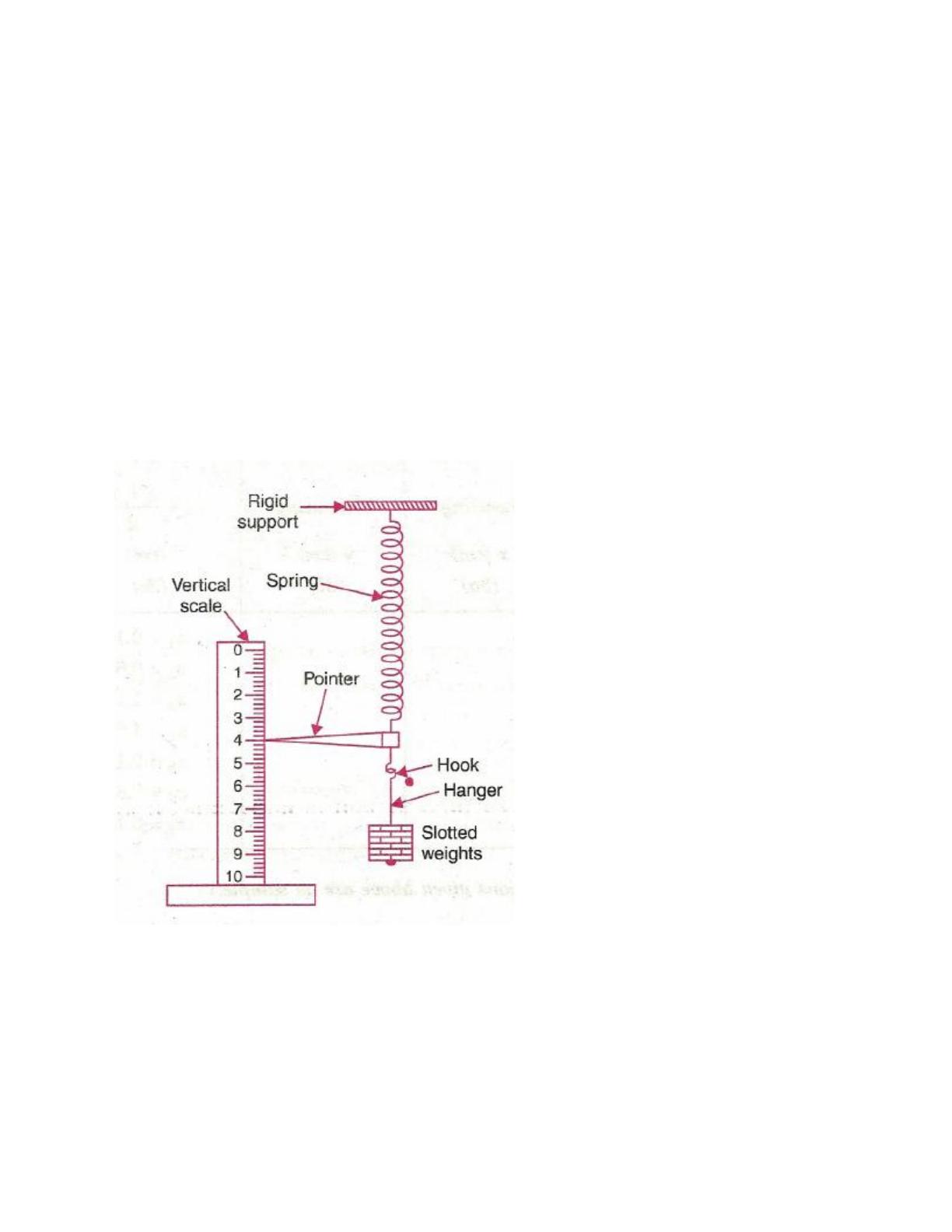
Spring, a rigid support, slotted weights, a vertical wooden
scale, a fine pointer, a hook.
THEORY
When a load F suspended from lower free end of a spring hanging from a rigid support,
it increases its length by amount x,
then F
x
or F= k x,
where k is constant of proportionality.
It is called the force constant or the spring constant of the spring.
DIAGRAM
PROCEDURE
1. Suspend the spring from a rigid support. Attach a pointer and a hook from .
free end.
2. Hang a 20 g hanger from the hook.
3. Set the vertical wooden scale such that the tip of the pointer comes over the
the scale.
4. Note the reading of the position of the tip of the pointer on the scale. Record the reading in
loading column against zero load. .
5. Gently add a 20 g slotted weight to the hanger. The pointer tip moves down.
6. Wait for few minutes till the pointer tip comes to rest. Repeat step 4.
7. Repeat steps 5 and 6 till five slotted weights have been added.
8. Now remove one slotted weight. The pointer tip moves up. Repeat step 6. Record the
reading in unloading column.
9. Repeat step 8 till only hanger is left.
10. Record your observations as given below.
OBSERVATIONS
Least count of vertical scale = 0.1 cm.
Table for load and extension
CALCULATIONS
From graph,
k =……………… gwt per cm.
RESULT
The force constant of the given spring is …………. g wt per cm.
PRECAUTIONS
1. Loading and unloading of weight must be done gently.
2. Reading should be noted only when tip of pointer comes to rest.
3. Pointer tip should not touch the scale surface.
4. Loading should not be beyond elastic limit.
SOURCES OF ERROR
1. The support may not be rigid.
2. The slotted weights may not have correct weight (20g).
Serial
No.
Load (g)
Reading of the scale
while
Extension x
(cm)
Loading
unloading
EXPERIMENT 10 COOLING CURVE
AIM
To study the relationship between the temperature of a hot body and time by
plotting a cooling curve.
APPARATUS
Newton's law of cooling apparatus, two thermometers, clamp and stand, stop watch.
THEORY
From Newton's law of cooling,
Rate of cooling ∞ Difference of temperature of body arid surrounding.
(T-T
0
) , (T-T
0
)
(T-T
0
)
PROCEDURE
1. Fill the calorimeter two-third with water heated to about 90
0
C.
2. Suspend the calorimeter inside the enclosure along-with a stirrer in it. Cover it with
a wooden lid having a hole in its middle.
3. Suspend from clamp and stand, one thermometer in enclosure water and the other in
calorimeter water.
4. Set the stop clock/watch at zero and note its least count. - _.+
5. Note temperature (T
0
) of water in enclosure.
6. Start stirring the water in calorimeter to make it cool uniformly.
7. Just when calorimeter water has some convenient temperature reading
note it and start the stop watch. .
8. Continue stirring and note temperature after every two minutes. The temperature'
falls quickly in the beginning.
9. Stop when fall of temperature becomes very slow.
10. Record your observations.
OBSERVATIONS
Least count of enclosure water thermometer =
Table for time and temperature
Serial
No.
Time of cooling
(min)
Temperature (
0
C)
RESULT
The temperature falls quickly in the beginning and then slowly as difference of temperature
goes on decreasing. .
.PRECAUTIONS
1. Double-walled enclosure should be used to maintain surrounding at a constant temperature.
2. Stirring should remain for uniform cooling.
/ 4
End of Document
124
You May Also Like

FAQs of Spring Constant and Cooling Curve Experiments

How is the spring constant determined in the experiment?
The spring constant is determined by measuring the extension of a helical spring when different weights are applied. As weights are added, the extension is recorded, and a graph is plotted to show the relationship between load and extension. The slope of this graph represents the spring constant, allowing students to understand the proportionality between force and extension as described by Hooke's Law.
What is the significance of the cooling curve experiment?
The cooling curve experiment illustrates the principles of heat transfer and thermodynamics. By measuring the temperature of a hot body over time, students can observe how the rate of cooling changes as the temperature difference between the body and its surroundings decreases. This experiment reinforces the concept of Newton's Law of Cooling, which states that the rate of heat loss is proportional to the temperature difference.
What precautions should be taken during the spring constant experiment?
Precautions in the spring constant experiment include ensuring that weights are added and removed gently to avoid damaging the spring. Readings should only be taken when the pointer is at rest, and the pointer should not touch the scale surface. Additionally, it is important to avoid exceeding the elastic limit of the spring to maintain its integrity.
What apparatus is used in the cooling curve experiment?
The cooling curve experiment utilizes a Newton's law of cooling apparatus, which includes two thermometers, a calorimeter filled with water, and a stirrer to ensure uniform cooling. A stopwatch is also used to time the cooling process. This setup allows for accurate temperature measurements and helps maintain consistent conditions throughout the experiment.
What data is collected during the cooling curve experiment?
During the cooling curve experiment, temperature readings are taken at regular intervals as the hot water cools. These readings are recorded in a table alongside the corresponding time, allowing for analysis of the cooling rate. The data collected helps students visualize the relationship between time and temperature, illustrating how cooling slows as the temperature approaches that of the surroundings.

Related of Spring Constant and Cooling Curve Experiments