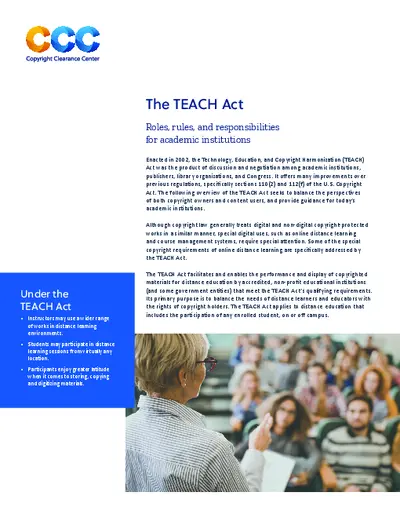
The TEACH Act Primer provides essential guidelines for accredited, non-profit educational institutions navigating copyright compliance in distance education. It outlines the requirements for using copyrighted materials in online learning environments, emphasizing the balance between educators' needs and copyright holders' rights. Key topics include the scope of permissible materials, technological measures for compliance, and the limitations imposed by the Act. This primer is a valuable resource for educators and administrators seeking to enhance their understanding of copyright issues related to online teaching.
Key Points
Explains the TEACH Act's requirements for distance education compliance.
Details the types of copyrighted materials that can be used under the TEACH Act.
Outlines the technological measures institutions must implement for compliance.
Clarifies what the TEACH Act does not allow, including electronic reserves and commercial document delivery.
This link leads to an external site. We do not know or endorse its content, and are not responsible for its safety. Click the link to proceed only if you trust this site.
What are the main requirements of the TEACH Act for educational institutions?
The TEACH Act requires that institutions be accredited and non-profit, ensuring that the use of copyrighted materials is part of mediated instructional activities. Additionally, the use must be limited to enrolled students in specific classes, and it can occur during live or asynchronous sessions. Institutions must also have clear copyright policies in place and implement technological measures to ensure compliance, such as user authentication and content restrictions.
What types of materials are excluded from the TEACH Act exemptions?
The TEACH Act specifically excludes the use of electronic reserves, coursepacks, and interlibrary loans. It also does not cover commercial document delivery or textbooks that students typically purchase. Furthermore, materials developed specifically for online use are not included in the exemptions, ensuring that the Act does not undermine the market for educational resources.
How does the TEACH Act balance the needs of educators and copyright holders?
The TEACH Act aims to facilitate distance education while respecting the rights of copyright holders. By allowing accredited institutions to use a broader range of copyrighted materials, it supports educators in delivering effective online instruction. However, it also imposes strict guidelines and requirements to ensure that copyright owners' rights are not infringed upon, thus creating a framework that benefits both parties.
What technological measures must institutions implement under the TEACH Act?
Institutions must adopt several technological measures to comply with the TEACH Act, which go beyond simple password protection. These measures can include user and location authentication through IP checking, content timeouts, and disabling print and copy functions. Such technologies help ensure that only authorized users can access copyrighted materials, thereby protecting the rights of copyright holders while facilitating educational use.