Top 10 Most Common AP Errors – AP Guide

Top 10 Most Common AP Errors - AP Guide

The Top 10 Most Common AP Errors guide provides essential insights for students and educators aiming to master AP writing standards. It outlines critical mistakes to avoid, such as incorrect quotation attribution and improper use of commas. This guide is particularly useful for high school students preparing for AP exams, ensuring clarity and adherence to the Associated Press Style. With practical examples and clear explanations, it serves as a valuable resource for anyone looking to improve their writing skills in a journalistic context.

Key Points

  • Identifies the top 10 common errors in AP writing style.
  • Explains the correct use of quotation attribution and punctuation.
  • Highlights the importance of avoiding first-person language in articles.
  • Provides guidelines for proper capitalization and abbreviation usage.
69
/ 3
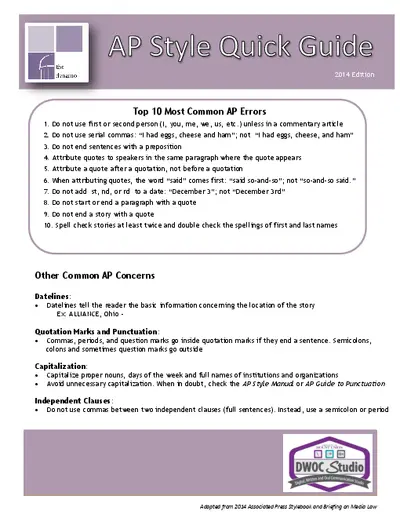
Top 10 Most Common AP Errors
1. Do not use first or second person (I, you, me, we, us, etc.) unless in a commentary article
2. Do not use serial commas: “I had eggs, cheese and ham”; not “I had eggs, cheese, and ham”
3. Do not end sentences with a preposition
4. Attribute quotes to speakers in the same paragraph where the quote appears
5. Attribute a quote after a quotation, not before a quotation
6. When attributing quotes, the word “said” comes first: “said so-and-so”; not “so-and-so said.”
7. Do not add st, nd, or rd to a date: “December 3”; not “December 3rd
8. Do not start or end a paragraph with a quote
9. Do not end a story with a quote
10. Spell check stories at least twice and double check the spellings of first and last names
Other Common AP Concerns
Datelines:
Datelines tell the reader the basic information concerning the location of the story
Ex: ALLIANCE, Ohio
Quotation Marks and Punctuation:
Commas, periods, and question marks go inside quotation marks if they end a sentence. Semicolons,
colons and sometimes question marks go outside
Capitalization:
Capitalize proper nouns, days of the week and full names of institutions and organizations
Avoid unnecessary capitalization. When in doubt, check the AP Style Manual or AP Guide to Punctuation
Independent Clauses:
Do not use commas between two independent clauses (full sentences). Instead, use a semicolon or period
Adapted from 2014 Associated Press Stylebook and Briefing on Media Law
2014 Edition
Abbreviate the Following:
Titles when used before a full name (Dr., Mrs., Ms.,); after a name (Jr., Sr.)
Company (co.), corporation (corp.), incorporated (inc.)
Dates/numerals (A.D./ B.C., a.m./p.m.)
Certain months when no year is given; months with specific dates (Jan., Feb.,
Aug., Sept., Oct., Nov., Dec.)
Addresses when paired with numbers (Ave., Blvd., St.)
The names of some organizations and government agencies (CIA, FBI, GOP)
B.A., M.A., Ph.D only when referencing a person’s full name
Abbreviations after a name are set off by commas: John Smith, Ph.D, believes…
Academic Degrees:
If credentials are needed, avoid abbreviations and use a phrase: John Smith, who
has a doctorate in psychology,…
Apostrophes should be used as follows: bachelor’s, master’s, etc.
Do not use apostrophes when spelling out the name of the degree: Bachelor of
Arts, Master of Science and associate degree
Numerals:
Spell out numbers one through nine or if a number appears at the beginning of a
sentence
Use figures for 10 or above; when preceding a unit of measure and when
referring to ages; academic course numbers; addresses; plane destination;
dimensions or ratios
State Names:
Spell out state names when they stand by themselves
Eight states are never abbreviated: Alaska, Hawaii, Idaho, Iowa, Maine, Ohio, Texas
and Utah
Time:
Use the days of the week, not “today” or “tonight” in print
Use the month and date when appropriate
Titles:
Use lowercase and spell out titles when they are not used with a name (The
president issued a statement.)
Capitalize formal titles when they are used immediately before one or more names
(President Barack Obama)
-Information of 2013 AP Style Guide and Kelsey Tomlinson
LOCATION
KHIC Library
Across from Circulation
x3560
HOURS
Sunday: 610 PM
Mon-Thurs: 9 AM10 PM
Friday: 9 AM3 PM
MAKE AN APPOINTMENT
ONLINE
mountunion.edu/dwocs
DIRECTOR
Danielle Cordaro, Ph.D.
x4893
cordarda@mountunion.edu
Who, What, Where,
When, Why and How
Important
Background
Info
Lede
Five W’s and attention-grabber
Nut Graf
Whatever the lede didn’t cover
Direct Quote
Details
Indirect Quote
Other important notes on writing news stories:
Don’t bury the lede! Start with the most important info first so that readers can quickly
get the gist of the story
Conciseness is key in AP style. Most paragraphs should be 2 sentences long
Don’t be lazy—when in doubt, check the AP Style Guide. The CWOC has copies available
The Structure of News Stories: Inverted Pyramid
Details
/ 3
End of Document
69
You May Also Like

FAQs of Top 10 Most Common AP Errors – AP Guide

What are the most common AP errors identified in the guide?
The guide identifies ten prevalent errors in AP writing, including the misuse of first-person language, incorrect quotation attribution, and the improper placement of commas. It emphasizes the importance of clarity and consistency in journalistic writing. Each error is explained with examples, making it easier for students to understand and avoid these pitfalls in their own writing.
How does the guide suggest handling quotation attribution?
The guide advises that quotes should be attributed to speakers within the same paragraph where the quote appears. It emphasizes that the word 'said' should come first in the attribution, ensuring clarity and proper flow in the text. This approach helps maintain the integrity of the quote and provides context for the reader.
What punctuation rules are highlighted in the AP errors guide?
The guide outlines specific punctuation rules, such as placing commas and periods inside quotation marks when they end a sentence. It also discusses the correct use of semicolons and colons, emphasizing that commas should not be used between independent clauses. These rules are crucial for maintaining proper sentence structure and clarity in writing.
Why is it important to avoid first-person language in AP writing?
Avoiding first-person language is essential in AP writing to maintain an objective tone. This style is designed to present information without personal bias, allowing readers to focus on the content rather than the author's perspective. The guide stresses that using third-person language enhances credibility and professionalism in journalistic writing.

Related of Top 10 Most Common AP Errors – AP Guide