Urea Calorimetry Lab Experiment for Chemistry Students

Urea Calorimetry Lab Experiment for Chemistry Students

Urea calorimetry lab explores the principles of calorimetry and specific heat through the dissolution of urea in water. This experiment measures the heat exchange between the urea solution and the surrounding water, utilizing a coffee cup calorimeter setup. Students will learn to calculate heat transfer using the formula q = mc∆T, where they will analyze temperature changes and specific heat values. The lab is designed for high school chemistry students and provides hands-on experience in calorimetry techniques and thermodynamic principles.

Key Points

  • Explores the principles of calorimetry using urea and water.
  • Utilizes a coffee cup calorimeter to measure heat exchange.
  • Calculates heat transfer using the formula q = mc∆T.
  • Designed for high school chemistry students to understand thermodynamics.
58
/ 3
Name:______________________________________________________Date:____________Block:____
Urea Calorimetry Lab
Introduction
When a substance is heated, the motion of its individual particles increases, resulting in an increase in
temperature. The more heat that is added per gram of substance, the greater the temperature change.
The relationship between the heat added, the mass of a substance, and the temperature change it
undergoes is known as specific heat.
𝑆𝑝𝑒𝑐𝑖𝑓𝑖𝑐 𝐻𝑒𝑎𝑡 =
𝐸𝑛𝑒𝑟𝑔𝑦 𝑖𝑛 𝑗𝑜𝑢𝑙𝑒𝑠
𝑀𝑎𝑠𝑠 𝑖𝑛 𝑔𝑟𝑎𝑚𝑠 𝑥 𝑇𝑒𝑚𝑝𝑒𝑟𝑎𝑡𝑢𝑟𝑒 𝑐ℎ𝑎𝑛𝑔𝑒 𝑖𝑛 𝐶𝑒𝑙𝑠𝑖𝑢𝑠 𝑜𝑟 𝐾𝑒𝑙𝑣𝑖𝑛
Specific heat is defined as the amount of energy necessary to produce a temperature change of 1°C per
gram of substance. The specific heats of different substances vary, and therefore this quantity may be
useful in identifying an unknown.
The measurement of heat changes is called calorimetry. A calorimeter is a piece of equipment designed
to measure the energy released or absorbed during a chemical reaction or phase change. In this lab, a
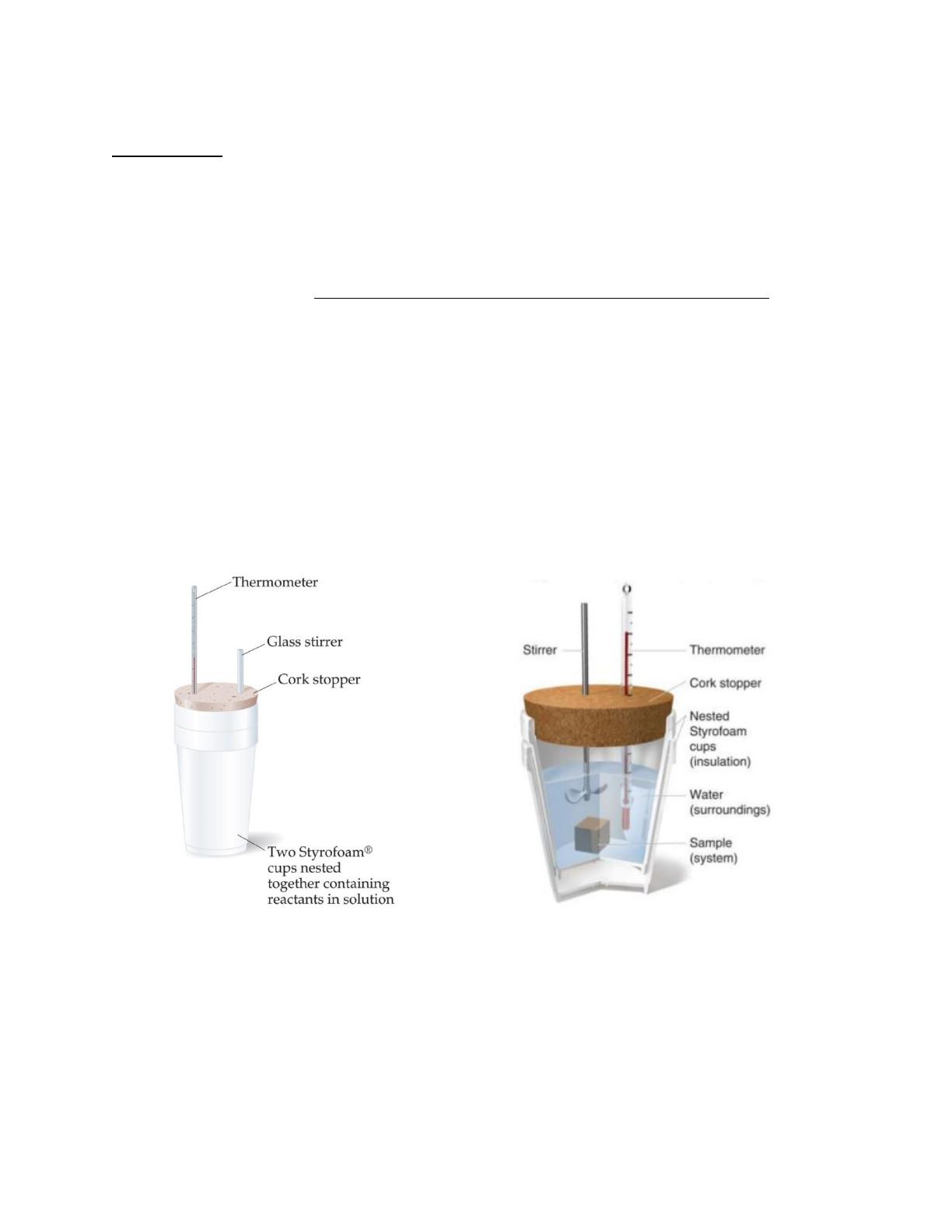
coffee cup calorimeter will be constructed to measure the heat exchanged between the system
(reactants and products) and the surroundings (the water). The temperature change of water will then
be used to determine the amount of energy transferred either into or out of the water.
The diagram below shows the basic setup of a coffee cup calorimeter.
According to the Law of Conservation of Energy, energy is neither created nor destroyed. It can be
assumed that no heat is lost to the calorimeter or the environment outside the calorimeter.
Energy lost/gained by the system = Energy gained gained/lost by water
The formula below is used to calculate the amount of energy absorbed/released during calorimetry.
q = mc∆T
where q = heat (in joules); m = mass (in grams); c = specific heat (in joules/grams • °C); T = change in
temperature (i.e. final temp initial temp) (in °C or K)
Safety
Goggles and closed toed shoes must be worn at all times.
Pre-lab
Consider the structure of urea.
1. Is urea a polar or nonpolar molecule? Explain your reasoning.
2. Would you expect urea to dissolve in water? Explain your reasoning.
Procedure
1. Assemble the calorimeter.
a. Place one Styrofoam cup inside the other.
b. Place the Styrofoam cups into the beaker.
2. Measure 50.0 mL of distilled water into the top Styrofoam cup.
3. Measure and record the initial temperature of the water.
4. Measure approximately 2 grams of urea. Record the exact mass of urea used.
5. Quickly add the urea to the water and stir with a glass stirring rod to dissolve the urea.
6. Record the final temperature of the water.
7. Discard the aqueous urea solution down the sink.
8. Rinse the Styrofoam cup with tap water.
9. Repeat Steps 1-8 twice.
Data
Construct your own data table.
Data Analysis and Calculations
*Note: the density of water is 1.00 g/mL and specific heat of water is 4.184 joules/grams • °C. Assume
the urea solution has the same density and specific heat of water.
1. Calculate the amount of heat transferred, in joules, for each trial.
a. Trial #1
b. Trial #2
c. Trial #3
2. Calculate the amount of heat transferred, in kilojoules per gram of urea, for each trial.
a. Trial #1
b. Trial #2
c. Trial #3
3. Calculate the amount of heat transferred, in kilojoules per mole of urea, for each trial.
a. Trial #1
b. Trial #2
c. Trail #3
4. Calculate the average heat transferred, in kilojoules per mole of urea.
5. The accepted value of heat transfer (∆H) is 13.8 kJ/mol. Using the average obtained in Question
#4 as the experimental ∆H, calculate the experimental error.
Discussion Questions
1. During any chemical reaction or physical process, heat is exchanged between the system and
the surroundings. In a coffee cup calorimeter, the water is considered the surroundings. Is the
dissolving of urea in water an exothermic or endothermic process? Justify your answer using
the data collected in this lab.
2. The enthalpy change, H, the dissolving of urea is 13.8 kJ/mol. Calculate the amount of heat
that would be transferred if a student dissolved 8.8 grams of urea in water.
3. Entropy (S) is the measure of randomness of particle arrangements. For example, gases have
much more entropy than solids because gas particles are more dispersed and in constant
motion. Which would you expect to have a larger entropy value: solid urea or an aqueous urea
solution?
/ 3
End of Document
58
You May Also Like

FAQs of Urea Calorimetry Lab Experiment for Chemistry Students

What is the purpose of the urea calorimetry lab?
The purpose of the urea calorimetry lab is to investigate the heat exchange that occurs when urea dissolves in water. By measuring the temperature change in the water, students can calculate the amount of heat absorbed or released during the dissolution process. This experiment helps illustrate the concepts of specific heat and calorimetry, allowing students to apply theoretical knowledge in a practical setting.
How do you calculate heat transfer in this experiment?
Heat transfer in the urea calorimetry lab is calculated using the formula q = mc∆T. In this equation, 'q' represents the heat absorbed or released, 'm' is the mass of the water, 'c' is the specific heat capacity of water, and '∆T' is the change in temperature. By measuring the initial and final temperatures of the water and knowing its mass, students can determine the heat transfer associated with the dissolution of urea.
What safety precautions should be taken during the lab?
Safety precautions for the urea calorimetry lab include wearing goggles and closed-toed shoes at all times. These measures protect students from potential spills and chemical exposure. Additionally, proper disposal of the urea solution down the sink and rinsing the equipment after use are essential to maintain a safe laboratory environment.
Is the dissolution of urea in water an exothermic or endothermic process?
The dissolution of urea in water is considered an endothermic process. This means that the process absorbs heat from the surroundings, resulting in a decrease in temperature of the water. Data collected during the lab will help students understand the energy changes involved in the dissolution and how it relates to thermodynamic principles.
What is the significance of specific heat in this lab?
Specific heat is significant in the urea calorimetry lab as it determines how much energy is required to change the temperature of a substance. Understanding specific heat allows students to calculate the heat transfer accurately when urea dissolves in water. This concept is crucial for grasping broader thermodynamic principles and the behavior of different substances during heat exchange.

Related of Urea Calorimetry Lab Experiment for Chemistry Students


