Year 10 Mathematics Single Variable and Bivariate Data

Year 10 Mathematics Single Variable and Bivariate Data

Year 10 Mathematics focuses on single variable and bivariate data analysis, essential for understanding statistics. This resource includes practice tests, frequency tables, and graphical representations like histograms and scatter plots. Students will explore concepts such as mean, median, mode, and quartiles, along with data interpretation techniques. Ideal for Year 10 students preparing for assessments in mathematics, this guide enhances skills in data organization and analysis.

Key Points

  • Covers single variable and bivariate data analysis for Year 10 students.
  • Includes practice tests with frequency tables and graphical representations.
  • Explains statistical concepts such as mean, median, mode, and quartiles.
  • Provides data interpretation techniques essential for mathematics assessments.
111
/ 8
Year 10 Mathematics
Single Variable and Bivariate Data
Practice Test 1
1 What type of data would the following survey questions generate?
a How many televisions do you have in your home?
b To what type of music do you most like to listen?
2 Twenty people checking out of a hotel were surveyed on the level of service provided
by the hotel staff. The results were
poor first class poor average good
good average good first class first class
good good first class good average
average good poor first class good
a Construct a frequency table to record the data, with headings Category, Tally and
Frequency.
b Construct a column graph for the data.
3 Twenty people were surveyed to find out how many times they use the internet in a
week. The raw data are listed.
21, 19, 5, 10, 15, 18, 31, 40, 32, 25
11, 28, 31, 29, 16, 2, 13, 33, 14, 24
a Organise the data into a frequency table using class intervals of 10. Include a
percentage frequency column.
b Construct a histogram for the data, showing both the frequency and percentage
frequency on the one graph.
c Which interval is the most frequent?
d What percentage of people used the internet 20 times or more?
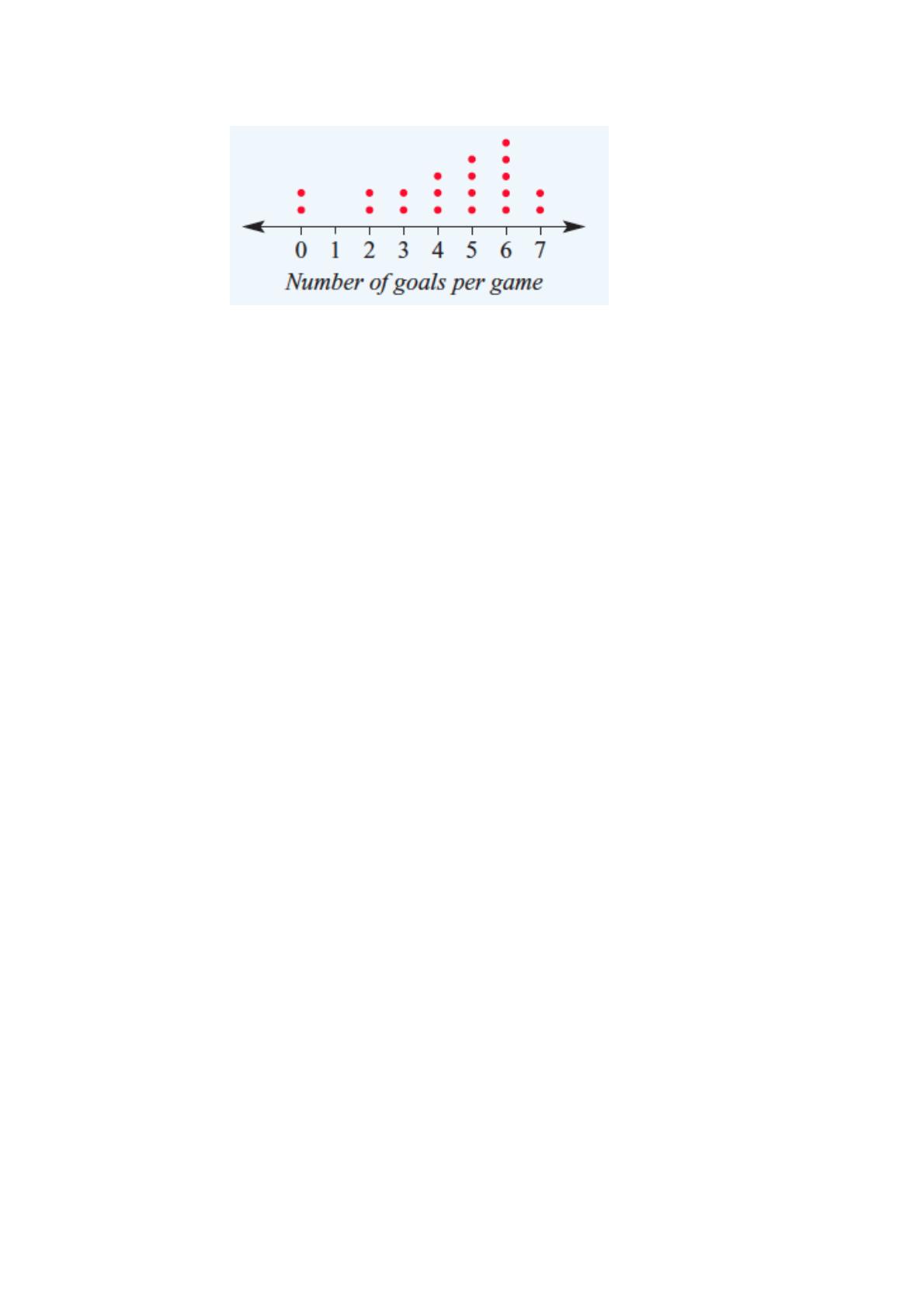
4 This dot plot shows the number of goals per game scored by a team during the soccer
season.
a How many games were played?
b What was the most common number of goals per game?
c How many goals were scored for the season?
d Describe the data in the dot plot.
5 For the following set of data:
a Organise the data into an ordered stem-and-leaf plot.
b Describe the distribution of the data as symmetrical or skewed.
22 62 53 44 35 47 51 64 72
32 43 57 64 70 33 51 68 59
6 Two television sales employees sell the following number of televisions each week
over a 15-weekperiod.
Employee 1
23 38 35 21 45 27 43 36 19 35 49 20 39 58 18
Employee 2
28 32 37 20 30 45 48 17 32 37 29 17 49 40 46
a Construct an ordered back-to-back stem-and-leaf plot.
b Describe the distribution of each employee’s sales.
7 For the following data sets, find:
i the mean ii the mode iii the range
a) 2, 4, 5, 8, 8 b) 3, 15, 12, 9, 12, 15, 6, 8
8 Find the median of each data set.
a) 4, 7, 12, 2, 9, 15, 1 b) 16, 20, 8, 5, 21, 14
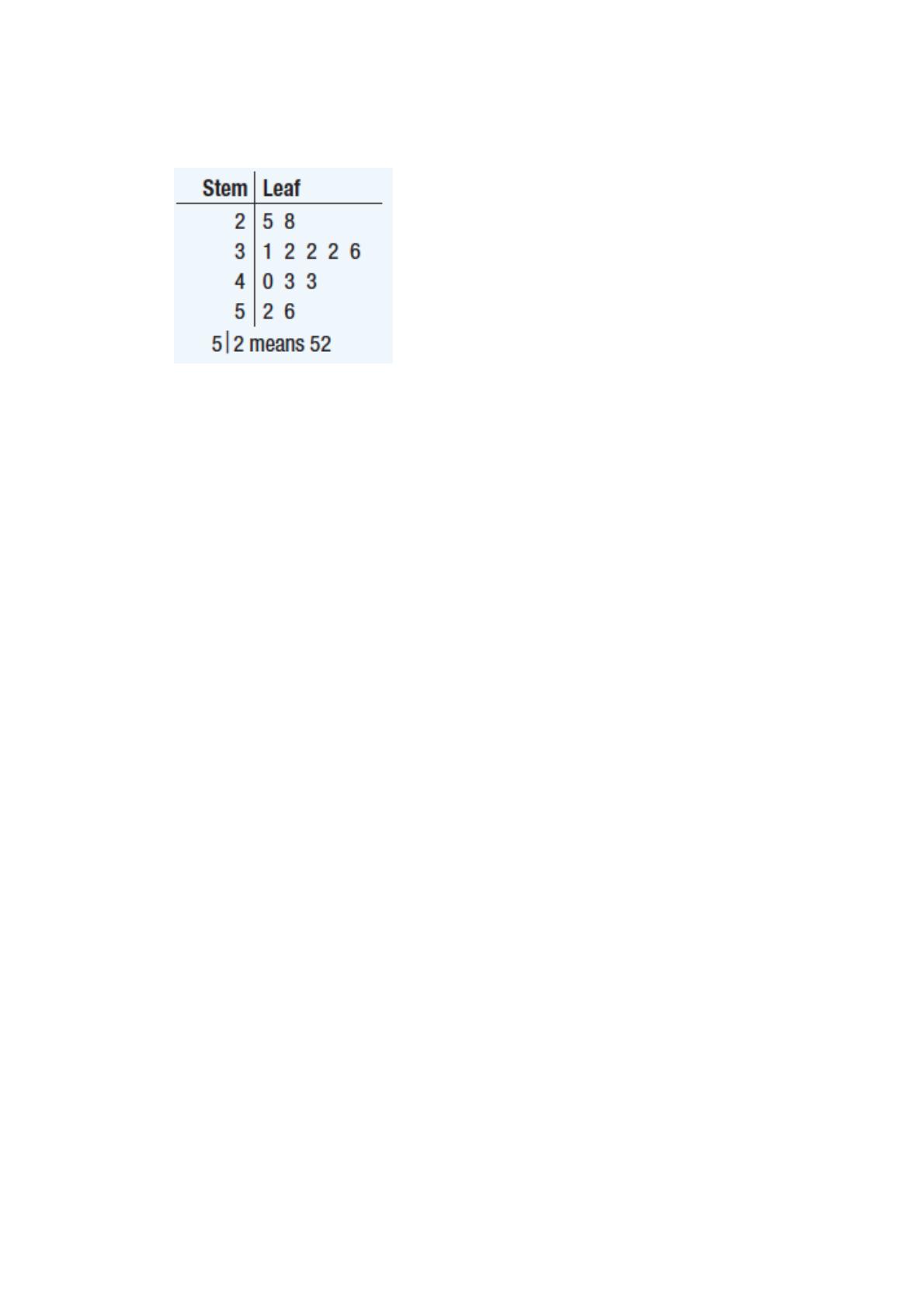
9 For the data in this stem-and-leaf plot, find:
a) the range b) the mode c) the mean d) the median
10 Consider this data set.
2, 2, 4, 5, 6, 8, 10, 13, 16, 20
a) Find the upper quartile (Q3 ) and the lower quartile (Q1 ).
b) Determine the IQR.
11. Consider this data set.
2.2, 1.6, 3.0, 2.7, 1.8, 3.6, 3.9, 2.8, 3.8
a Find the upper quartile (Q3 ) and the lower quartile (Q1).
b Determine the IQR.
12 The following data set represents the number of flying geese spotted on each day of
a 13-day tour of England.
5, 1, 2, 6, 3, 3, 18, 4, 4, 1, 7, 2, 4
a) For the data, find:
i the minimum and maximum number of geese spotted ii the median
iii the upper and lower quartiles iv the IQR
b) Find any outliers.
c) Can you give a possible reason for why the outlier occurred?
13 Consider the given data set.
12, 26, 14, 11, 15, 10, 18, 17, 21, 27
a) Find the five-figure summary (the minimum, lower quartile (Q1), median (Q2 ),
upper quartile (Q3 ) and the maximum).
b) Draw a box plot to summarise the data.
/ 8
End of Document
111
You May Also Like

FAQs of Year 10 Mathematics Single Variable and Bivariate Data

What types of data are covered in Year 10 Mathematics?
Year 10 Mathematics covers both single variable and bivariate data. Single variable data focuses on one set of data points, while bivariate data explores the relationship between two variables. Understanding these types of data is crucial for statistical analysis and helps students interpret real-world scenarios effectively.
How do students construct frequency tables in this resource?
Students learn to create frequency tables by organizing survey data into categories, tallying responses, and calculating frequencies. This process helps in visualizing data distribution and is foundational for further statistical analysis, such as creating histograms and understanding data trends.
What statistical concepts are emphasized in the practice tests?
The practice tests emphasize key statistical concepts such as mean, median, mode, and range. Students are required to calculate these measures from given data sets, which enhances their understanding of data centrality and variability. This knowledge is essential for interpreting data in various contexts.
What types of graphs do students learn to create?
Students learn to create various types of graphs, including histograms, scatter plots, and column graphs. These graphical representations are vital for visualizing data patterns and relationships, making it easier to analyze and interpret statistical information effectively.
How does this resource help with data interpretation skills?
This resource enhances data interpretation skills by providing practical exercises and examples. Students engage with real-world data sets, allowing them to practice analyzing and drawing conclusions based on statistical information. This hands-on approach fosters critical thinking and analytical skills.
What is the significance of quartiles in data analysis?
Quartiles are significant in data analysis as they divide a data set into four equal parts, providing insights into data distribution. Understanding quartiles helps students identify the spread and central tendency of data, which is crucial for making informed decisions based on statistical evidence.

Related of Year 10 Mathematics Single Variable and Bivariate Data