Bacterial interactions protocols explore the competitive and cooperative dynamics among soil bacteria and Safe ESKAPE pathogens. These lab exercises aim to evaluate the impact of soil bacteria on the growth of antibiotic-resistant pathogens through various experimental designs. Students will engage in hands-on activities, including measuring zones of inhibition and preparing conditioned media to assess bacterial growth. This resource is essential for biology students studying microbiology and antibiotic resistance, providing a comprehensive framework for understanding bacterial interactions in laboratory settings.

Key Points

  • Explores the competitive and cooperative interactions among soil bacteria and Safe ESKAPE pathogens.
  • Includes protocols for measuring zones of inhibition to assess bacterial growth.
  • Guides students in preparing conditioned media to evaluate the impact of soil bacteria on pathogen growth.
  • Designed for biology students studying microbiology and antibiotic resistance.
Katee
11 pages
Language:English
Type:Lab Report
Katee
11 pages
Language:English
Type:Lab Report
67
/ 11
BIOL 1500L
Bacterial Interactions (Part 1)
Preliminary Survey for Inhibition of Safe ESKAPEs by Soil Bacteria
Background: Bacteria exist in communities that often contain several
species. The fitness of a bacterium in these communities is partially
dependent on its ability to respond effectively to other organisms.
Organisms in a multispecies community must respond to resource
utilization, production of metabolic byproducts, and other secreted
molecules. Due to limited resources, many interactions among
bacterial species are competitive
1,2
. However, bacteria do engage in
cooperative interactions in some environments, such as in our
intestines
3
. The goal of this lab is to evaluate whether metabolic
byproducts, and/or secreted molecules from our soil bacteria impact
the growth of ESKAPE pathogens. The ESKAPE pathogens are a group
of organisms that are at risk for developing antibiotic resistance. You
will test whether your unknown soil bacteria inhibit growth of Safe
ESKAPEs. Safe ESKAPEs are closely related to the ESKAPE pathogens
and can be used as a relatively safe model during scientific studies.
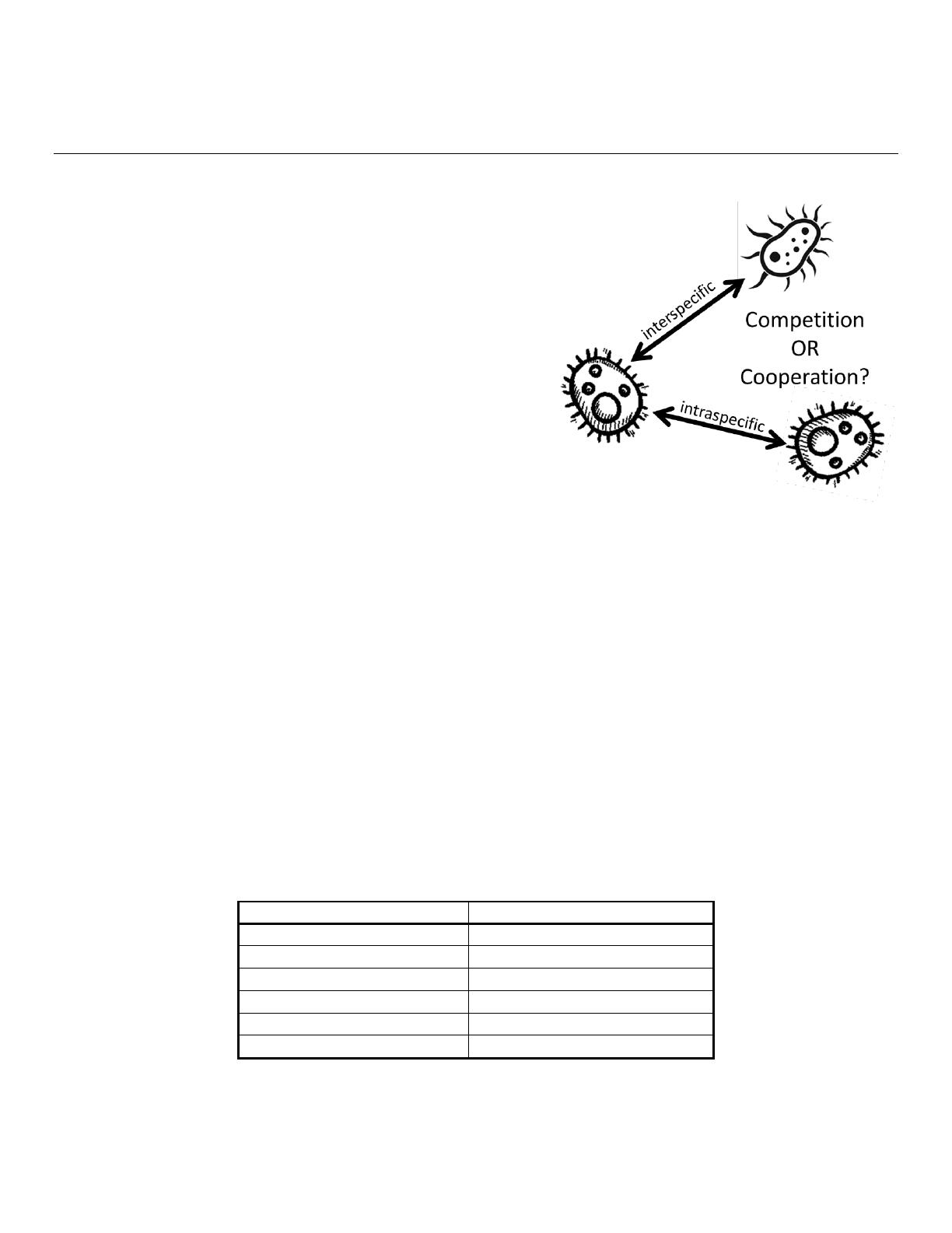
Scientific Concept: The growth of living organisms is sensitive to environmental factors, including the presence and
actions of other organisms. Interactions among organisms can be within the same species (intraspecific) or among
organisms of differing species (interspecific). Both intraspecific and interspecific interactions can impact growth and
survival. This lab is based on the hypothesis that the metabolic byproducts and/or secreted molecules of some soil
bacteria may inhibit the growth and survival of the Safe ESKAPEs.
Instructions: Before you begin, each of you will be assigned an ESKAPE pathogen to test from the following list. You
should develop a rationale that justifies studying your assigned ESKAPE pathogen. (Do a good job on this! You will need
to share your information and rationale with the rest of your lab partners next week.) As you develop your rationale,
consider questions such as:
What would studying this pathogen tell me about bacterial competition?
Why would this pathogen be interesting/relevant to study in the context of soil bacteria?
Is there evidence that bacterial products and/or other materials can inhibit the growth of this pathogen?
ESKAPE Pathogens
Safe ESKAPE (Relative)
Enterococcus faecium
Enterococcus raffinosus
Staphylococcus aureus
Staphylococcus epidermidis
Klebsiella pneumoniae
Escherichia coli
Acinetobacter baumannii
Acinetobacter baylyi
Pseudomonas aeruginosa
Pseudomonas putida
Enterobacter spp.
Enterobacter aerogenes
Before proceeding with the following protocol, have your lab instructor or assistant check your rationale. The protocol
outlines the steps to plate your unknown bacteria on your Safe ESKAPEs. Be sure to record the exact steps you complete
in your colab notebook.

BIOL 1500L
Protocol:
1. Prior to the experiment:
a. Put on your personal protective equipment.
b. Sterilize your working area with 10% bleach.
c. Review the protocols to help you avoid mistakes that would result in contamination of your samples or
your workspace.
2. Obtain 2 LB agar plates and two sterile cotton swabs.
3. Ask your lab assistant for the appropriate Safe ESKAPE. (Each Safe ESKAPE pathogen is in a 15ml conical tube.)
4. Use the cotton swab to coat the plates with your Safe ESKAPE. To do this,
a. Dip a sterile cotton swab in the broth culture.
(Use a new cotton swab each time you dip it in the broth culture!)
b. Remove excess liquid by gently rolling the swab along the inside of the
culture tube.
c. Using the swab, coat the agar in your plate by gently moving the tip of the
swab back and forth across the plate in the pattern from the image. To
coat evenly, swab one direction, then turn the plate 90 degrees and swab
in the same pattern and repeat two more times. The goal is to completely
and evenly cover your plate. Let your plate dry for ~2-3 minutes then cover.
5. Label your plates with your initials, date, lab section (e.g. T 8:00, R 1:00), and Safe ESKAPE.
6. On the plastic of the agar side of the plates, use a permanent marker to create a grid similar to the one for the
patch plates. Label each section with the sample ID for the bacteria that will go in that square.
7. Using a toothpick, transfer a little bit of each unknown bacteria from the patch plate to the square designated
for this sample on the safe ESKAPE plate. Repeat until you have transferred each morphotype to a Safe ESKAPE
plate. (If you have a morphotype that is a bad spreader, do not transfer it to your Safe ESKAPE plates.)
8. Once your plates are complete, cover and place your plates agar side up in the 30°C incubator.
Be sure your plate is labeled with your initials, date, lab section, and Safe ESKAPE!
9. Enter your protocol steps into your colab notebook exactly as you completed them and then show them to your
laboratory assistant. Remember, your goal is to communicate in such a way that someone else could replicate
your experiment exactly.
Next week: You will measure whether any of your
soil bacteria inhibited growth of a Safe ESKAPE by
measuring the “zone of inhibition”.
BIOL 1500L
References
1. Foster, K. R. & Bell, T. Competition, Not Cooperation, Dominates Interactions among Culturable Microbial
Species. Curr. Biol. 22, 1845–1850 (2012).
2. Hibbing, M. E., Fuqua, C., Parsek, M. R. & Peterson, S. B. Bacterial competition: surviving and thriving in the
microbial jungle. Nat. Rev. Microbiol. 8, 15–25 (2010).
3. Rakoff-Nahoum S., Foster K. R., Comstock L. E. The evolution of cooperation within the gut microbiota. Nature.
533, 255-259 (2016). doi:10.1038/nature17626
/ 11
End of Document
67

FAQs

What are Safe ESKAPE pathogens and why are they important?
Safe ESKAPE pathogens are a group of bacteria that are closely related to antibiotic-resistant ESKAPE pathogens but are considered safe for laboratory studies. They serve as a model to understand the mechanisms of antibiotic resistance and the interactions between different bacterial species. Studying these pathogens helps researchers develop strategies to combat antibiotic resistance, which is a growing public health concern.
How do soil bacteria influence the growth of Safe ESKAPE pathogens?
Soil bacteria can produce metabolic byproducts and secreted molecules that may inhibit or promote the growth of Safe ESKAPE pathogens. Through competitive interactions, soil bacteria may limit the resources available to pathogens, thereby reducing their growth. Conversely, some bacteria may produce substances that enhance the growth of Safe ESKAPE pathogens, highlighting the complex dynamics within microbial communities.
What is the significance of measuring zones of inhibition in bacterial studies?
Measuring zones of inhibition is crucial for assessing the antimicrobial effects of soil bacteria on Safe ESKAPE pathogens. A zone of inhibition indicates that the soil bacteria produce substances that inhibit the growth of the pathogens. This measurement helps researchers identify potential antibacterial compounds and understand the interactions between different bacterial species, contributing to the development of new treatments for antibiotic-resistant infections.
What experimental methods are used to study bacterial interactions?
The protocols include plating soil bacteria on agar plates inoculated with Safe ESKAPE pathogens to observe zones of inhibition. Additionally, students prepare conditioned media from soil bacteria to evaluate its effects on pathogen growth in broth cultures. These methods allow for a comprehensive analysis of both competitive and cooperative interactions among bacterial species.
What role does conditioned media play in bacterial interaction studies?
Conditioned media is used to assess how the metabolic byproducts of one bacterial species affect the growth of another. By using media that has been previously utilized to grow soil bacteria, researchers can determine whether these byproducts inhibit or promote the growth of Safe ESKAPE pathogens. This approach provides insights into the ecological interactions within microbial communities.

