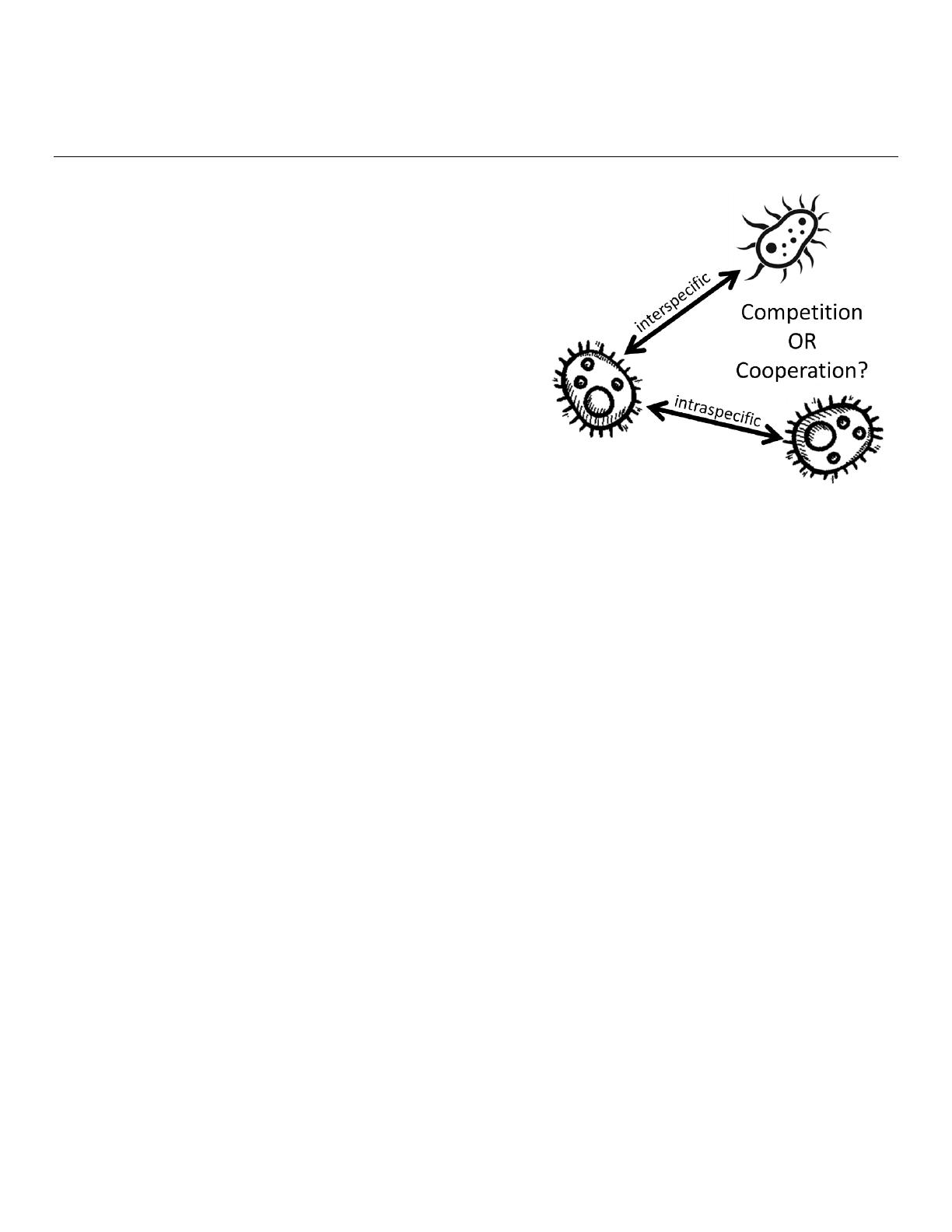
Bacterial interactions are crucial for understanding microbial ecology and competition. This lab report focuses on measuring the growth of Safe ESKAPE bacteria in conditioned media, exploring how interspecific and intraspecific interactions influence bacterial growth. Students will prepare conditioned media from soil bacteria and analyze its effects on the growth of selected Safe ESKAPE strains. The report includes protocols for measuring bacterial growth using Optical Density and evaluating the impact of metabolic byproducts on bacterial competition. Ideal for biology students studying microbial interactions and laboratory techniques.

Key Points

  • Explores the effects of conditioned media on Safe ESKAPE bacteria growth.
  • Includes protocols for measuring bacterial growth using Optical Density.
  • Analyzes interspecific and intraspecific bacterial interactions.
  • Focuses on the preparation of conditioned media from soil bacteria.
Katee
4 pages
Language:English
Type:Lab Report
Katee
4 pages
Language:English
Type:Lab Report
68
/ 4
BIOL 1500L
Bacterial Interactions (Part 2)
Measuring Safe ESKAPE Population Growth in Conditioned Media
Background: Bacteria exist in communities that often contain
several species. The fitness of a bacterium in these communities is
partially dependent on its ability to respond effectively to other
organisms. Organisms in a multispecies community must respond to
resource utilization, production of metabolic byproducts, and other
secreted molecules. Due to limited resources, many interactions
among bacterial species are competitive
1,2
. However, bacteria do
engage in cooperative interactions in some environments, such as
the intestine. The goal of this lab is to evaluate whether resource
utilization and/or secreted molecules from other bacterial species
impact the growth of Safe ESKAPEs.
Scientific Concept: The growth of living organisms is sensitive to
environmental factors, including the presence and actions of other
organisms. Interactions among organisms can be within the same species (intraspecific) or among organisms of differing
species (interspecific). Both intraspecific and interspecific interactions can impact growth. This lab is based on the
hypothesis that the presence of conditioned media (an environment previously used to grow bacteria) models the
impact of an organism on the growth of a Safe ESKAPE bacteria. The prediction is that conditioned media from
organisms that compete with Safe ESKAPE bacteria will inhibit growth while conditioned media from organisms that
cooperate with your chosen Safe ESKAPE will promote growth.
In this laboratory exercise students will
measure bacterial growth in a broth culture
evaluate whether bacterial-conditioned media impacts the growth of Safe ESKAPE bacteria
model the response of living organisms to other species living in the same environment
What is Conditioned Media?
Bacteria are often grown in a nutrient rich broth called Luria broth (LB). Bacteria grown in this broth consume the
nutrients and release metabolic byproducts. Conditioned media is Luria broth that has been used to grow bacteria, but
has subsequently had the bacteria killed or removed. For this lab the bacteria will be killed by autoclaving (exposing to
high temperature and pressure) and then removed with a filter. The bacteria grown in the Luria broth potentially
changes the broth in such a way that it affects the ability of subsequent bacteria to grow in the broth. In this experiment
you will be using conditioned media from one of your unknown soil bacteria that showed interesting results from the
zone of inhibition test.
References
1. Foster, K. R. & Bell, T. Competition, Not Cooperation, Dominates Interactions among Culturable Microbial Species.
Curr. Biol. 22, 18451850 (2012).
2. Hibbing, M. E., Fuqua, C., Parsek, M. R. & Peterson, S. B. Bacterial competition: surviving and thriving in the microbial
jungle. Nat. Rev. Microbiol. 8, 1525 (2010).
BIOL 1500L
Part 2A: Make Conditioned Media
Protocol:
Zone of interaction analysis
1) Look for zones around each unknown bacteria where Safe ESKAPE growth was either inhibited or promoted.
Please note that zones of inhibition
a) May be broad and clear
b) May be very narrow and easily overlooked
c) May be areas where there is reduced growth (but some growth is still present). This may appear as a lighter ring
around the unknown bacteria rather than a cleared space.
2) Be sure to record all bacteria that display evidence of interspecific interactions.
Conditioned media preparation from unknown soil bacteria
3) As a lab group, select one unknown bacterial colony (and the Safe ESKAPE with which it was grown) that you would like
to test for further bacterial interactions.
4) For the selected bacterial colony
a) Obtain a tube of LB broth.
b) Label it with the sample ID, your initials, date, and lab section. The label should be written in permanent ink on a
piece of lab tap that is placed on the glass tube. Do not write on the plastic tops!
c) Use a plastic bacterial loop to transfer a little bit of the selected bacterial colony to the LB broth tube.
d) Place the tube in a rack in the 30°C incubator.
Important Note: Because each person in your group was assigned a different Safe ESKAPE, the Safe ESKAPE that displays
a zone of inhibition may not be the Safe ESKAPE you were assigned and researched. It will be important that each of you
share the information and citations for your Safe ESKAPE with the rest of the group. As you prepare to write your
laboratory report, it will be useful to think of this project as a two-step process:
1) Doing a broad survey to see if any of the bacterial colonies isolated from your soil samples have an inhibitory effect
on the 3-4 Safe ESKAPES your group was assigned.
2) Focusing on the one or two soil bacteria / Safe ESKAPE combinations that produced the strongest zone(s) of
inhibition for further investigation of the effects of the soil bacteria on Safe ESKAPE population growth.
Pre-lab for next week
Read the protocol on the next page (Part 2B: Bacterial Interactions Protocol). Work with your group to decide on an
experimental design. Then, individually write out your Rationale and Experimental Design based on what your group
decided (i.e. write the rationale and experimental design in your own words). Each person should turn in their colab
notebook containing this rationale and experimental design before coming to lab next week.
BIOL 1500L
Part 2B: Bacterial Interactions Protocol
Protocol:
1) Sterilize your working area with 10% bleach.
2) First, we will need to prepare your chosen unknown conditioned media. To do this, you will filter your unknown
conditioned media sample using a syringe filter:
a) Obtain a 5 ml syringe and a 0.44 µm filter. Prepare the syringe filter set-up by removing the syringe plunger then
screwing the filter on the end of the syringe.
b) Once the filter is in place and secure, pipet your conditioned media into the top of the syringe. Once complete,
obtain a 15 ml conical tube and place the syringe over the tube.
c) Place the plunger back in your syringe and slowly press the plunger to filter your conditioned media into your
tube. Do NOT force the plunger! If it gets stuck ask for help!
3) Obtain nine 1.5 ml tubes and label them on the cap (tube number [1-9], your initials, Safe ESKAPE bacteria,
control/treatment group). You will have three replicates for each control/treatment group.
4) Add 25 µl of your chosen Safe ESKAPE to each 1.5 ml tube. (Remember that you are now using a single Safe
ESKAPE that you chose as a group last week. You should have a rationale for that choice.)
5) Add the appropriate control/treatment conditioned
media to each tube so the volume of the
control/treatment media is 75% of the final
volume. The final volume will be 200 µl.
a) Three 1.5 ml tubes should contain
unconditioned new media (Luria Broth control).
Far left tube in visual.
b) Three tubes should contain conditioned media
from your Safe ESKAPE (intraspecific
competition treatment). We prepared this for
you. Middle tube in visual.
c) Three tubes should contain conditioned media
from your unknown soil bacteria (interspecific
competition treatment). You prepared earlier.
Far right tube in visual.
NOTE: Be sure to pipette and use the clear media from the top of the conditioned media tubes. If you pipette the
bacterial debris at the bottom of the tubes, it can interfere with your Optical Density measurements.
6) Use new media (Luria Broth) to adjust the liquid in all 1.5 ml tubes to a final volume of 200 µl.
/ 4
End of Document
68

FAQs

What are Safe ESKAPE bacteria and why are they studied?
Safe ESKAPE bacteria are a group of pathogens known for their resistance to antibiotics. They are significant in medical microbiology due to their ability to cause serious infections in humans. Understanding their growth patterns and interactions with other bacteria can help in developing better treatment strategies and managing infections. This lab focuses on how these bacteria respond to their environment and other microbial species.
How is conditioned media prepared in this lab?
Conditioned media is prepared by growing bacteria in a nutrient-rich broth, allowing them to consume nutrients and release metabolic byproducts. After growth, the bacteria are killed through autoclaving, and the media is filtered to remove any bacterial debris. This process creates an environment that can influence the growth of subsequent bacterial cultures, particularly in studying competitive and cooperative interactions.
What methods are used to measure bacterial growth?
Bacterial growth is measured using Optical Density (OD) at 600 nm, which quantifies turbidity in the broth. Higher absorbance readings indicate greater bacterial growth. This method is efficient for assessing the impact of different media on bacterial populations over time. The experiment involves using a spectrophotometer to take absorbance readings at regular intervals.
What are the expected outcomes of the bacterial interactions experiment?
The experiment aims to demonstrate how conditioned media from different bacterial species can either inhibit or promote the growth of Safe ESKAPE bacteria. It is hypothesized that media from competitive bacteria will show inhibitory effects, while media from cooperative bacteria will enhance growth. These outcomes will provide insights into microbial interactions and their implications for bacterial ecology.


