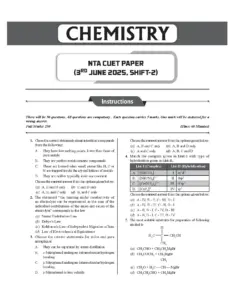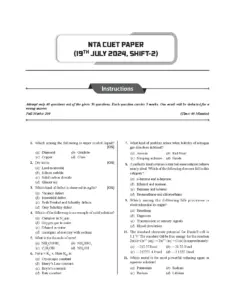
The CUET Chemistry June 2023 Paper includes a comprehensive set of questions designed for students preparing for the Central Universities Entrance Test. Topics covered range from electrochemistry to organic chemistry, providing a robust review for candidates. This paper serves as an essential resource for understanding the exam format and the types of questions that may appear. With a focus on problem-solving and conceptual understanding, it aids students in their revision efforts. Ideal for CUET aspirants aiming for a strong performance in their chemistry section.

Key Points

  • Includes a variety of questions on electrochemistry and organic chemistry topics.
  • Designed specifically for students preparing for the CUET exam.
  • Offers insights into the exam format and question types.
  • Aids in enhancing problem-solving and conceptual understanding in chemistry.
Sreeja Singh
9 pages
Language:English
Type:Past Paper
Sreeja Singh
9 pages
Language:English
Type:Past Paper
339
/ 9
1. The cell reaction occurring at anode in the electrolysis
of aqueous NaCl solution is:
(a)
( ) ( )
o
2 cell
1
H aq e H g , E 0.00 V
2
+−
+→ =
(b)
( ) ( )
o
2 cell
1
Cl aq Cl g e , E 1.36 V
2
−−
+=
(c)
( ) ( )
o
cell
Na aq e Na s , E 2.71 V
+−
+→ =
(d)
( ) ( ) ( )
o
2 2 cell
2H O I O g 4H aq 4e , E 1.23 V
+−
→+ + =
2. The standard reduction potential for Sn
4+
/Sn
2+
is +0.15 V
and for Cr
3+
/Cr is –0.74 V. These two half-cells, coupled
in their standard states, are connected to make a cell. The
galvanic cell can be correctly represented by:
(a) Sn
2+
(aq) |Sn
4+
(aq)||Cr(s) Cr
3+
(aq)
(b) Sn
4+
(aq) Sn
2+
(aq)||Cr
3+
(aq)|Cr (s)
(c) Cr(s)|Cr
3+
(aq)||Sn
4+
(aq)|Sn
2+
(aq)
(d) Cr(s)|Cr
3+
(aq)||Sn
2+
(aq)|Sn
4+
(aq)
3. An alkyl halide with molecular formula C
5
H
11
Br on
dehydrohalogenation give two isomeric alkenes X and
Y with formula C
5
H
10
. On reductive ozonolysis X and
Y gave four compounds CH
3
CHO, CH
3
C
||
O
–CH
3
,(CH
3
)
2
CHCHO, HCHO. The alkyl halide is:
(a) 3-Bromopentane
(b) 2-Bromo-3-methylbutane
(c) 2-Bromo-2-methylbutane
(d) 1-Bromo-2-2-dimethyl propane
4. The oxoacid of sulphur which has a lone pair of electron
on sulphur atom is:
[OS]
(a) H
2
SO
4
(b) H
2
SO
3
(c) H
2
S
2
O
8
(d) H
2
S
2
O
7
5.
Match List-I with List-II.
List - I List - II
A. Fuel Cell (i) Rechargeable
B. Mercury Cell (ii) Reaction at anode,
Zn → Zn
2+
+ 2e
C. Leclanche Cell (iii)
Cell reaction 2H
2
+ O
2
→ 2H
2
O
D. Ni-Cd Cell (iv) Gives steady potential
Choose the correct answer from the options given below:
(a)
A-(i), B-(iv), C-(iii), D-(ii)
(b) A-(ii), B-(i), C-(iv), D-(iii)
(c)
A-(iii), B-(iv), C-(ii), D-(i)
(d) A-(iv), B-(i), C-(ii), D-(iii)
6. The half-life of a first order reaction is 25 minutes. Its
rate constant is:
(a) 2.27 × 10
–2
min
–1
(b) 3.2 × 10
–3
min
–1
(c) 9.2 × 10
–2
min
–1
(d) 2.8 × 10
–2
min
–1
7. The vapour pressure curve of the mixture of ethanol and
acetone is higher than its constituents because:
(a) Weaking of interactions between molecules takes
place
(b) Strengthening of interactions between molecules
takes place
(c) New hydrogen bonds are formed
(d) Molecules are not able to escape from the
solution
NTA CUET PAPER
(22
ND
MAY 2023, ONLINE PAPER)
Attempt only 40 questions out of the given 50 questions. Each question carries 5 marks. One mark will be deducted for a
wrong answer.
Full Marks: 200
(T
ime: 45 Minutes)
Instructions
230
NTA CUET (UG) - Science
P
W
8. Match List - I with List - II.
List - I
K
H
values/K bar
List - II
Gas
A. 145 (i) CO
2
B. 89 (ii) He
C. 76.5 (iii) N
2
(at 293 K)
D. 1.67 (iv) N
2
(at 303 K)
Choose the correct answer from the options given below:
(a) A-(ii), B-(iv), C-(iii), D-(i)
(b) A-(i), B-(ii), C-(iii), D-(iv)
(c) A-(ii), B-(iii), C-(iv), D-(i)
(d) A-(i), B-(iii), C-(ii), D-(iv)
9. In Freundlich adsorption isotherm, the value of
1
n
is:
[OS]
(a) 1 in case of chemisorption
(b) 1 in case of physisorption
(c) Between 0 and 1 in all cases
(d) Between 2 and 4 in all cases
10. The quantity of charge required to obtain 2 mol of Mn
2+
from MnO
4
is:
(a) 2 F (b) 10 F
(c) 5 F (d) 1 F
11. In the cyanide extraction process of silver the oxidising
and reducing agents used are: [OS]
(a) O
2
and CO respectively
(b) O
2
and Zn dust respectively
(c) H
2
O and Zn dust respectively
(d) H
2
O and NaCN respectively
12. A drop of solution (Volume 0.05 mL) contains 3.0 × 10
–6
mole of H
+
ions. If the rate constant of disappearance of
H
+
is 1.0 × 10
–7
mol litre
–1
sec
–1
, how long will take H
+
ions to disappear?
(a) 6 × 10
–8
s (b) 6 × 10
–9
s
(c)
6 × 10
–7
s (d) 6 × 10
–10
s
13. Identify 'X' along with oxidation state of halogen in the
given reaction: [OS]
3Cl
2
+ 6NaOH 5NaCl + X + 3H
2
O
(hot and conc.)
(a) NaClO
2
, +3 (b) NaClO
3
, +5
(c) NaClO
2
, +7 (d) NaClO
3
, +1
14. Which of the following is not an expression of Dalton's
law of partial pressures?
(a) P = P
1
+ P
2
(b) P = P
1
° x
1
(c) P = P
1
° + (P
2
° – P
1
°) x
2
(d) P
1
= P – P
2
15.
Glucose does not react with:
(a) Conc. HNO
3
(b) Acetic Anhydride
(c) Hydroxylamine
(
d)
Sodium bisulphite
16.
Which of the followi
ng defects are shown by KCl
Crystal?
[OS]
A.
Schottky defect
B. Frenkel defect
C. Metal excess defect
D.
Metal deficiency defect
Choose the correct answer from the options given below:
(a) A and B only (b) A and C only
(c) B and C only (d) B and D only
17. D (+) Glucose reacts with hydroxylamine and forms
oxime. The structure of oxime would be:
(a)
CH = N–OH
|
H –C–OH
|
HO –C–H
|
HO –C–H
|
H –C–OH
|
CH OH
2
(b)
CH = N–OH
|
HO –C–H
|
HO –C–H
|
H –C–OH
|
H –C–OH
|
CH OH
2
(c)
CH = N–OH
|
HO –C–H
|
H –C–OH
|
HO –C–H
|
H –C–OH
|
CH OH
2
(d)
CH = N–OH
|
H –C–OH
|
HO –C–H
|
H –C–OH
|
H –C–OH
|
CH OH
2
18. The correct IUPAC name of CH
3
|
– CH
2
– Br is:
(a) 1-Bromo-2-methylbutane
(b) 1-Bromo-2-ethylpropane
(c) 1-Bromo-2-ethyl-2-methyl ethane
(d) 2-Methyl-1-bromobutane
19.
Which of the following reaction will not produce
ketones?
(a) Hydration of alkynes
(b) Ozonolysis of substituted alkenes
(c) Treating nitrile with a Grignard reagent
(d) Stephen's reaction
20.
Arrange the following amines in the order of decreasing
basic character in gaseous phase:
A. NH
3
B. (CH)
3
N
C. (CH
3
)
2
NH D. CH
3
NH
2
231
NTA CUET Paper 2023
Choose the correct answer from the options given below:
(a) (CH
3
)
2
NH, CH
3
NH
2
, (CH
3
)
3
N, NH
3
(b) (CH
3
)
3
N, (CH
3
)
2
NH, CH
3
NH
2
, NH
3
(c) (CH
3
)
2
NH, (CH
3
)
3
N, CH
3
NH
3
, NH
3
(d) (CH
3
)
3
N, CH
3
NH
2
, (CH
3
)
2
NH, NH
3
21.
Which of the following electrolytes will have maximum
coagulating value for AgI/Ag
+
sol? [OS]
(a) Na
2
S (b) Na
3
PO
4
(c) Na
2
SO
4
(d) NaCl
22.
Ammonia is manufactured by:
[OS]
N
2
(g) + 3H
2
(g) NH
3
(g)DH
f
° = –46.1 kJ/mol
–1
The various steps involved are:
A.
Condensation of mixture of gases
B. Passing the gaseous mixture over catalyst
C.
Compression of the mixture of gases
D.
Recirculation of the gaseous mixture
Choose the correct answer from the options given below:
(a)
C, B,
A and D
(
b)
B, C, D and
A
(c) A, D, C and B (d) B, A, D and C
23.
Acetaldehyde and benzaldehyde can be best distinguished
by:
(a) 2, 4 DNP test
(b) Tollens' test
(c)
Sodium bicarbonate test
(d)
Fehling's test
24. Amongst the following, identify the condensation
polymer/s:
[OS]
A.
Bakelite
B. Teflon
C.
Melamine formaldehyde resin
D.
Nylon-2 nylon-6
E.
Buna-S
Choose the correct answer from the options given below:
(a)
B and E only
(
b)
A, C and D only
(c) C and D only (d) A, B and E only
25.
Basic hydrolysis of esters produces:
(a) Carboxylates
(
b)
Carboxylic acids
(c) Aldehydes (d) Ketones
26. Chemical formula of laughing gas is: [OS]
(a) NO
(
b) N
2
O
(c) N
2
O
3
(d) N
2
O
4
27. Match List - I with List - II. [OS]
List - I List - II
A. Electrolytic reduction (i) Iron
B. Bessemerization (ii) Zinc
C. Smelting (iii) Aluminium
D. Reduction from oxide (iv) Copper
Choose the correct answer from the options given below:
(a)
A-(iii), B-(i), C-(ii), D-(iv)
(b) A-(ii), B-(iii), C-(iv), D-(i)
(c)
A-(iii), B-(iv), C-(i), D-(ii)
(d) A-(iv), B-(ii), C-(iii), D-(i)
28.
A
compound forms hexagonal closed packed structure.
What is the number of tetrahedral voids in 0.8 mol of it?
[OS]
(a)
1.5055 × 10
23
(b) 2.4088 × 10
23
(c) 9.635×10
23
(d) 3.011 × 10
23
29.
In case of phosphorus, PCl
3
and PCl
5
are possible while
nitrogen only forms NCl
3
and not NCl
5
. This due to:
[OS]
(a)
Nitrogen
is a gas while phosphorus is a solid at
room temperature.
(b)
Nitrogen
does not have vacant d-orbitals in its
atom while phosphorus has vacant d-orbitals.
(c)
The electronegativity
of nitrogen is higher than
that of phosphorus.
(d)
The atom
of nitrogen is smaller in size than
phosphorus.
30.
In amines, t
he nitrogen atom is A and B hybridised,
making geometry of amines as C. Then A, B and C
respectively are:
(a)
trivalent, sp
2
, trigonal
(b) tetravalent, sp
3
, tetrahedral
(c)
trivalent, sp
3
, pyramidal
(d) tetravalent, sp
2
, pyramidal
31. Aspartame is most successful artificial sweetener but is
only limited to cold food and cold drinks because: [OS]
(a)
The control of sweetness of food is dif
ficult
(b) Too many calories are released at high temperature
(c) Releases acetic acid when not in cold medium
(d) Unstable at cooking temperature
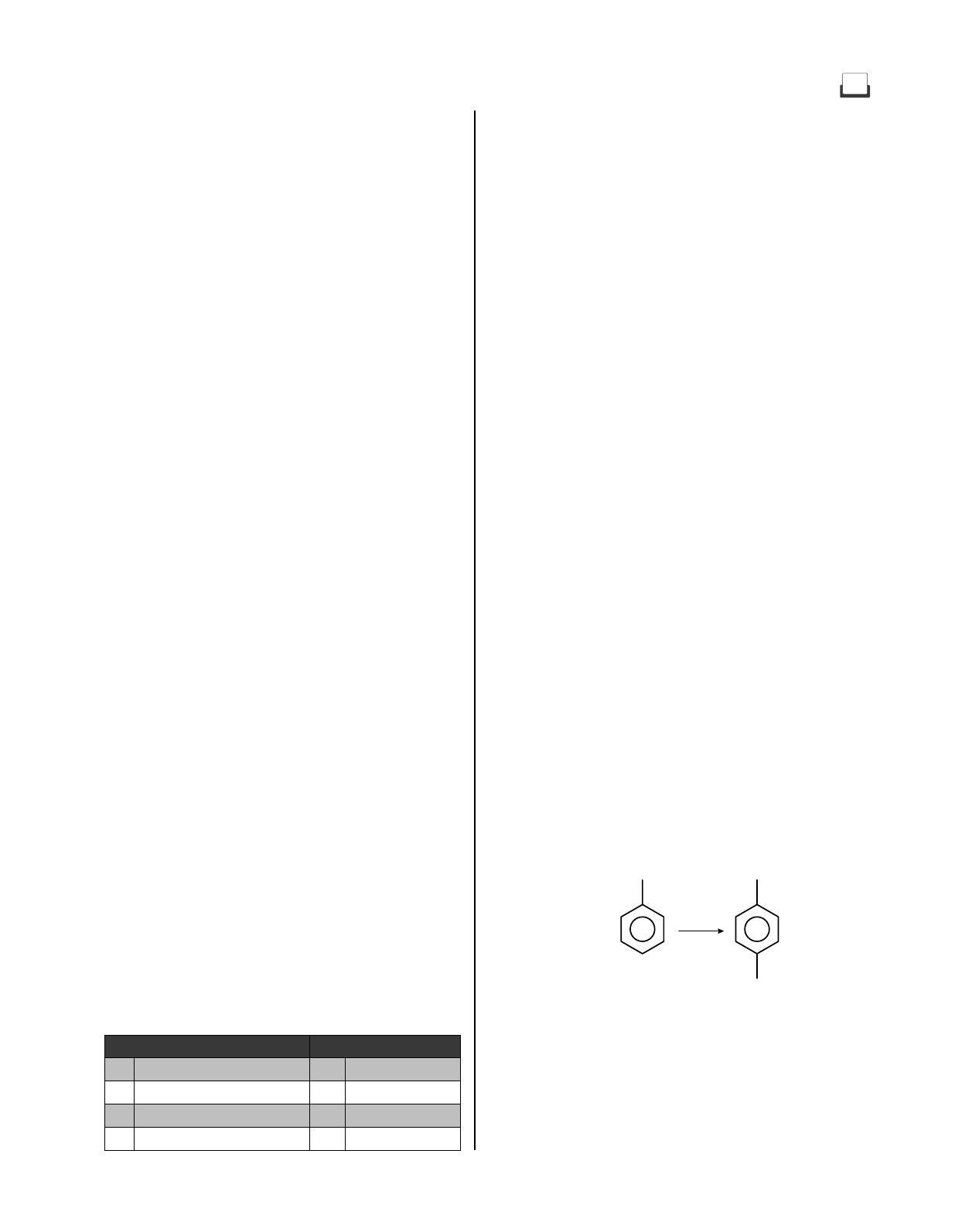
32.
The appropriate
reagent for the following conversion is:
Cl
(a) SO
2
Cl
2
(b) N-Chlorosuccinamide
(c) Cl
2
/FeCl
3
(d) SOCl
2
33. The hormone which control the processes of burning
of fats, proteins and carbohydrates, with liberation of
energy in the body is:
(a) thyroxine (b) insulin
(c) adrenaline (d) estradiol

/ 9
End of Document
339

FAQs

What topics are covered in the CUET Chemistry June 2023 Paper?
The CUET Chemistry June 2023 Paper covers a wide range of topics including electrochemistry, organic chemistry, and physical chemistry. Each section is designed to test students' understanding of fundamental concepts and their application in problem-solving. Additionally, the paper includes questions that reflect the latest syllabus and exam patterns, ensuring that students are well-prepared for the actual test.
How can students use this paper for exam preparation?
Students can utilize the CUET Chemistry June 2023 Paper as a practice tool to familiarize themselves with the exam format and question types. By attempting the questions, students can identify their strengths and weaknesses in various chemistry topics. This practice will help them improve their time management skills and boost their confidence ahead of the exam.
What is the significance of the CUET Chemistry exam?
The CUET Chemistry exam is crucial for students seeking admission to various undergraduate programs in central universities across India. It assesses students' knowledge and understanding of chemistry concepts, which are essential for their future studies in science and engineering fields. Performing well in this exam can significantly enhance a student's academic prospects.
Are there any specific strategies for tackling the questions in this paper?
To effectively tackle the questions in the CUET Chemistry June 2023 Paper, students should first read each question carefully and identify the key concepts involved. Practicing previous years' papers can also help in understanding the types of questions that are frequently asked. Additionally, time management is essential; students should allocate their time wisely to ensure they can attempt all questions within the given timeframe.
What types of questions can students expect in the CUET Chemistry exam?
Students can expect a mix of multiple-choice questions, numerical problems, and conceptual questions in the CUET Chemistry exam. The questions are designed to test not only rote memorization but also the application of concepts in real-world scenarios. This variety helps gauge a student's comprehensive understanding of chemistry.