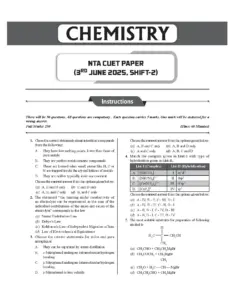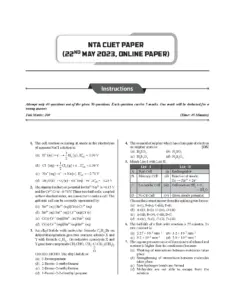
The CUET Chemistry June 2024 Paper provides a comprehensive assessment of chemistry concepts relevant for university entrance examinations in India. It includes multiple-choice questions covering various topics such as chemical bonding, thermodynamics, and organic chemistry. This paper is essential for students preparing for the Common University Entrance Test (CUET) and aims to enhance their understanding and application of chemistry principles. Designed for aspiring university students, it serves as a valuable resource for exam preparation and practice.

Key Points

  • Includes multiple-choice questions on key chemistry topics for CUET.
  • Covers essential concepts like chemical bonding and thermodynamics.
  • Designed for students preparing for university entrance exams in India.
  • Helps enhance understanding and application of chemistry principles.
  • Provides a comprehensive assessment format for effective exam practice.
Sreeja Singh
6 pages
Language:English
Type:Past Paper
Sreeja Singh
6 pages
Language:English
Type:Past Paper
336
/ 6
Attempt only 40 questions out of the given 50 questions. Each question carries 5 marks. One mark will be deducted for a
wrong answer.
Full Marks: 200
(T
ime: 60 Minutes)
Instructions
1. Which among the following is super cooled liquid?
[OS]
(a) Diamond (b) Graphite
(c) Copper
(
d) Glass
2.
Dry ice is: [OS]
(a)
Lead monoxide
(b)
Silicon carbide
(c) Solid carbon dioxide
(d) Glacier ice
3. Which kind of defect is observed in AgBr? [OS]
(a) Vacancy defect
(b) Interstitial defect
(c)
Both Frenkel and Schottky defects
(d) Only Schottky defect
4. Which of the following is an example of solid solution?
(a) Camphor in N
2
gas
(b) Oxygen gas in water
(c) Ethanol in water
(d) Amalgam of mercury with sodium
5. What is the formula of urea?
(a) NH
2
COΝΗ
2
(b) NH
4
HSO
4
(c) C
2
H
5
OH (d) NH
4
OH
6. For p = K
H
x. Here K
H
is:
(a) Cryoscopic constant
(b) Henry’s Law constant
(c) Boyle’s constant
(d) Rate constant
7.
What
kind of problem arises when bubbles of nitrogen
gas dissolves in blood?
(a) Anoxia
(
b)
Red fever
(c)
Sleeping sickness
(
d) Bends
8. A perfectly ideal solution is rare but some solution behave
nearly ideal. Which of the following does not fall in this
category?
(a) n-hexane and n-heptane
(b)
Ethanol and acetone
(c) Benzene and toluene
(d) Bromoethane and chloroethane
9.
Which among the following life processes is
electrochemical in origin?
(a) Breathing
(b) Digestion
(c) Transmission of sensory signals
(d) Blood circulation
10. The standard electrode potential for Daniell cell is
1.1 V. The standard Gibbs free energy for the reaction
Zn(s)+Cu
2 +
(aq) Zn
2 +
(aq) + Cu(s) is approximately:
(a)
– 212.27J/mol
(
b)
– 21.22 J/mol
(c) – 212271.4 J/mol (d) – 2.1227 J/mol
11. Which metal is the most powerful reducing agent in
aqueous solution?
(a) Potassium (b) Sodium
(c) Barium (d) Lithium
NTA CUET PAPER
(19
TH
JULY 2024, SHIFT-2)
209
NTA CUET Paper 2024
12. What is the overall order of reaction which has the
following rate expression? Rate= k[A]
1/2
[B]
3/2
(a) One (b) Two
(c) Zero
(
d) Three
13.
Inversion of cane sugar is a:
(a)
Zero order reaction
(b)
Pseudo first order reaction
(c) Second order reaction
(d)
Third order reaction
14.
Which term from the following is not related to
adsorption? [OS]
(a) Adsorbent
(
b) Effluent
(c) Adsorbate (d) Desorption
15.
Which statement is not true for physisorption?
[OS]
(a)
It is not specific in nature.
(b)
It is reversible in nature.
(c) Enthalpy of adsorption is low.
(d) Chemical bond is responsible.
16. Which among the following chemicals is used for control
of humidity? [OS]
(a) Charcoal
(
b)
Silica gel
(c)
Ammonia gas
(
d)
Sodium chloride
17. Which among the following chemicals is used as catalytic
promoter in Habers process? [OS]
(a) Ni
(
b) MnO
2
(c) Fe (d) Mo
18.
Which
of the following metal’s ore can be concentrated
by magnetic separation method?
[OS]
(a) Aluminium
(
b) Cadmium
(c) Iron (d) Zinc
19. Which of the following is a polyhydric alcohol?
(a) Ethanol
(
b) Glycerol
(c) Propanol
(
d) Phenol
20.
What
is the other term used for thermal reductions?
[OS]
(a) Hydrometallurgy
(
b) Leaching
(c)
Froth floatation
(
d) Pyrometallurgy
21.
Which member of 15 group elements does not show
allotropy? [OS]
(a) Nitrogen (b) Phosphorus
(c) Arsenic
(
d) Antimony
22.
What
is the colour of product when ammonia reacts with
a solution of Cu
2+
?
(a) Orange (b) Green
(c) Deep blue (d) Yellow
23.
What is the co-ordination number of metal in
[Fe(C
2
O
4
)
3
]
3–
?
(a) Two (b) Three
(c) Six (d) Four
24. Which among the following compounds is most soluble
in water?
(a) Ethanol (b) Ethane
(c) Phenol (d) Ethylene glycol
25. Which important compound is prepared by using
cumene?
(a) Ethanol (b) Phenol
(c) Propanone (d) Propene
26. Which of the following reaction is shown by aldehydes
that do not have alpha H-atom?
(a) Aldol condensation
(b) Cross aldol condensation
(c)
Cannizzaro reaction
(d)
Kolbe’
s reaction
27.
What is the measurement
of C O C bond angle in
methoxymethane?
(a) 108°
(
b) 111.7°
(c) 90°
(
d) 60°
28.
Which among the follow
ing compounds is not an
artificial sweetener?
[OS]
(a) Aspartame
(
b) Alitame
(c) Sucralose
(
d)
Sodium benzoate
29.
What is
Aspirin chemically?
(a)
Salicylic acid
(b)
Ethyl Salicylic acid
(c)
Methyl Salicylic acid
(d)
Acetyl Salicylic acid
30.
Match
List-I with List-II.
List-I
(Ions)
List-II
(No. Of Unpaired Electrons)
A. Zn
2+
I. 0
B. Cu
2+
II. 4
C. Ni
2+
III. 1
D. Fe
2+
I V. 2
Choose the correct answer from the options given below:
(a) A-I, B-II, C-III, D-IV
(b) A-I, В-III, С-II, D-IV
(c) A-I, B-III, C-IV, D-II
(d) A-II, B-IV, C-I, D-II
31. Increasing order of ionic radii of the followings:
A. Eu
3+
B. Lu
3+
C. Y
3+
D. La
3+
210
NTA CUET (UG) - Science
P
W
Choose the correct answer from the options given below:
(a)
A
< B < C < D
(
b)
A
< C < B < D
(c)
B < C <
A < D
(
d)
C < B < D <
A
32.
Match
List-I with List-II.
List-I
Types Of
Hybridisation
List-II
Distribution Of Hybrid
Orbitals In Space
A. sp
3
I. Trigonal bipyramidal
B. dsp
2
II. Octahedral
C. sp
3
d III. Tetrahedral
D. sp
3
d
2
I V. Square Planar
Choose the correct answer from the options given below:
(a)
A-1, B-II, C-III, D-IV
(b)
A-I, B-III, C-II, D-IV
(c)
A-I, B-II, C-IV
, D-III
(d) A-III, B-IV, C-I, D-II
33.
Increasing order of crystal
field splitting power of
following ligands will be:
A.
CN
B. Cl
C. F
D. H
2
O
Choose the
correct answer from the options given below:
(a) A < B < C < D (b) A < C < B < D
(c)
A
< D < C < B
(
d)
B < C < D <
A
34.
Match
List-I with List-II.
List-I
Vitamins
List-II
Deficiency Diseases
A. Vitamin B
6
I. Cheilosis
B. Vitamin B
2
II. Osteomalacia
C. Vitamin D III. Anaemia
D. Vitamin B
12
I V. Convulsions
Choose the correct answer from the options given below:
(a) A-I, B-II, C-III, D-IV
(b) A-I, B-III, C-II, D-IV
(c)
A-I, B-II, C-IV
, D-III
(d)
A-IV
, B-I, C-II, D-III
35.
R
eactivity order of following towards nucleophilic
substitution reactions will be:
A. 4-Nitro-1-chlorobenzene
B. 2,4-Dinitro-1-chlorobenzene
C.
Chlorobenzene
D. 2,4,6-Trinitro-1-chlorobenzene
Choose the correct answer from the options given below:
(a)
A
< B < C < D
(
b)
A
< C < B < D
(c)
B <
A < D < C
(
d)
C <
A < B < D
36. Which of the following gives positive Tollens test?
A. Phenylethanal B. Acetophenone
C. Formic acid D. Benzene carbaldehyde
Choose the correct answer from the options given below:
(a)
A, B and D only
(
b)
A, B and C only
(c)
A, B, C and D
(
d)
A, C and D only
37.
Match
List-I with List-II.
List-I
Compound
List-II
Product in Basic Medium
(in NaOH+Heat)
A. Ethanal I. Benzoic acid +
Phenylmethanol
B. Methanal II. 3-Hydroxybutanal +
But-2-enal
C. Benzenecar-
baldehyde
III. 4-Hydroxy-4-
methylpentan-2-one +4
Methylpent-3- en-2-one
D. Acetone I V. Formic acid + Methanol
Choose the correct answer from the options given below:
(a)
A-I, B-II, C-III, D-IV
(b)
A-II, B-IV
, C-I, D-III
(c) A-I, B-II, C-IV, D-III
(d)
A-III, B-IV
, C-I, D-II
38.
Which
of the following on reaction with NaOI will give
yellow precipitates?
A.
Phenylethanone
B.
Sec-Butyl alcohol
C.
Phenylethanal
D.
Methyl n-propylketone
Choose the correct answer from the options given below :
(a)
A, B and D only
(
b)
A, B and C only
(c) A, B, C and D (d) B, C and D only
39. The correct order of increasing pK
a
values of the
compounds:
A. CH
3
COOH B. CH
3
OCH
2
COOH
C.
C1
3
COOH D. (CH
3
)
3
CCOOH
Choose the correct answer from the options given below:
(a)
A
< B < C < D
(
b)
A
< C < B < D
(c) B < A < C < D (d) C < B < A < D
40.
Reactivity
order of the following alkyl halides towards
dehydrohalogenation is:
A.
I
B.
Br
C.
Cl
D.
F
Choose the correct answer from the options given below:
(a) A > B > C > D (b) A > C > B > D
(c) D > B > C > A (d) D > C > B > A

/ 6
End of Document
336

FAQs

What topics are covered in the CUET Chemistry June 2024 Paper?
The CUET Chemistry June 2024 Paper covers a wide range of topics essential for the exam, including chemical bonding, thermodynamics, kinetics, and organic chemistry. Each section is designed to test students' understanding of fundamental concepts and their ability to apply these concepts to solve problems. Additionally, it may include questions on inorganic chemistry and analytical techniques, ensuring a well-rounded assessment of the subject.
How is the CUET Chemistry Paper structured?
The CUET Chemistry Paper is structured with multiple-choice questions that assess students' knowledge and problem-solving skills in chemistry. Each question typically presents a scenario or concept, followed by several answer options. Students must select the correct answer based on their understanding of the material. This format not only tests recall but also the application of chemistry principles in various contexts.
Who is the target audience for the CUET Chemistry June 2024 Paper?
The target audience for the CUET Chemistry June 2024 Paper includes students preparing for the Common University Entrance Test (CUET) in India. This paper is particularly beneficial for those aiming to pursue undergraduate courses in science and engineering fields. It serves as a crucial resource for high school students looking to strengthen their chemistry knowledge and improve their exam performance.
What is the significance of practicing with the CUET Chemistry Paper?
Practicing with the CUET Chemistry Paper is significant for students as it helps familiarize them with the exam format and question types they will encounter. Regular practice can enhance their time management skills and boost confidence on test day. Additionally, it allows students to identify areas where they may need further study or clarification, ultimately leading to improved performance in the actual examination.
Are there any specific strategies for tackling the CUET Chemistry questions?
To effectively tackle the CUET Chemistry questions, students should focus on understanding core concepts rather than rote memorization. It's beneficial to practice past papers and sample questions to identify common themes and question formats. Time management during the exam is crucial; students should allocate their time wisely to ensure they can attempt all questions. Additionally, reviewing mistakes from practice tests can provide valuable insights into areas needing improvement.