


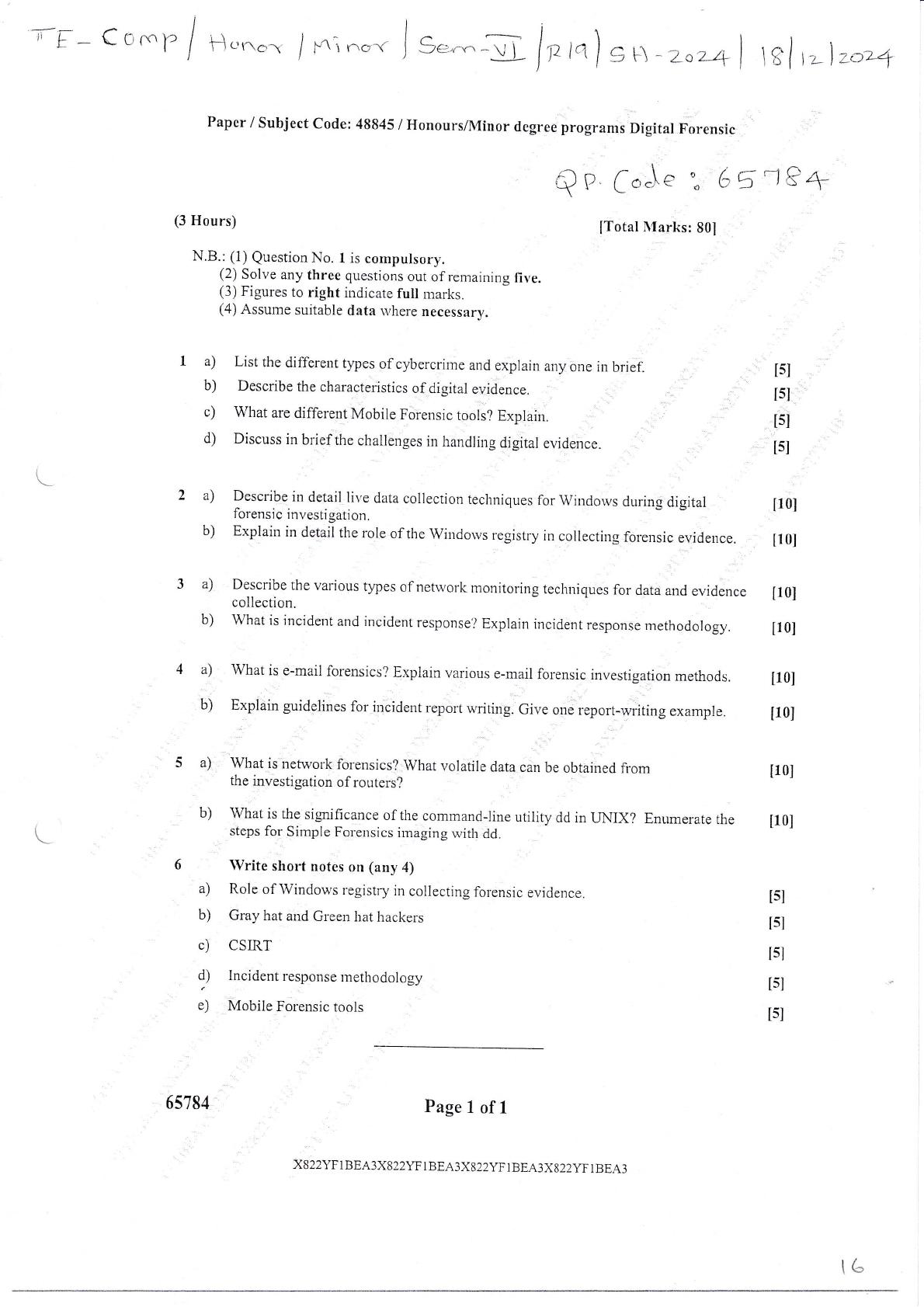
Mumbai University's December 2024 question paper for the Digital Forensics honours course covers various aspects of cybercrime, digital evidence, and forensic tools. It includes essential topics such as live data collection techniques, mobile forensic tools, and incident response methodologies. This exam paper is designed for students pursuing a degree in Digital Forensics, providing a comprehensive assessment of their knowledge in the field. It serves as a valuable resource for exam preparation and understanding key concepts in digital forensics.

Key Points

  • Covers essential topics in digital forensics including cybercrime and digital evidence.
  • Includes questions on mobile forensic tools and their applications.
  • Discusses incident response methodologies relevant to digital investigations.
  • Explores live data collection techniques specific to Windows systems.
devika mestri
1 page
Language:English
Type:Past Paper
devika mestri
1 page
Language:English
Type:Past Paper
248
/ 1
n-F-
Con.P
/
tl'n.r.
/n:tro{
}
C.^ :--
--le-,{^\'-r
^JI
Paper
/
Subject
code:
48845
/ Honours/l\{inor
degree
progranls
Digital
Forensic
Plq
g
i-\
^
zozty
1e
\z- 1r.4
lTotal
N{arks:
80]
(3
Hours)
tsl
tsl
N.B.: (1)
Question
No.
1 is cornpulsor5..
(2)
Solve
any
three
qilestiorrs
out
of
rerrainrng
lit,e.
(3)
Figures
to
right
indicare
full
marhs.
(4)
Assurae
suitable
data
n,here
necessrtry.
1 a)
lr)
c)
d)
List
the
dilferenr
t1'pes
ofcybercriure
a,d
explai,
auy
ore i.
brief.
Describe
rhe
characreristics
of dieiral
er.idence.
\\'hat
are
clillelcrrr
lvlobilc
Forensic
rools?
Explain.
Discuss
in
brief
the
challenges
in
Jrandling
digital
evidence.
Describe
in
detail
live
dara
collection
techniques
for
\\rindou,s
dur-ing
digital
I10l
lorensic
irrvesti gation.
Explain
in
detail
the role
of
the
Windon,s
registry
in
collecting
forensic
evidence.
t10l
') .-\
b)
4
3 a)
Describe
the
various
types
ol.netr.r,ork
monitorirr
g
techniques
lor
data
and
evidence
collection
b)
What
is incident
and inciclent
response'/
Explain
inciclent
r-espon.se
nrethodology
a)
What
is e-mail
forensics?
Erplain
various
e-mail
lorensic
investigation
prethods.
b)
Explain guidelines
lor
irtcident
repolt
u,r'iting.
Give
orre-
report-\\,r.iting
example.
a)
what
is
nehvork
forensics?
what
volatile
data
can
be
obtai,ed
fi.orl
the
investigation
of
routers?
b) \\rhat
is the
significance
olthe
comrland-line
utility
dd in
LNIX?
Enumerate
tire
steps
for
Simple
Forensics
imaging
u,ith
dcl.
6
Write
short notes
on
(any
4)
a)
Role
of Windov,,s
registry
in
collecting
for.ensic
evidence.
b)
Gray
hat
and
Gleen
lrat
hackers
c)
CSIRT
d)
h.rcidentrespotlsen.rethodology
e)
Mobile
Forensic
tools
t1
0l
[1
0l
tl0l
110I
t10I
I10I
tsl
tsl
tst
tsl
Isl
Page
1 of
1
X822\'F
1BEA3X822YF
1BEA3X822\'F
1BEA3X822YF
I BE,,\]
t6
Qr
foJe
""
6q18+
f
lsl
f
65184
/ 1
End of Document
248

FAQs

What types of cybercrime are discussed in the question paper?
The question paper outlines various types of cybercrime, including identity theft, hacking, and online fraud. Each type is characterized by its methods and impacts on individuals and organizations. Understanding these types is crucial for students in Digital Forensics as they prepare to combat such crimes in real-world scenarios.
What are the characteristics of digital evidence mentioned?
Digital evidence is defined by its intangible nature, meaning it exists in digital form and can be easily altered or destroyed. It is often volatile, requiring immediate collection and preservation to maintain its integrity. The question paper emphasizes the importance of proper handling and documentation to ensure that digital evidence remains admissible in court.
What challenges are faced in handling digital evidence?
Handling digital evidence presents several challenges, including the rapid evolution of technology and the complexity of data storage. Investigators must be adept at using various forensic tools and techniques to extract and analyze data effectively. Additionally, ensuring the chain of custody and maintaining the integrity of evidence are critical to successful investigations.
How does the Windows registry play a role in digital forensics?
The Windows registry is a critical component in digital forensics as it contains configuration settings and information about installed software and user activity. Investigators can analyze registry keys to uncover evidence related to user actions, system changes, and potential malicious activity. The question paper highlights techniques for extracting and interpreting data from the registry.